


Wheat bran and glycemia in type 2 diabetes: results of a randomized study
In 2024, Brazilian researcher Moreira and colleagues, in the journal Nutrition, Metabolism and Cardiovascular Diseases, evaluated whether the intake of raw wheat bran before a balanced breakfast could attenuate the post-meal increase in glycemia in men with type 2 diabetes. The publication examines a non-viscous insoluble fiber and the possible role of the food's physical structure.
- Published 11/11/2026
- Updated 13/11/2026
- Article history
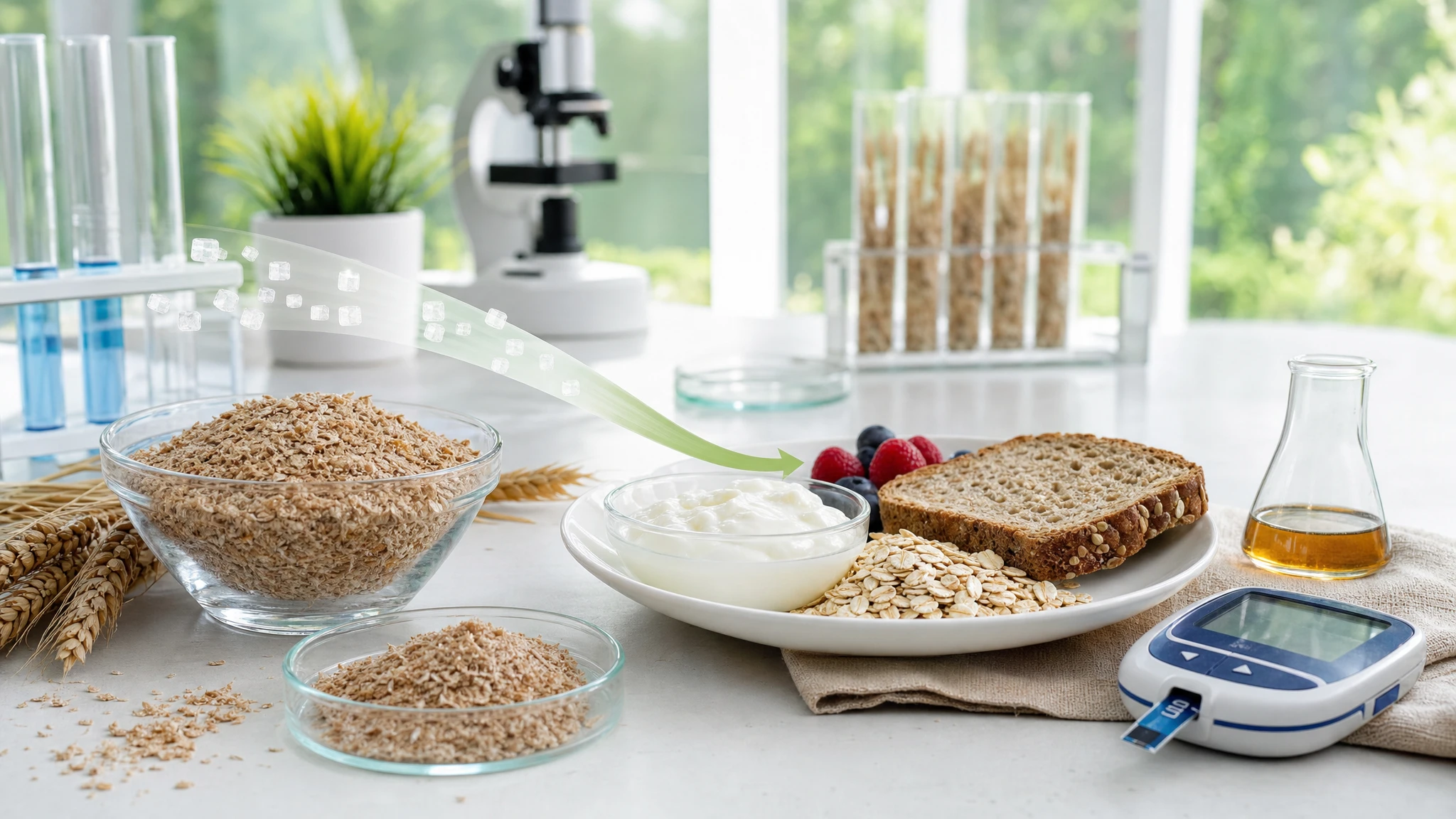
ABSTRACT : WHAT THE SCIENCE SAYS
A randomized study evaluated whether raw wheat bran, a source of predominantly insoluble fiber, can modify the rise in glycemia after breakfast in men with type 2 diabetes. The results suggest an acute effect on the glycemic profile, but do not demonstrate lasting clinical benefits.
The authors' summary describes a randomized clinical trial with a crossover design, meaning a comparison in which the same participants receive both conditions at different times. Nineteen men with type 2 diabetes consumed a balanced breakfast either without bran or preceded by 15 grams of raw wheat bran, equivalent to 5.8 grams of insoluble fiber. Glycemia was measured before the meal and up to 120 minutes afterward. Compared to the control condition, the bran reduced the maximum rise in glycemia by 15.80% and the incremental area under the curve by 23.14%, a measure that summarizes how much glycemia increases over time compared to the initial value. The time required to reach the peak did not change. Participants also judged the meal with bran to be less creamy and less palatable, with a greater perception of acidity and bitterness. The authors hypothesize that components of raw bran may reduce the activity of carbohydrate-digesting enzymes, but the study did not directly measure this mechanism. The data therefore concern an immediate response to a specific food, not long-term diabetes control.
What this research analyzed
The practical question was whether a fiber that does not form a gel can still reduce the post-meal spike in glycemia. Moreira and colleagues compared a balanced breakfast with and without the prior intake of raw wheat bran in the same 19 men. The crossover design reduces some individual differences, as each participant also acts as their own control.
The bran provided 5.8 g of insoluble fiber in 15 g of food. The researchers measured fasting glycemia and levels at 15, 30, 45, 60, 90, and 120 minutes. They also evaluated the palatability and sensory characteristics of the meal. They did not measure gastric emptying, intestinal absorption, insulin, or enzymatic activity.
Research data
Postprandial hyperglycemia in patients with type 2 diabetes is reduced by raw insoluble fiber: A randomized trial
- Randomized crossover clinical trial in 19 men with type 2 diabetes, with glycemia measured up to 120 minutes after breakfast.
- The intervention consisted of 15 g of raw wheat bran, corresponding to 5.8 g of insoluble fiber, consumed before the meal.
- The maximum increase in glycemia was reduced by 15.80% and the incremental area under the curve by 23.14%; the time to peak did not change.
What results emerged from the study
In simple terms, with raw bran, blood glucose increased less during the two hours observed. The maximum increase, which was 87 mg/dL in the control condition, was 15.80% lower. The incremental area under the curve, which indicates the overall exposure to a rise in glycemia, was reduced by 23.14%.
The time required to reach the maximum value did not differ. This suggests that, in this experiment, the bran did not clearly delay the peak, but rather attenuated its intensity. The meal with bran was perceived as less creamy and tasty, and more acidic and bitter: an important finding because acceptability influences daily applicability.
Why this study is relevant
The publication is relevant because it challenges a common simplification: that only soluble and viscous fibers are useful for the glycemic response. Here, a predominantly insoluble fiber, included in its raw food matrix, was associated with lower post-prandial hyperglycemia, i.e., the rise in blood sugar after a meal.
The authors propose a hypothesis: arabinoxylans, components of the wheat cell wall, may hinder the action of alpha-amylase and alpha-glucosidase, enzymes that release glucose from starches. This is a possible biological mechanism, not an experimental demonstration in this study. The result therefore invites us to also consider food processing, structure, and context.
Study limitations and what it does NOT demonstrate
The study is small, includes only men with type 2 diabetes, and observes a single breakfast over two hours. It does not allow for the results to be automatically extended to women, people without diabetes, other types of diabetes, or meals prepared in different ways. It also does not indicate whether the effect is maintained with regular use.
It does not demonstrate a reduction in glycated hemoglobin, known as HbA1c, which summarizes average glucose exposure over the previous months. It does not demonstrate fewer complications, a reduced need for medication, or cardiovascular protection. Furthermore, because the bran and control groups also differed in texture and sensory characteristics, it is not possible to attribute the effect to a single chemical component.
Independent supporting evidence
A consistent chain of results begins with wheat arabinoxylans. In a small crossover study of 15 people with type 2 diabetes, Lu and colleagues compared baked goods enriched with approximately 15 g per day of arabinoxylan-rich fiber with control products for five weeks. Fasting and two-hour glycemia, two-hour insulin, and fructosamine—an indicator of glycemia from the previous weeks—all decreased [1]. The confirmation is direct regarding the type of fiber and the population, but it involves a longer intervention and not raw bran.
Garcia and colleagues obtained a similar signal in 11 adults with impaired glucose tolerance: six weeks of 15 g per day of arabinoxylans reduced the responses to a liquid glucose meal for glucose, insulin, and triglycerides [2]. The model is close to the proposed metabolic chain, but differs in clinical condition, fiber form, and meal. In 77 men without diabetes, Wolever and colleagues also observed an 11.8% lower glycemic area with a fiber-rich cereal, over 95% of which was insoluble [3]. This is an indirect confirmation, limited by the different composition of the cereals.
Conflicting evidence
The results are not uniform. Jenkins and colleagues followed 23 people with type 2 diabetes in two three-month crossover phases, comparing foods with an additional 19 g of cereal fiber per day with low-fiber products. They did not detect any differences in fasting glycemia or HbA1c [4]. This data contrasts with a lasting metabolic benefit, but it does not invalidate Moreira's acute result: the preparation, dose, duration, and indicators evaluated were different.
In a crossover experiment on 20 healthy adults, Juvonen and colleagues compared puddings containing 10 g of wheat bran, oat bran, or a combination. The lowest glycemic response emerged with the preparation richest in oat beta-glucan, a viscous fiber [5]. This evidence suggests that the effects depend on the food, processing, and population. No sufficiently relevant directly discordant evidence on the same dose of raw bran was identified; this does not prove the absence of contrary results.
Comparative overview
The following publications help place the results in different experimental contexts.
| Publication | Model and duration | Main result | Relationship to the Moreira study |
|---|---|---|---|
| Lu et al., 2004 [1] | Crossover RCT; 15 people with type 2 diabetes; five weeks | Improvement in glycemia, insulin, and fructosamine with arabinoxylan-rich fiber | Direct confirmation regarding wheat and diabetes, but not acute raw bran |
| Garcia et al., 2007 [2] | Crossover RCT; 11 adults with impaired glucose tolerance; six weeks | Reduced post-prandial glucose and insulin responses with arabinoxylans | Indirect confirmation of the possible metabolic pathway |
| Wolever et al., 2004 [3] | Randomized crossover study; 77 men without diabetes; single meal | Lower glycemic area with high-fiber cereal, predominantly insoluble | Indirect confirmation of the acute effect of cereal fiber |
| Jenkins et al., 2002 [4] | Crossover RCT; 23 people with type 2 diabetes; two three-month phases | No improvement in fasting glycemia or HbA1c | Discordance regarding long-term outcomes and products used |
| Juvonen et al., 2011 [5] | Crossover RCT; 20 healthy adults; single meal | Lower response with oat beta-glucan compared to wheat bran meals | Discordance dependent on viscosity, matrix, and population |
Editorial conclusion
The 2024 study by Moreira and colleagues indicates that, in men with type 2 diabetes, consuming raw wheat bran before a balanced breakfast was associated with a smaller increase in glycemia over the following two hours. The result is interesting because the fiber used was predominantly insoluble and non-viscous: remember that the behavior of a food does not depend on a single label. The randomized crossover trial makes the immediate comparison between the two conditions more robust. However, important limitations remain: nineteen participants, only men, one dosage, one preparation, and a short evaluation. It therefore does not allow for establishing effects on HbA1c, complications, medications, or cardiovascular health. Studies on arabinoxylans and high-fiber grains offer consistent signals, while other research has not detected lasting improvements. The prudent conclusion is that the matrix, processing, dosage, and individual characteristics can modify the glycemic response after a meal.
References
[2] Arabinoxylan consumption decreases postprandial serum glucose, serum insulin and plasma total ghrelin response in subjects with impaired glucose tolerance
[3] High-Fiber Cereal Reduces Postprandial Insulin Responses in Hyperinsulinemic but not Normoinsulinemic Subjects
[4] Effect of Wheat Bran on Glycemic Control and Risk Factors for Cardiovascular Disease in Type 2 Diabetes
Editorial note
Artificial Intelligence was used solely as a tool to support editorial and documentary work. All content, interpretations, bibliographic citations and conclusions have been verified, reviewed and approved by the author, who assumes full scientific responsibility for them.
The manuscript was also subject to independent peer review prior to publication.
To ensure maximum transparency, the article's complete history — including the dates of submission, review, acceptance and publication, as well as information on the peer review process — is available on the dedicated Article History page.