


When to limit turmeric: safety, dosages, medications, and context of use
Research clearly distinguishes between turmeric used as a spice and concentrated forms. In the first case, we are talking about dietary use. In the second, dosage, tolerability, and possible interactions with medications or other products matter. Studies indicate that some products are well tolerated, but not all have the same characteristics. The assessment therefore depends on the form chosen, the duration of use, and personal conditions.
- Published 20/10/2026
- Updated 27/10/2026
- Reviewed 27/10/2026
- Article history
ABSTRACT : WHAT THE SCIENCE SAYS
Turmeric is a common spice, but its various forms are not all the same. In cooking, the spice plays a different role than extracts and supplements of curcumin (the main active substance studied). This difference clarifies when its use is straightforward and when it requires more care. It is not just the dosage that matters, but also the form, tolerability, and the use of medications. Other products a person takes during the same period also matter. Therefore, one should not confuse a culinary ingredient with a supplement for targeted purposes. In this article, we will look at when turmeric can be included in the diet and when it is better to limit it. In summary, we will examine these key points:
- Difference between culinary spice and concentrated products
- When daily use remains consistent with the diet
- Why dosage and tolerability change the usage profile
- When medications and ongoing treatments require caution
- How to choose a reasonable use without excess
Culinary turmeric: when it remains a suitable ingredient for the diet
In the kitchen, the point is not whether turmeric "works," but when it is suitable for your diet. This section distinguishes between its safe use as a spice and supplementation (the use of concentrated products). It also explains why the form and context matter more than the name. This distinction is necessary before discussing dosage, tolerability, and precautions.
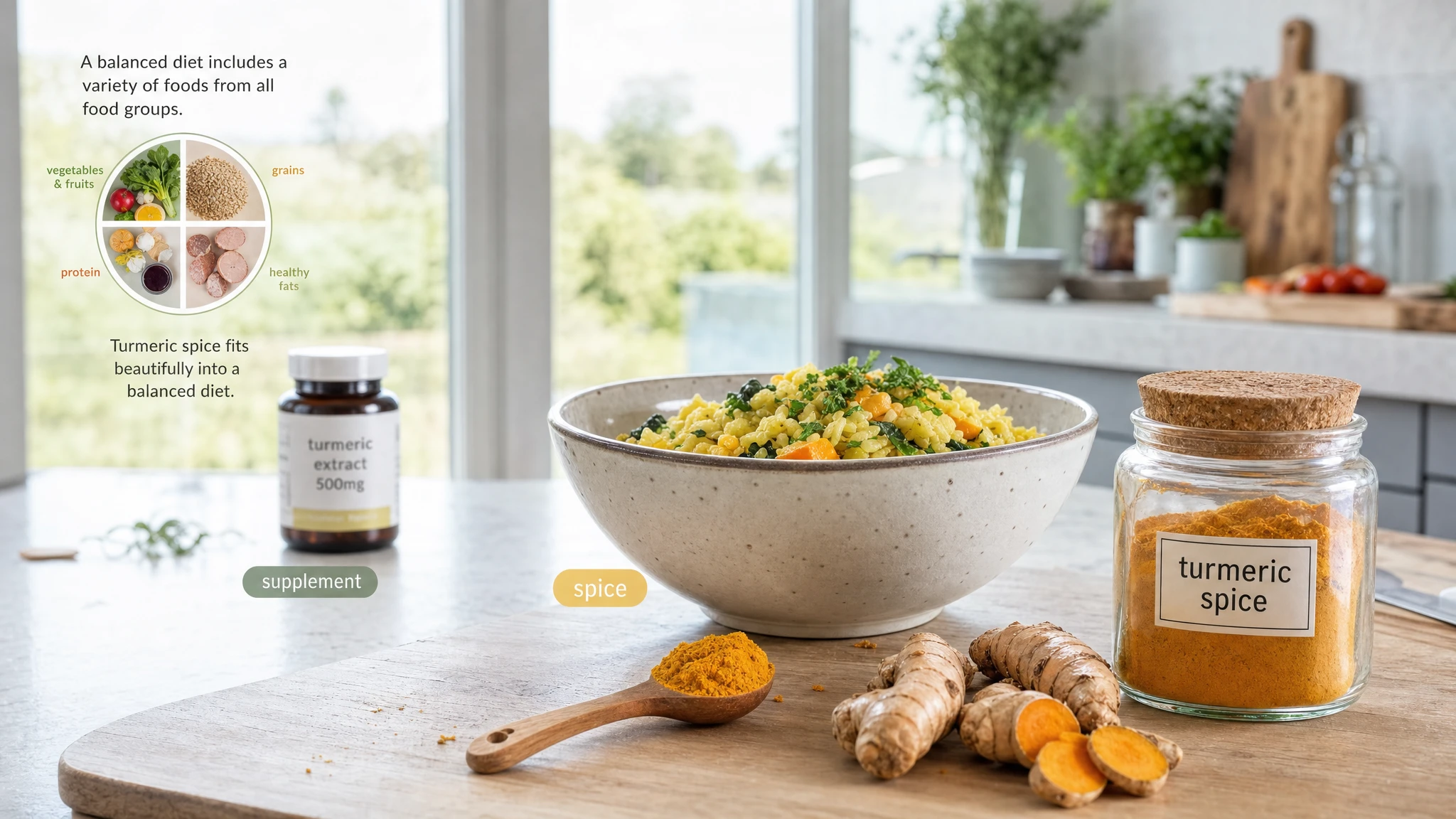
When used as a spice, turmeric remains within a dietary context. It adds flavor and color, just like any other ingredient in your diet. It is not intended to produce intense effects, but rather to fit into a varied and safe eating plan. For this reason, its use in cooking requires a different assessment than that of concentrated products.
Turmeric can therefore remain a normal presence as long as it is used as a seasoning. In this case, it is a common ingredient, not an intervention aimed at a specific purpose. This foundation helps to understand when daily use is reasonable. It also allows you to see when you are moving outside of a normal dietary context.
To navigate this, it is necessary to distinguish what goes on your plate from a choice of supplementation. The key points are as follows:
- On the plate, the spice remains an ingredient compatible with your diet.
- Reasonable daily use depends on the meal and the overall diet.
- The boundary changes when the purpose is no longer just culinary.
- Distinguishing between the spice and a concentrated product helps to avoid confusion.
Using turmeric in cooking can be a reasonable choice, provided it maintains its role as a spice. The following three steps explain when daily use fits into a diet. They also clarify when one transitions to supplementation and why the form taken changes the assessment.
Turmeric on the plate: why it is different from a supplement
On the plate, turmeric should be considered a spice, not a treatment. In cooking, it primarily adds flavor, color, and variety to the diet. The amount consumed is different from that found in capsules or extracts. This distinction prevents attributing the effects studied for concentrated products to the spice itself. If it is distributed in a recipe, it is part of a standard meal and a varied diet. It can therefore be part of a routine, without following a supplementation logic. What matters first and foremost is the type of use, not just the Intake. The ingredient becomes part of the diet and is not intended as an intervention for a specific purpose.
However, the term “turmeric” can refer to both culinary powder and extracts or supplements. Distinguishing between these forms is already a prudent choice. Therefore, one should not seek stronger effects, but rather understand which category the product falls into. From this distinction comes a clearer choice that is better suited to one's own use.
When daily dietary use is reasonable
The daily use of turmeric can be reasonable if it is part of a normal and varied diet [1]. In this case, the spice plays a culinary role and is not used with clinical expectations. This distinction avoids the search for "effective" doses, i.e., quantities associated with other types of products. Generally, dietary use does not require a precise plan. The ingredient is added to recipes just like other herbs and seasonings. The practical criterion is simple: if it serves to enrich the meal, it remains within normal dietary use. If, on the other hand, targeted effects are sought, the product must be evaluated differently. Data on dietary use indicate that the spice can be regularly included in a varied diet.
However, there is no measurable effect similar to that associated with concentrated products [2]. Therefore, using it often in cooking does not automatically imply a "functional" action. Many expectations, in fact, arise from the improper transition between two different contexts. If the spice makes the meal more enjoyable, it remains in the realm of diet. To seek other effects, however, the form of the product must be considered more carefully.
When the dietary context is no longer enough
The dietary context is not enough when turmeric is used as a supplement. Supplements are products designed to add substances to the diet. In this case, the purpose goes beyond simple use in the kitchen. We are no longer talking about a spice distributed in a meal, but about a product taken for a specific goal. This change requires more attention. It is not enough to ask whether the food is suitable for the diet. One must also evaluate the chosen form and how often it is taken. Even without discussing dosages, it is useful to distinguish a common ingredient from a concentrated preparation. Beyond this boundary, questions about tolerability, interactions, and the usefulness of its use increase [3].
The point is not the spice itself, but the transition from a condiment to a concentrated product. Furthermore, not everyone perceives this change in use in the same way. A more concentrated formula is not necessarily more suitable. Caution therefore helps not to confuse cooking with supplementation. If the product is chosen for a specific purpose, a more rigorous evaluation is needed. This boundary introduces the topic of concentrated turmeric.
Recent research and updates
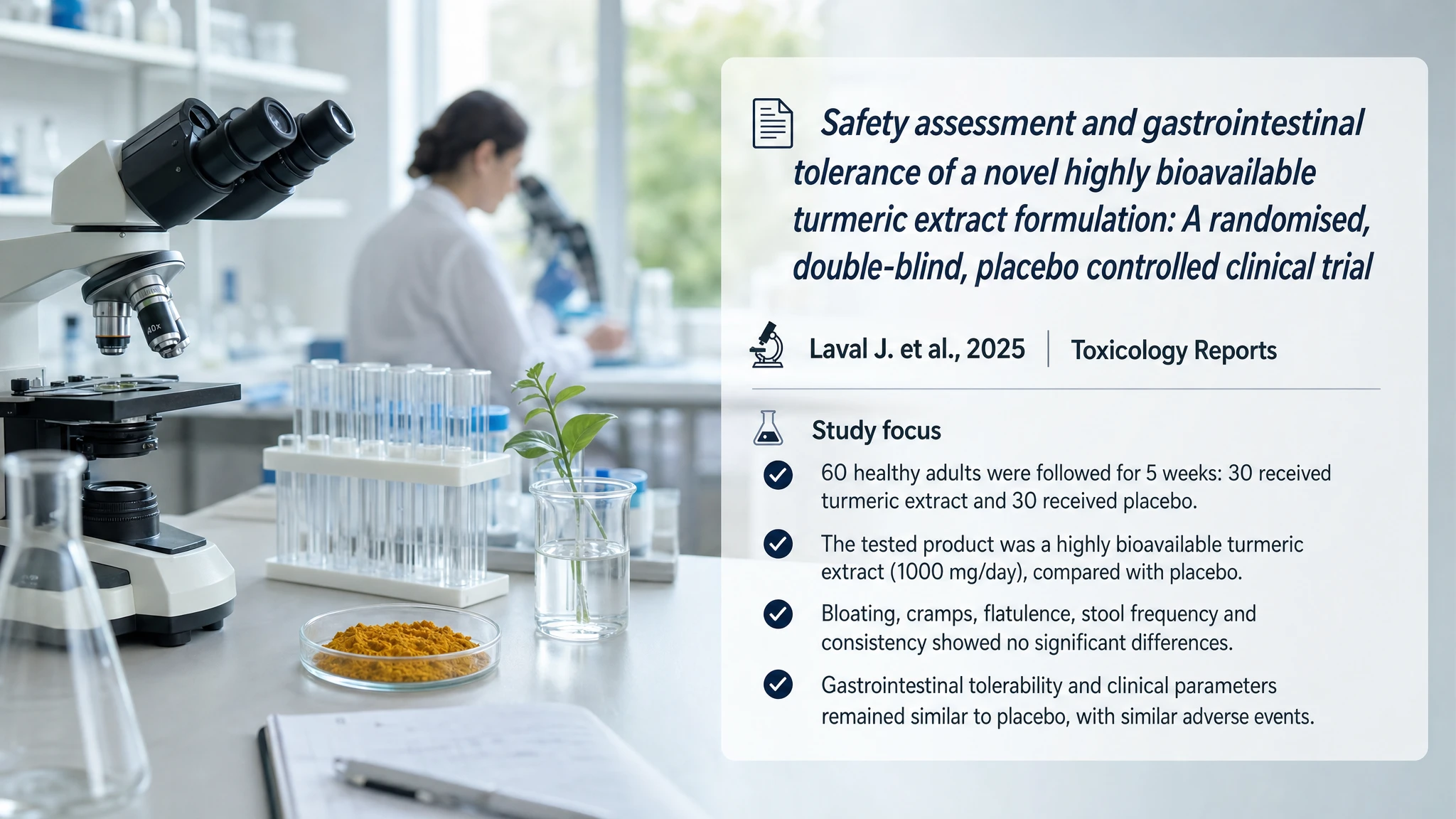
In 2025, French researcher Julie Laval and her colleagues published a study in Toxicology Reports. The researchers analyzed a highly bioavailable turmeric extract (easier to absorb). This work helps distinguish between dietary use and concentrated use, showing what happens when taking a more intense form of the common kitchen spice every day.
Safety assessment and gastrointestinal tolerance of a novel highly bioavailable turmeric extract formulation: A randomised, double-blind, placebo controlled clinical trial
- 60 healthy adults were followed for 5 weeks. Of these, 30 received the turmeric extract and 30 received a placebo.
- The product tested was a highly bioavailable turmeric extract at 1000 mg per day. The comparison used a maltodextrin-based placebo.
- The researchers evaluated bloating, cramps, gas, and stool frequency and consistency. They found no significant differences between the two groups.
- Gastrointestinal tolerability and clinical data remained similar to the placebo. Adverse events were also similar in both groups.
Concentrated turmeric: dose, tolerability, and threshold of attention
When turmeric shifts from being an ingredient to a concentrated product, the assessment of its safety changes as well. Dosage, duration of use, and individual response all matter. These aspects help determine when to limit its use, without confusing supplements with its normal culinary use.
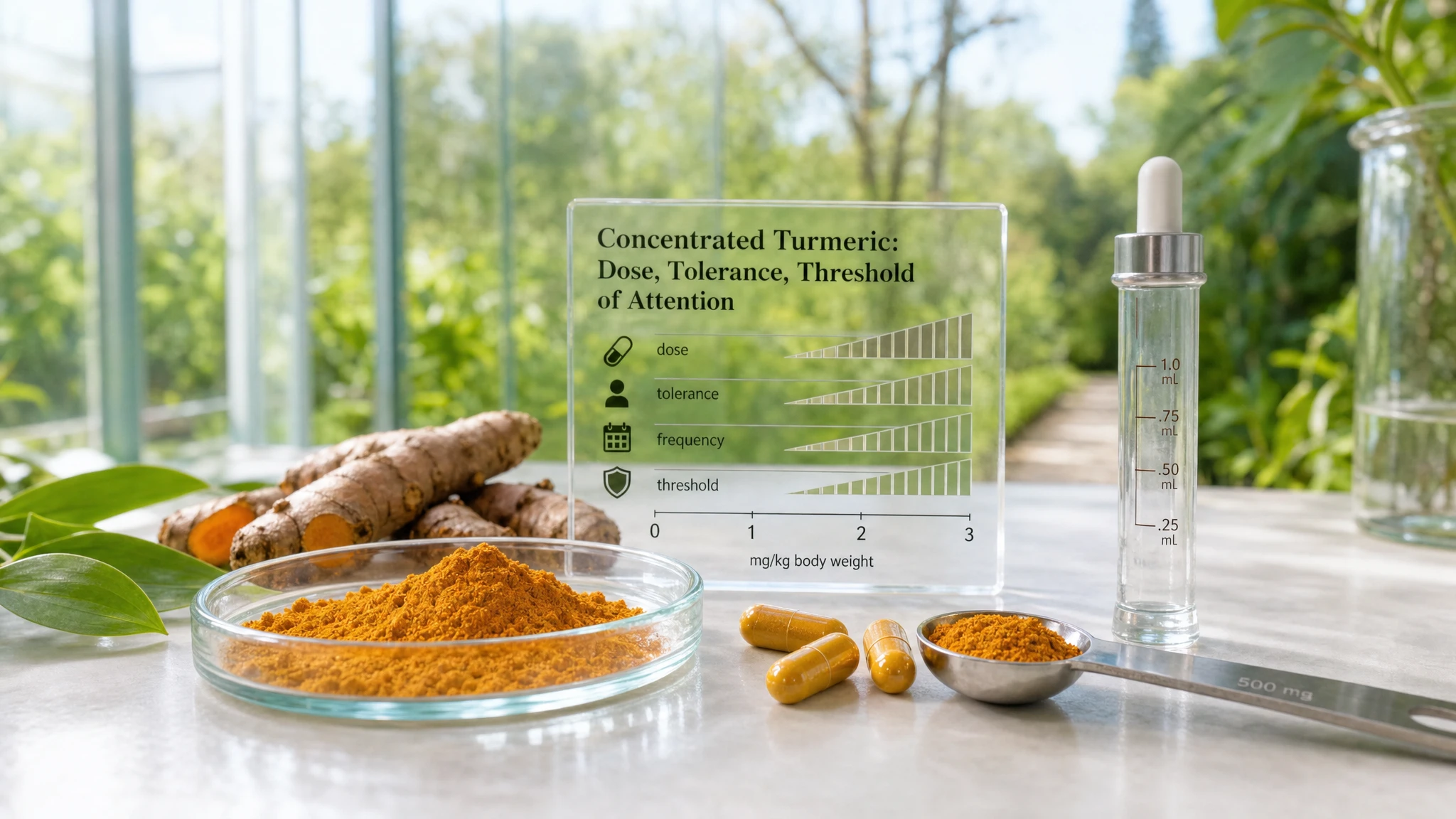
Concentrated turmeric requires more caution than the spice used in cooking. The proportion of active compounds can be higher, which may reduce tolerability. To assess its safety, one must consider quantity, frequency, purpose, and individual response. Attention is especially important with supplements. Limiting intake, when necessary, is a prudent choice.
A useful piece of data comes from the JECFA opinion on curcumin, one of the main active compounds. The document indicates an acceptable daily intake of 0-3 mg per kilogram of body weight. It also reports a no-observed-adverse-effect level of 250-320 mg per kilogram per day. This value is derived from a multi-generational study conducted on rats.
These data do not encourage increasing doses, but they highlight the importance of the amount consumed. The product and the context of use can also change the assessment. When the dose increases or use becomes habitual, greater caution is required.
To navigate this, it is useful to evaluate four concrete aspects:
- The concentrated form exposes you to different amounts compared to normal culinary use.
- The daily dose should be evaluated in conjunction with the individual's response.
- Continuous use may lead to signs that should not be overlooked.
- The choice depends on the context and the purpose of use.
Let's look at why an extract differs from the spice, how the dose affects tolerability, and which signs suggest reducing its use.
Why extracts and capsules are not the same as culinary turmeric
Extracts and capsules are not the same as culinary turmeric because their concentration and method of use differ. In a meal, the spice is distributed throughout the food and generally provides modest doses. A concentrated product, however, exposes the body to a higher amount of active compounds. This reduces the margin between habitual use and use that requires caution. The transition from ingredient to supplement does not just create a "stronger" version. It changes the context and, with it, how safety is assessed.
Techniques that increase the oral availability of curcumin clearly illustrate this difference. Bioavailability (the amount the body can absorb and use) depends on the form of the product. Some formulas can increase exposure and the risk of exceeding the level considered acceptable [4]. However, different products do not have the same bioavailability. Furthermore, data on extracts do not apply directly to culinary use. The same plant can therefore entail different risks. Before limiting its use, it is necessary to understand which form is being taken and in what quantity.
How the dose changes the tolerability profile
The turmeric dosage is one of the factors that most affects tolerability. If the quantity and frequency increase, its use may become less well-tolerated over time. This applies especially to a supplement taken without breaks, not to occasional use. However, there is no single threshold suitable for every person and every product. The practical point is to understand that the dosage is not a neutral factor. Furthermore, normal use in food remains different from taking a concentrated form.
For this reason, a small amount in a meal is not equivalent to the same dose in an extract. The response can vary greatly between people, products, and methods of intake. This variety makes it unhelpful to set a dosage that is valid in every case. Instead, it is better to compare actual use with the reason why the product was chosen. If the quantity and duration are no longer suitable for the purpose, a new assessment is needed. Continuing only out of habit can make it more difficult to recognize poor tolerability.
Practical signs that suggest reducing its use
Some signs may indicate that concentrated turmeric is no longer suitable at a given time. There is no need for alarm, but it is useful to observe your body's response. Use should be reviewed if it becomes uncomfortable, difficult to manage, or deviates from the initial goal. When tolerability changes, it is prudent to reduce the frequency or suspend use for a period. You can also re-evaluate the type of product, rather than continuing out of simple habit. This criterion applies primarily to supplements and not to normal, occasional use in cooking.
Reports of liver damage (liver distress) linked to these supplements remain rare. However, some cases have been described following the use of concentrated products [5] [6]. These data should not cause alarm, but they serve as a reminder that persistent discomfort should not be ignored. Furthermore, similar symptoms can have different causes and therefore require careful evaluation. The reported cases are not all the same and do not prove that every ailment depends on the supplement. If signs of poor tolerability emerge, it is safer to reduce or suspend use. Persisting, on the other hand, offers no proven benefit.
Turmeric and medications: why interactions matter, especially with concentrated products
Turmeric interactions are more significant with concentrated products taken daily or over long periods. Greater caution is needed if the person is already using medications or other supplements. The assessment concerns not only the ingredient itself but also the potential cumulative effects. Understanding when to limit turmeric therefore requires examining any ongoing treatments.
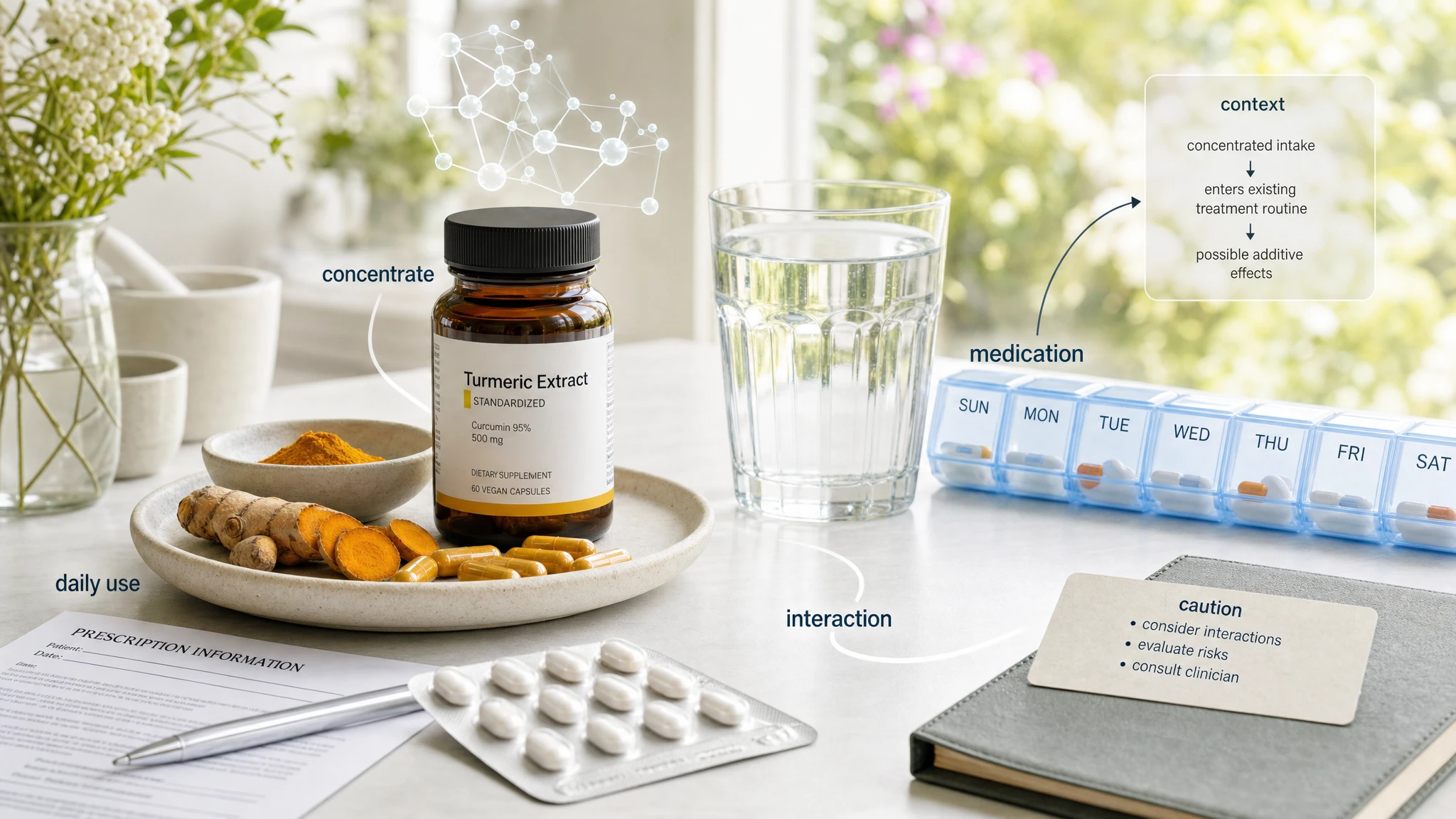
With turmeric supplements, interactions matter more than in normal dietary use. These products are concentrated and follow different dosages and timelines than those used in cooking. Not every combination causes problems, but safety of use also depends on ongoing treatments.
In summary, turmeric and tolerability depend on dose, duration, type of product, and medications taken. Caution increases when use is regular and occurs without expert advice. The situation is different when the spice is used only as an ingredient in a meal. Let us therefore see how ongoing treatments change the assessment and when more attention is needed.
Other supplements, the duration of use, and individual response also play a role. There is no need for alarm: it is necessary to understand how the product fits into an already complex clinical picture. To choose with the right level of caution, it is useful to evaluate a few points:
- Ongoing treatments can change the final assessment.
- Potential interactions primarily concern concentrated extracts.
- Consistent use requires more attention than occasional use.
- The combination with other products must be evaluated for each individual.
Interactions depend on the therapeutic context and do not follow a one-size-fits-all rule. The following steps explain why concentrated products require greater caution.
Why the therapeutic context changes the assessment
The therapeutic context includes treatments, other supplements, and the individual's health conditions. A turmeric-based product is therefore introduced into an already established routine. For this reason, the same dose may have a different impact from person to person. A universal ban is not necessary: precaution depends on the overall clinical picture. With a concentrated form, more attention is required, as it introduces factors absent in normal culinary use.
Literature on plant-based medicines suggests evaluating interactions within the entire treatment plan [3]. However, not all possible combinations have been studied with the same level of rigor. Therefore, the absence of known issues does not prove that all risks are excluded. This attention helps to avoid cumulative, unnecessary effects during therapy. It also allows one to understand when a concentrated product requires professional advice. It is a way to ensure safety without causing alarm.
Possible interactions: why they mainly concern extracts
Turmeric interactions primarily concern extracts, because the concentration changes how they are used. In cooking, the spice is part of a meal and usually provides lower doses. In supplements, however, the dose can be higher and repeated over time. It therefore becomes more useful to evaluate compatibility and individual response together. A concentrated product does not necessarily cause a problem. However, moving from dietary use to supplementation requires more caution. The dose matters, but the chosen form also matters.
Clinical reports explain the reason for this caution. Ten cases have been described in the U.S. Drug-Induced Liver Injury Network and a series of cases in Tuscany [7,8]. Other analyses note that, in some contexts, the substance may also have favorable effects [7,8]. These data, however, do not apply to every product or every person. Formulas can contain different substances and do not share the same safety profile. With extracts, dose and regular use therefore make a tailored assessment more important.
When caution is higher with continuous use
Caution increases when concentrated turmeric is taken every day or for long periods. Repeated use effectively becomes a stable part of a person's routine. This aspect matters especially in the presence of medications or other supplements. The potential risk depends not only on the single dose but also on the cumulative amount over time. Long-term use is not always inappropriate, but it requires verifying its actual necessity. The difference between occasional consumption and regular use therefore changes the final assessment.
An official evaluation has indicated an acceptable daily intake of 0-3 mg/kg of body weight for curcumin [1]. However, there is no duration that is suitable for everyone. Furthermore, products with high bioavailability (the amount the body absorbs) are not the same as the culinary spice [2,4]. The duration of use must therefore be evaluated in relation to the dose, the type of product, and any ongoing treatments. The more stable the use becomes, the more a conscious and non-automatic choice is required.
Turmeric and tolerability: who should pay closer attention
The tolerability of turmeric does not depend solely on the dose. An individual's personal tolerance and the type of product also matter. Supplements are different from using the spice in food. Therefore, more caution is needed if discomfort arises, if the product is concentrated, or if use becomes habitual. Limiting turmeric, however, does not mean giving up its normal use in cooking.
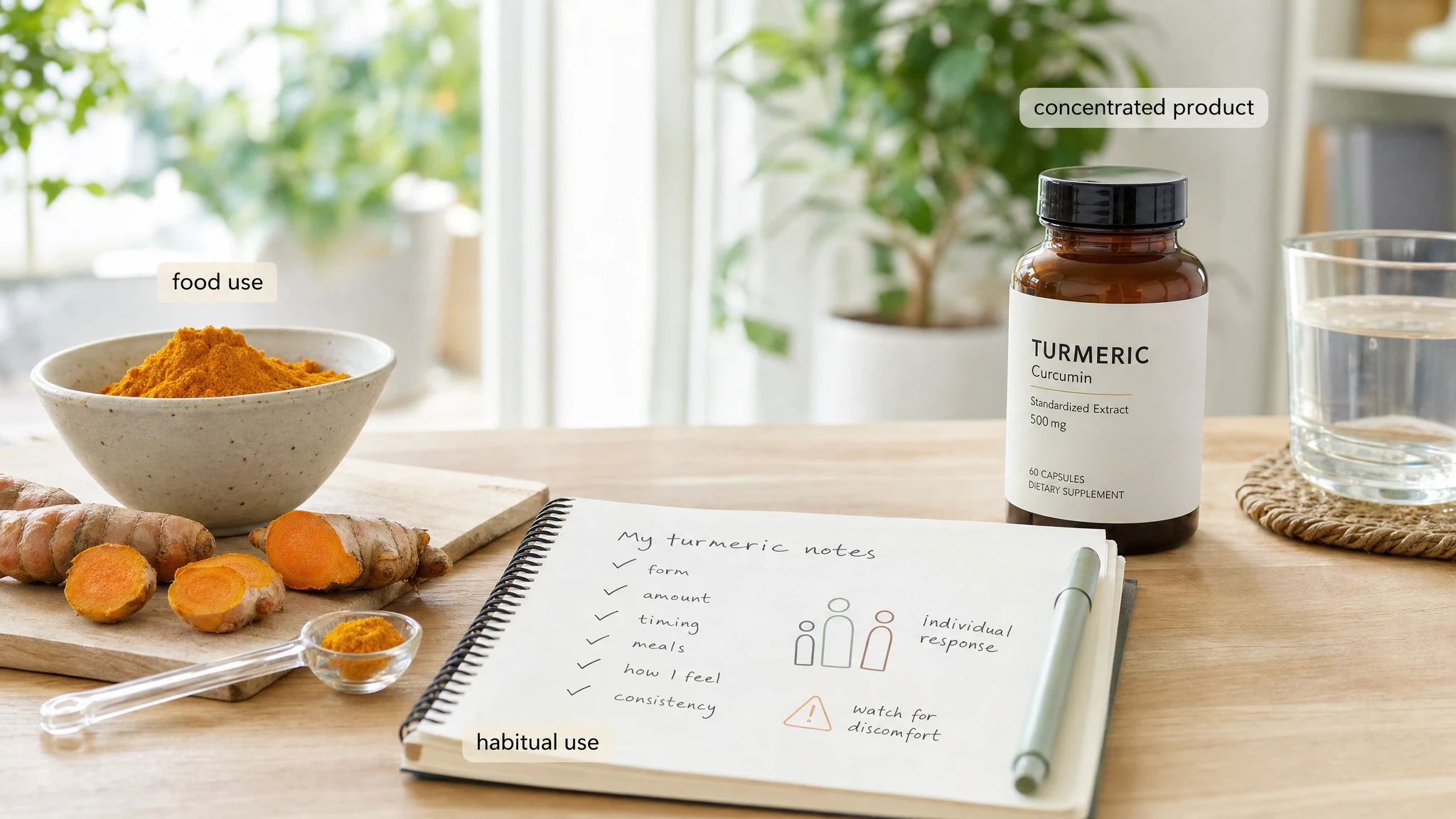
Individual tolerability refers to how well a person tolerates a product. For this reason, the same turmeric may be suitable for some and less suitable for others. The method of use also matters. In a diet, the safety margin is generally different from that of concentrated products. Therefore, to understand when to limit it, evaluating the dose is not enough. One must also observe the personal response and the duration of the intake.
Those who notice signs of poor tolerance should review their usage. This applies especially to supplements and extracts, which contain more concentrated doses. The goal is not to avoid the spice altogether. Instead, it is about using it in food in a way that suits how well your body tolerates it. The following sections explain who may more easily reach the limits of personal tolerance.
To navigate this, it is useful to distinguish some practical aspects of tolerability:
- The personal response can change even if the method of use remains the same.
- Digestive discomfort should be evaluated based on the product and the dose.
- Concentrated products require more care than the spice used in food.
- Caution should increase when intake becomes habitual and lasts over time.
Tolerability varies from person to person. A choice that is well-accepted by some may cause discomfort for others. The following sections explain why the personal response matters and when more caution is needed.
Individual tolerability: why it is not the same for everyone
Individual tolerability explains why the same turmeric may be suitable for some, but not for others. What matters is how the body responds to the product during daily use. The response can change based on the form, frequency, and how well the body tolerates it. This is especially true for concentrated products, which are very different from the spice used in cooking. For this reason, observing your own response is essential, even when the product seems simple to use.
The choice must therefore remain practical and cautious. A product may fit into one person's diet without any issues, but prove less suitable for another. This difference is more significant with concentrated extracts. It should not be exaggerated, but it should not be ignored either. The variety of responses requires a careful choice, based on the effects noted during use. The assessment therefore concerns what happens over time, without extending your own experience to others.
Digestive symptoms and discomfort: when it is not worth persisting
If turmeric, especially in concentrated form, is associated with digestive discomfort (digestive-related issues), it is best not to persist. It is not always possible to attribute the discomfort to the product with certainty. However, a person's well-being is just as important as the initial purpose of use. A supplement or extract should not become an uncomfortable habit. In these cases, it is more sensible to reconsider the form, frequency, or actual necessity of the intake.
Practical experience shows that perceived discomfort is a useful signal. However, on its own, it does not allow for a certain understanding of the cause [9]. Observing when the discomfort occurs helps to cautiously evaluate the specific methods of intake. Prudence prevents continuing a use that causes distress. If the product weighs on daily life, it is better to reduce or suspend it rather than persist. This is especially true for extracts, where tolerability is a key criterion. The body's response therefore helps to understand when intake should be limited.
Who should pay more attention to concentrated products
Concentrated products require more attention if a person is more sensitive or already follows a complex routine. There is no absolute rule that applies to everyone. However, the range of choices changes when the use of turmeric becomes frequent. The culinary spice is added to a meal in smaller quantities. An extract, on the other hand, focuses attention on the dose and duration of the intake. Therefore, more caution is needed when the product is taken on its own rather than to flavor a dish. These differences explain why the same choice is not equally suitable for everyone.
The choice must therefore be adapted to the individual and the context. Those who are more sensitive or frequently use these products should carefully evaluate concentrated forms. The point is not the spice added to food, but an ill-considered habit. Limiting an extract does not mean giving up its use entirely. It means choosing the form, dose, and frequency more wisely. At this stage, caution can become a concrete and useful decision.
Turmeric in daily life: how to choose without overdoing it
In everyday life, the choice depends on the use, not on the idea that more turmeric provides more benefits. It is advisable to distinguish between use in food, concentrated products, and a real need to reduce the quantity. Caution helps maintain safe dietary use and avoid concentrated products when they are not needed.
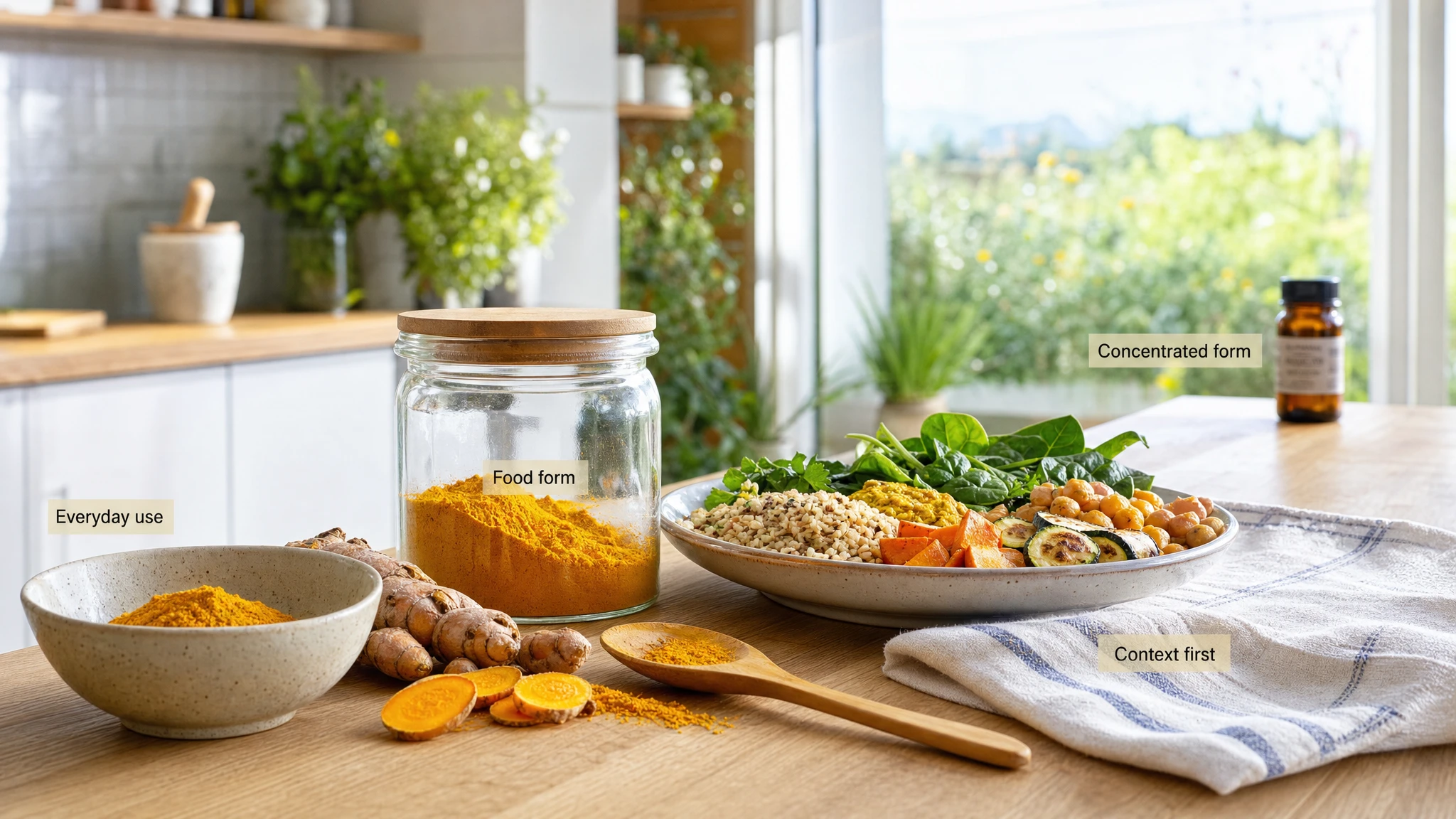
To use turmeric in your daily routine, you need to understand which form best suits your purpose. In a dish, it is a common ingredient; in supplements, dosages, precautions, and individual tolerability (how well a person tolerates the product) change. The choice therefore depends on the use, taste, habits, and your own health conditions.
For this reason, turmeric and tolerability must always be evaluated together, based on the chosen form. There is no need to go beyond culinary use, especially if the expected benefit is unclear.
The practical rule is to start with the mildest form and choose concentrated products only if they are truly needed. This maintains good safety of use, without treating a concentrated product lightly. If your health requires caution, reducing the dose is often the simplest choice.
To avoid excesses, a few questions are enough: is the food itself sufficient, is the supplement really necessary, or is more caution required? To choose, it is worth evaluating these points:
- Understand when dietary use is sufficient in your everyday diet.
- Recognize cases where a concentrated product is not advisable.
- Evaluate three practical questions before reducing or stopping use.
- Link your daily choice to your specific needs and health conditions.
To choose in a balanced way, you must evaluate the factors that truly change the decision: form of use, purpose, and health. The following steps help distinguish a common ingredient from a concentrated product, which requires more care.
How to determine if dietary use is sufficient
Determining if dietary use is sufficient means asking yourself whether turmeric is primarily needed for flavor or if you are seeking a more specific effect. When the goal is culinary, staying within the dietary context avoids shifting the choice toward supplementation without a real need. This step is useful because it keeps the decision simple and reduces the risk of treating what originated as an ingredient as a "therapy." In practice, if its use in cooking satisfies the need, the most straightforward choice is not to complicate it further.
The limitation of this data is clear: it defines a safety framework, but it does not automatically make culinary use and concentrated use equivalent. For this reason, when the function remains gastronomic, the ingredient may remain the most consistent choice. If, however, you are looking for something else, the category of use changes, and so does the level of attention required. The distinction is sharp: it is one thing to season a dish, and another to take a standardized extract. The curcumin dose in a serving of food remains much lower than that in a capsule. For this reason, dietary use has a broader safety profile and raises fewer questions regarding long-term tolerability.
When a concentrated product is not the right choice
A concentrated product is not advisable if there is no real reason to go beyond normal dietary use. It may also be unsuitable if continuous use is not in line with your personal health. In these cases, it requires more caution than a simple dose of turmeric in your diet. Being cautious does not mean banning it, but rather understanding whether the expected benefit justifies a stronger form.
Clinical studies show that the effects of curcumin vary greatly depending on the formula. Bioavailability (the amount the body is able to absorb) also matters [10] [11]. Therefore, the observed results do not automatically apply to simple everyday use. Concentration alone, therefore, does not allow the clinically studied effects to be transferred to daily life. A supplement tested with a controlled protocol can be very different from a product used at home. If your health advises against this choice, returning to dietary use can avoid unnecessary problems.
Three practical questions to decide whether to limit turmeric
To decide whether to limit turmeric, especially during continuous use, three practical questions can help. Am I using a spice or a concentrated product? Is the purpose culinary, or am I seeking a specific effect? Is the choice appropriate and easy to manage for my personal conditions? The answers distinguish safe dietary use from the use of a supplement. If they indicate that caution is needed, reducing or stopping may be the clearest path. The point is not to always use less, but to choose consistently with your goal.
For rheumatoid arthritis, a systematic review found clinical benefits with turmeric/curcumin [12]. However, this result concerns a context very different from normal kitchen use. A potential benefit in selected cases does not, therefore, justify excessive use in daily life. The three questions help separate the expected effect, the chosen form, and personal tolerability. If an answer signals a problem, limiting use is a prudent and sensible choice.
Summary of scientific evidence
This summary brings together the most useful sources for understanding how evidence and safety change. The comparison concerns dietary use, supplements, and concentrated forms.
| Publication year | Area studied | What the studies indicate |
|---|---|---|
| 2003 | food safety of curcumin | evidence indicates that dietary use has a defined safety profile, distinct from that of concentrated products [1] |
| 2019 | bioavailability of formulations | results vary and show that the product form changes absorption and practical assessment of use [4] |
| 2023 | inflammatory and oxidative markers | studies indicate potential beneficial effects, but results vary between products and groups of people [10] |
| 2023 | rheumatoid arthritis | favorable signals have emerged as an aid to treatment, but the picture is not conclusive [12] |
| 2024 | turmeric hepatotoxicity | results vary, but clinical cases confirm that concentrated products require caution [5] |
| 2024 | frequency of liver damage attributed to turmeric | data indicate a rare but documented risk, especially for concentrated products [7] |
| 2024 | safety and tolerability of concentrated products | some products are well tolerated, but this does not apply to all extracts [8] |
Editorial interpretation of the evidence
Reading the studies collected here, I found a clear distinction between the turmeric we use in cooking and its concentrated forms. The type of product, the dose, and the frequency of use change the potential biological effect, and they also change how I assess the risk. The data show me a common point: some extracts are well-tolerated in specific contexts. But these are not the same thing as the spice on your plate. For this reason, my assessment must start from the context of use, not just the name of the substance.
The limitations I encountered concern products that are very different from one another, variable doses, and studies that are often of short duration. Much of the safety data comes from studies with few people; others arise from individual clinical cases or small series. For this reason, I cannot always apply the results to daily life. I also noted the absence of a single threshold for establishing when everyone should limit turmeric. My conclusions must therefore remain anchored to the available data and the specific product studied.
Conclusions and editorial summary
Final critical note
References
[1] KURKUM (Curcumin) - JECFA evaluation
[3] Key technical issues of herbal medicines with reference to interaction with other medicines
[4] Curcumin: Recent Advances in the Development of Strategies to Improve Oral Bioavailability
[5] Turmeric-Induced Liver Injury
[6] Turmeric-Induced Liver Injury
[8] Curcumin and analogues in mitigating liver injury and disease consequences: From molecular mechanisms to clinical perspectives
[9] The efficacy of curcumin-piperine co-supplementation on clinical symptoms, duration, severity, and inflammatory factors in COVID-19 outpatients: a randomized double-blind, placebo-controlled trial
[10] Antioxidant and anti-inflammatory effects of curcumin/turmeric supplementation in adults: A GRADE-assessed systematic review and dose–response meta-analysis of randomized controlled trials
[11] Profiling Inflammatory Biomarkers following Curcumin Supplementation: An Umbrella Meta‐Analysis of Randomized Clinical Trials
[12] Effect of curcumin on rheumatoid arthritis: a systematic review and meta-analysis
Editorial note
Artificial Intelligence was used solely as a tool to support editorial and documentary work. All content, interpretations, bibliographic citations and conclusions have been verified, reviewed and approved by the author, who assumes full scientific responsibility for them.
The manuscript was also subject to independent peer review prior to publication.
To ensure maximum transparency, the article's complete history — including the dates of submission, review, acceptance and publication, as well as information on the peer review process — is available on the dedicated Article History page.