


Where is piperine found in black pepper and how is the extract obtained
Research shows that piperine is not distributed uniformly in black pepper. It is concentrated primarily in the outer parts of the fruit and varies based on variety, ripeness, and the processes used. Products on the market are not equivalent, as grinding and extraction change stability and concentration. A proper comparison must therefore take into account the botanical part and the type of product.
- Published 13/10/2026
- Updated 15/10/2026
- Reviewed 15/10/2026
- Article history
ABSTRACT : WHAT THE SCIENCE SAYS
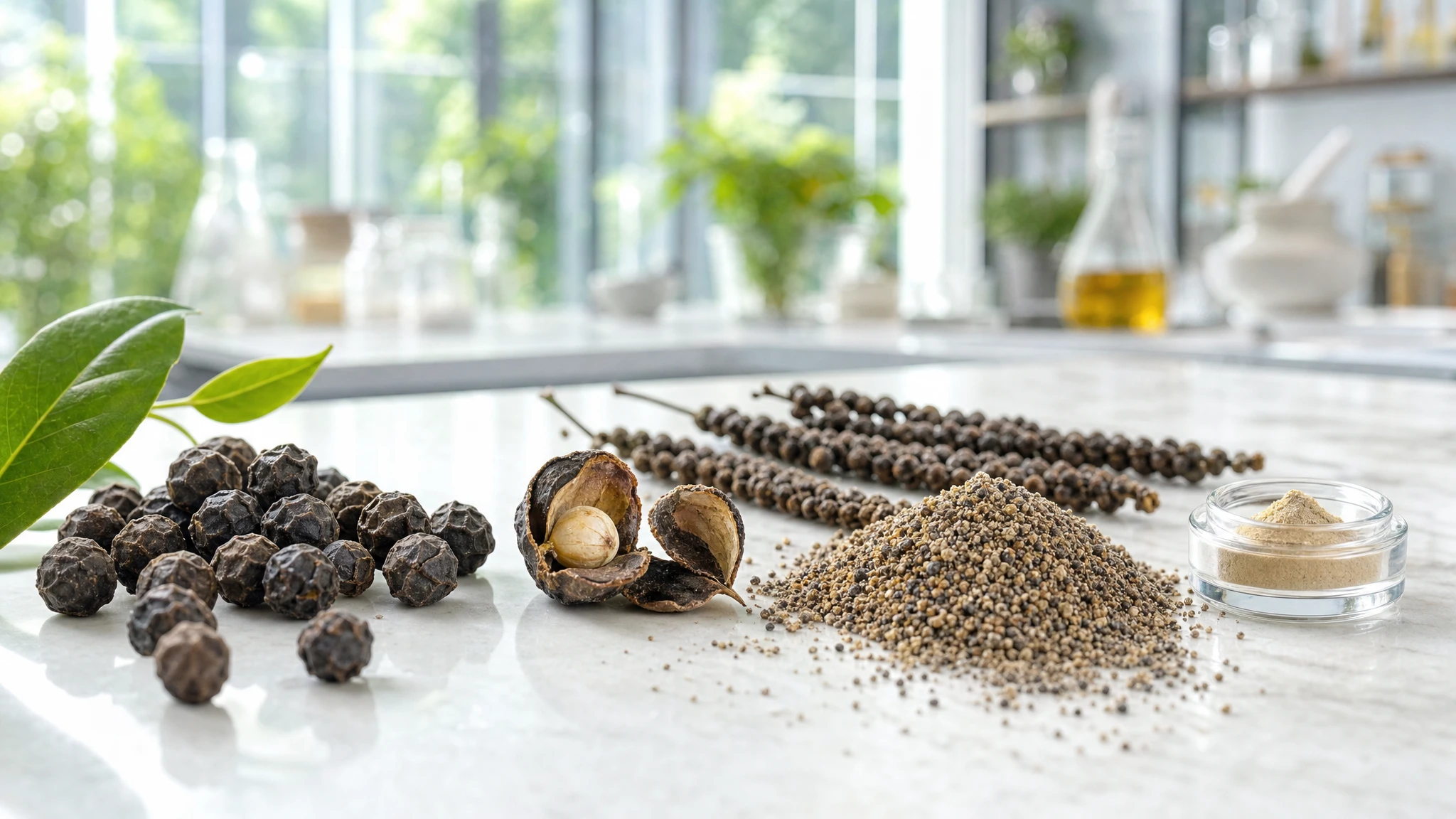
Piperine is the main alkaloid (natural compound) in black pepper and the most widely studied. Understanding where it is found is not just about the pungent taste of the spice. It also concerns its presence in the fruit, peppercorns, powder, and extracts. Furthermore, various processes can change the final content. Knowing the location of piperine therefore helps in understanding the plant and reading labels.
The topic is of interest to those comparing peppercorns and ground pepper, as well as whole spice and extract. In particular, the article explains where it is concentrated, why the quantity varies, and how storage affects it. It also describes the process used to obtain a standardized extract (with a defined content). In summary, here are the key points we will explore:
- Piperine is concentrated primarily in the pericarp.
- Variety, ripeness, and cultivation change its content.
- Peppercorns and powder are not stored in the same way.
- The extract concentrates the molecule compared to the whole spice.
- Obtaining it requires separation, concentration, and standardization.
In which part of black pepper is piperine concentrated
Before comparing ground black pepper and extract, it is necessary to understand where piperine is located. The answer depends on the structure of the fruit and the methods used to process it. In fact, the various parts of the peppercorn do not contain the same dose of the pungent compound.
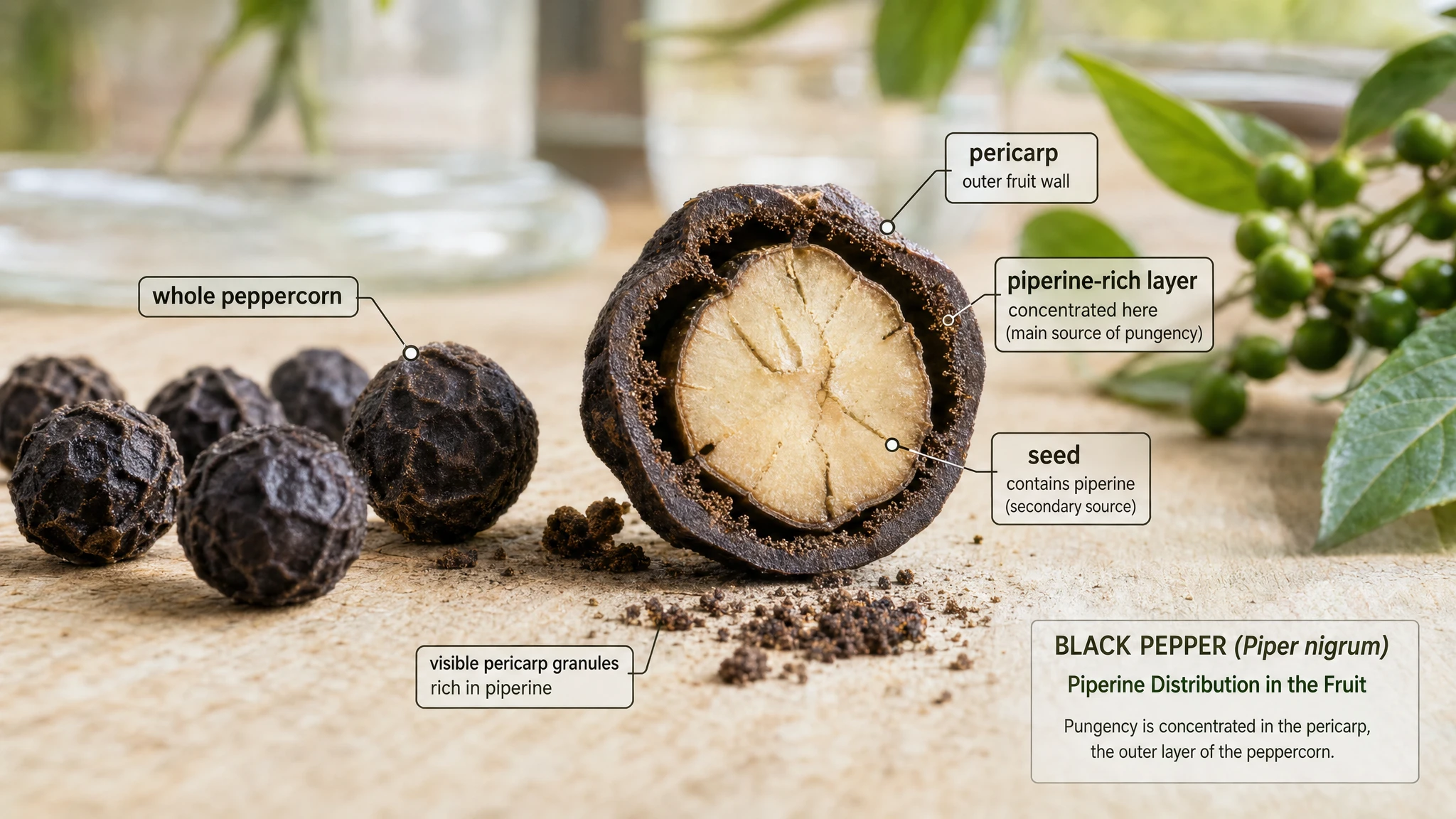
In black pepper, piperine is not distributed uniformly. It is concentrated primarily in the pericarp (the outer layer of the dried drupe), but it is also found in the seeds. The piperine content therefore depends on the part being examined, not just the weight of the sample. Two products obtained from the same pepper can therefore differ even before grinding.
This uneven distribution explains the differences between ground pepper, selected seeds, and the parts used in extracts. The data must therefore be interpreted based on the part examined and its proportion in the finished spice.
To correctly interpret the data, it is useful to distinguish a few points:
- The outer layer tends to contain the highest proportion of the compound.
- The seeds also contribute, but the amount is not always uniform.
- The structure of the fruit changes the value measured in the sample.
- The whole fruit does not coincide with the part that contains the most piperine.
To understand where piperine is located, one must first observe the fruit and then the sample. The following steps show how the quantity varies between the pericarp and the seeds. They also explain why this difference changes the final content of the product.
Piperine in the pericarp and seeds: where it accumulates
The compound accumulates primarily in the pericarp (the outer layer covering the fruit), but it is also found in the seeds. Therefore, the spice does not have a uniform composition throughout. The dried drupe itself contains parts with varying doses of the compound that provides the typical pungent sensation. When studying black pepper seeds or powder, the botanical origin helps in interpreting the final data. This means that the result also depends on how much pericarp is included in the analyzed sample.
Reviews identify piperine as one of the main components of black pepper. In the dried product, they report a total content between 2% and 7.4% [1]. However, these data include different materials and do not always distinguish between the outer part and the seeds in the same way. In practice, the outer part tends to be richer. The other parts, conversely, provide a contribution that can vary [2][3]. This value therefore describes the dried product as a whole, not every single part. For this reason, when analyzing a sample, one must always ask which portion of the fruit was included. A value measured on the seeds alone will differ from one that also includes the pericarp. This distinction is essential for comparing different studies or for evaluating the quality of a supplement. Without this information, the number alone can be misleading.
Why piperine content varies between varieties and stages of ripeness
The content of this compound is not fixed, as various factors act on the plant before harvest. These include botanical varieties, the degree of ripeness, and the conditions in which the plant grows. Two samples of black pepper can therefore have different values without one being of lower quality. This difference is natural and depends on the plant's biology and the growth of the drupe. For this reason, a single value does not represent all the variability possible between batches.
Reviews and technical analyses show even clear differences between samples and batches. In dried black pepper, the overall values reported often range from 2% to 7.4% [1]. The compound is also one of the most useful markers for estimating the pungency of the product [4][5]. However, these data cannot replace the examination of individual samples. Variety, ripeness, and origin must be considered together. Otherwise, comparisons can be misleading.
Drying and storage: what changes in the available piperine
After harvesting, drying and storage of spices can affect the amount of piperine still available in the finished product. Light, heat, humidity, and oxygen are factors that impact the overall stability of black pepper and its quality over time. For this reason, the issue is not just about aroma: it is also about how much of the original compound remains truly accessible when the consumer uses peppercorns, powder, or concentrated preparations. Piperine is sensitive to these conditions and can slowly degrade. Even careful storage does not completely stop this process. Therefore, those who consume it receive a product whose composition may differ from that measured immediately after drying.
Analytical assessments of black pepper and the foods containing it also show that monitoring piperine depends heavily on the state of the sample and storage conditions [6][7]. The limitation is simple: the data help describe the risk of loss, but they do not allow for precise prediction of every batch without direct measurement. To have a reliable picture, repeated analyses over time are needed. Only in this way can the actual amount of active compound reaching the point of consumption be estimated.
Recent research and updates
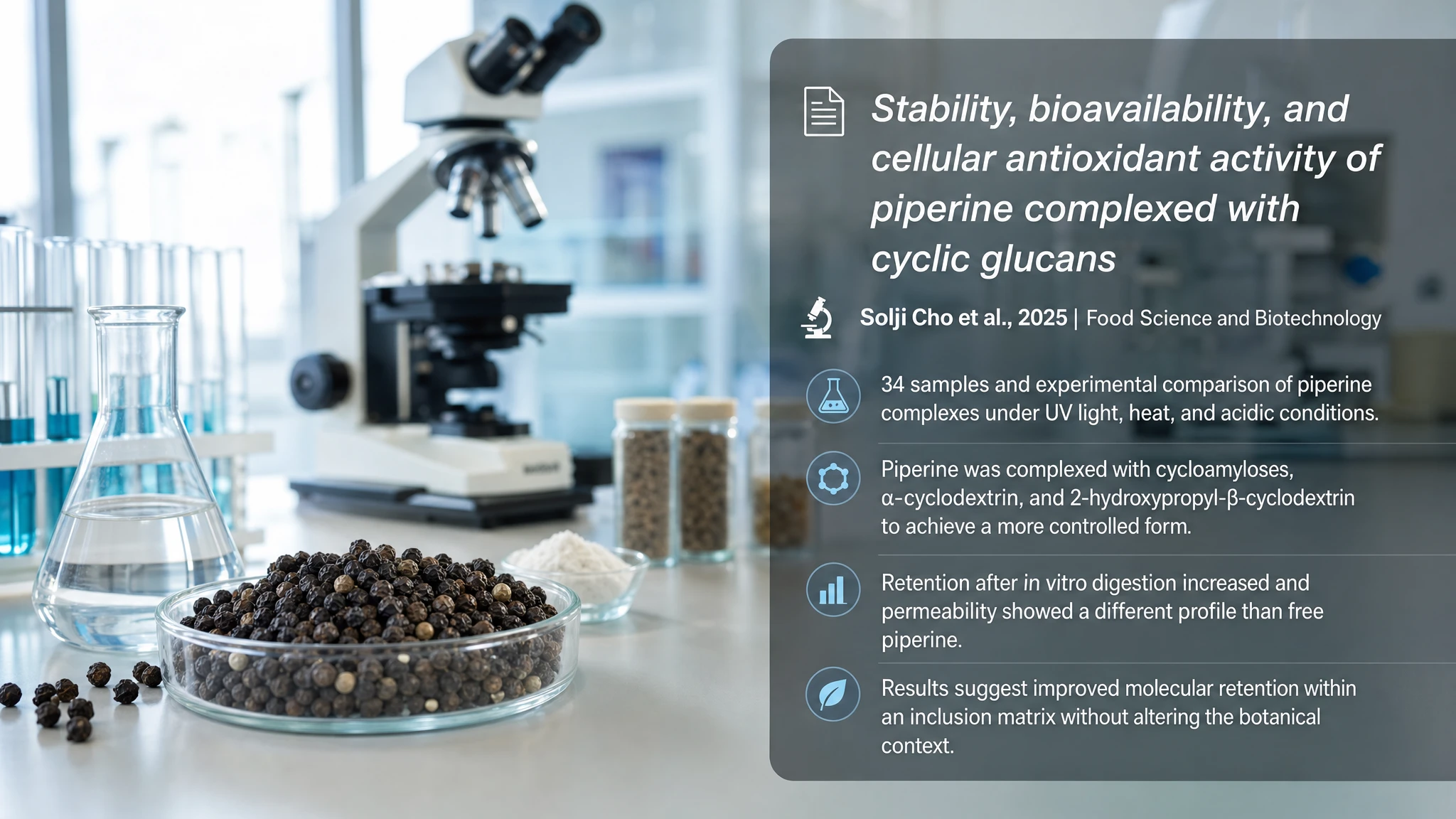
In 2025, Solji Cho and colleagues published a study in the journal Food Science and Biotechnology. The team investigated piperine combined with support structures called cyclic glucans. The work demonstrates how this chemical form can become more stable and easier to measure during food processing. It therefore helps to understand not only where the compound is located, but also how it may change after processing.
Stability, bioavailability, and cellular antioxidant activity of piperine complexed with cyclic glucans
- The study used 34 samples and compared the complexes under ultraviolet light, heat, and acidic conditions.
- Piperine was combined with cycloamylose, alpha-cyclodextrin, and 2-hydroxypropyl-beta-cyclodextrin to achieve a more controlled form.
- After in vitro digestion (simulated in the laboratory), the retained amount increased and permeability changed compared to the free form.
- The result indicates better retention within the inclusion matrix, but does not change the botanical theme of the article.
Why piperine content varies between peppercorns, powder, and extracts
The amount of piperine varies between the different forms in which black pepper is sold. The matrix (the structure enclosing the compound), exposure to air, and the concentration obtained during processing all vary. For this reason, black peppercorns, powder, and extracts do not provide the same dose per gram.
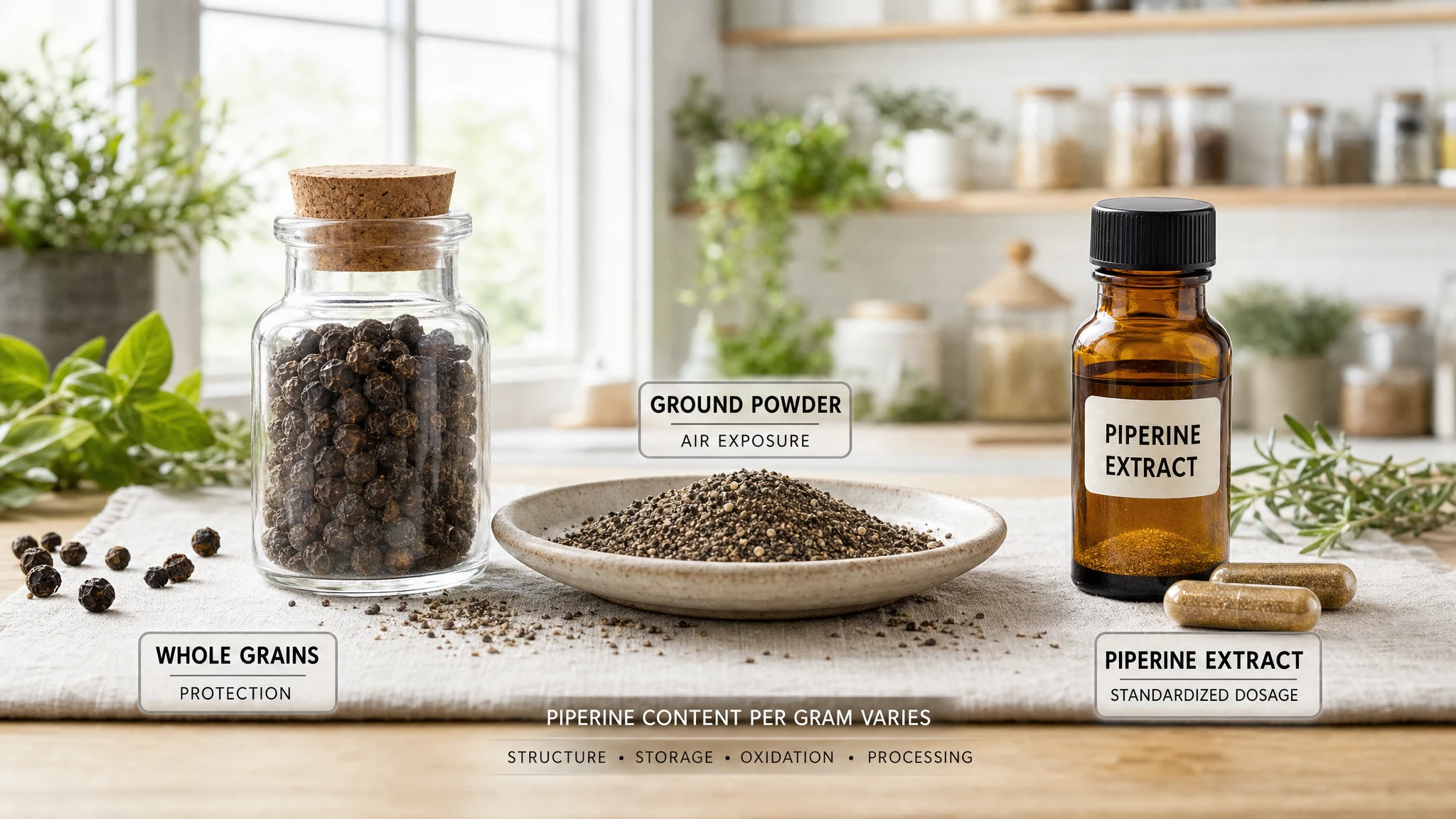
The difference between peppercorns, powder, and extracts depends primarily on how the spice is presented and stored. In black peppercorns, the matrix remains more compact, whereas in ground black pepper, the surface area exposed to air increases. In piperine extracts, however, the molecule is concentrated using food technology processes that isolate the compound of interest.
It is not just the physical form that changes: the piperine content available per dose also varies. These differences matter when comparing labels, recipes, and products intended for different uses. The storage of spices affects the stability of the powder, while standardization makes extracts more uniform.
The variation concerns not only the perceived quality but also how much piperine actually reaches a serving. This is why different products should not be compared as if they were equivalent. The following paragraphs show how each form changes behavior, stability, and concentration over time.
Here are the points that better clarify the distinction between the three forms:
- Peppercorns maintain the natural protection of their internal content for longer.
- Powder loses stability more easily after grinding.
- Extracts offer a more concentrated and standardized amount.
- Reading the label must take into account the form and the actual dose.
The three forms of black pepper react differently to air and processing. Standardization (the uniformity of content across products) also changes. For this reason, the final quantity may not match that of the raw material.
Whole black peppercorns: why they better preserve their structure
Whole black peppercorns tend to preserve the fruit's structure better than the pre-ground version. The reason is the reduced exposure of the matrix to air, light, and humidity, which slows down degradation processes. This whole form better protects the internal components and makes the product more stable over time.
For those concerned with spice storage, the whole peppercorn remains the most robust form. In practical terms, the greater protection of the whole peppercorn helps preserve the spice's profile for longer, including piperine. The limitation is clear: literature data do not describe a single value, and the whole peppercorn does not eliminate the natural variability of the raw material. Piperine is the main pungent compound in black pepper, but its quantity can vary based on origin, season, and growing conditions. For this reason, even whole peppercorns, while more stable, do not guarantee a constant content from one batch to another.
Ground black pepper: what happens to piperine when exposed to air
When black pepper is ground, the surface area exposed to air, light, and humidity increases significantly. This makes ground black pepper more vulnerable to the loss of aroma and the transformation of its more sensitive compounds. This does not mean that piperine disappears immediately, but rather that the powder tends to lose stability more quickly than the whole peppercorns.
For this reason, grinding should be viewed as a useful step in cooking, but one that is less favorable for long-term storage. In a poorly protected product, the piperine content can become less homogeneous and more difficult to compare with that of the whole peppercorn. The limitation of available data is that many measurements are point-in-time and do not describe the entire supply chain; therefore, the actual result varies based on packaging, storage, and environmental conditions. Piperine is sensitive to oxidation, and the powder exposes a larger surface area to the air. This accelerates the degradation of the compound and reduces its concentration over time. Therefore, freshly ground powder retains more piperine than powder that has been stored for a long time.
Piperine extract: why it is more concentrated than pepper
Piperine extract is not just ground pepper, as it is derived from a process that isolates and concentrates the molecule. This results in a more defined and uniform form compared to the whole spice. This is useful when a controlled content is required. The difference lies not only in particle size but also in the level of purity achieved.
The extract should therefore be viewed as a concentrated ingredient, not as finer pepper. In other words, the processing modifies the amount of piperine present in the same quantity. Reviews describe this molecule as the main pungent compound in black pepper. They also indicate that standardization makes the content clearer and more consistent [2][8][3]. Pharmacology studies report that it can influence the amount of other compounds absorbed by the body. This is why concentration also matters in product formulations [9]. However, these sources are primarily reviews: they explain the principle well, but they do not replace the analysis of each batch.
How piperine is obtained from black pepper
The extraction of piperine separates the compound from other substances present in black pepper. This results in an ingredient that is more defined and easier to dose. The process is used to evaluate content, make a product uniform, or create extracts for technical and nutritional uses.
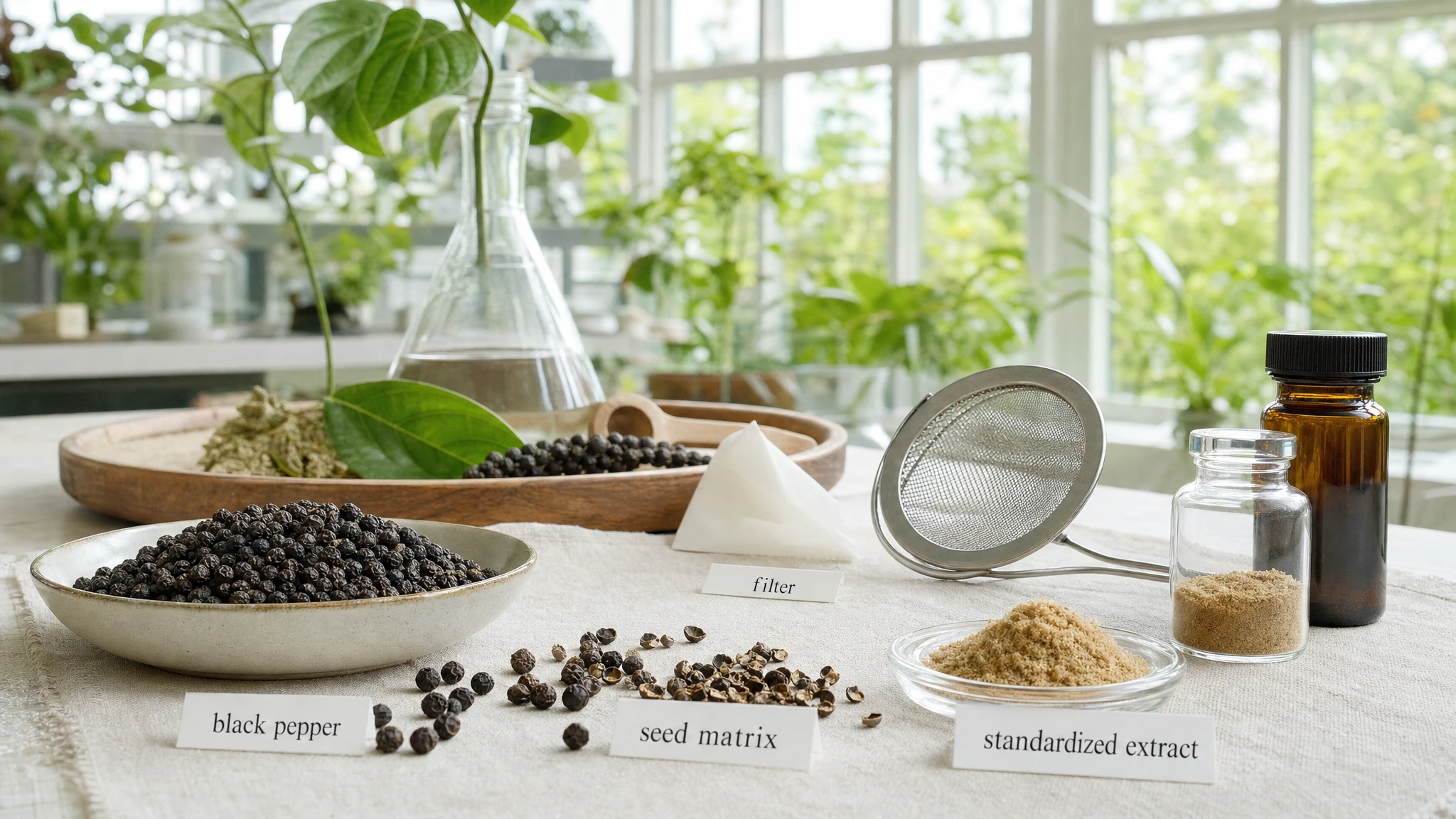
In food and industrial use, obtaining piperine means separating it from dried black pepper. Piperine is found in the seeds and the pericarp (the outer part of the fruit). This step concentrates it and makes it easier to dose accurately. In ground pepper, however, it remains combined with many other natural substances. Therefore, both the quality of the separation and the characteristics of the final product matter.
The result varies based on the method used and the purpose of the process. A laboratory test, a commercial extract, and a raw material offer different degrees of precision. The storage of the spice and the initial processing phase also affect the quantity recovered.
These factors can also change how uniform the final product remains. Extracting, therefore, does not just mean separating one molecule from other substances. It also means obtaining a stable extract that is well-defined and suitable for its intended use.
To obtain a concentrated ingredient, several technical steps are required:
- Separating the molecule from the black pepper matrix (the set of substances present).
- Reducing the complexity of the plant material used at the beginning.
- Concentrating the compound into a form that is easy to measure.
- Making the content suitable for standardization and comparison.
To obtain piperine, it must first be separated from the spice and then the properties of the product must be defined. The following three steps show what changes between plant material, extract, and concentrated ingredient.
Piperine extraction: separating the molecule from the spice
Extraction is the process by which piperine is separated from the rest of the spice to obtain a more defined raw material. In practical terms, it starts with black pepper seeds or other parts of the dried fruit to isolate the compound of interest. This process reduces the effect of the food matrix on the final product. This is why the extract should not be confused with ground black pepper: the former is created to be controlled, while the latter remains a natural mixture. Separation occurs using solvents or physical techniques that leverage the properties of piperine. The starting plant material is treated to remove unwanted substances. This concentrates the molecule into a fraction that is easier to manage. The result is a semi-finished product that contains piperine in a more accessible form.
The limitation is that the available sources are primarily synthetic: they clarify the technical principle but do not offer a single universal protocol. The yield depends on the starting material and the food technology employed. Black pepper can vary by origin, harvest season, and drying method. The choice of solvent and contact time also influence how much of the compound is recovered. In other words, separating does not just mean extracting, but also controlling how much and how the molecule is recovered.
Standardization of extracts: why the content must be defined
Standardization is the process that indicates how much piperine is present in an extract and makes different products comparable. It is an important step when discussing piperine content precisely. A whole spice or ground black pepper can vary significantly from batch to batch. The natural concentration of the compound changes based on the plant, the climate, and the processing. A standardized extract, on the other hand, more clearly declares the amount of the active compound. This facilitates label reading, quality control, and the comparison between different formulations. Those who produce a supplement or a technical food product need a reliable basis to work from. Standardization provides exactly this analytical certainty.
This is where measurement comes in: it is not enough to extract the piperine; its concentration must also be verified using reliable analytical methods. Techniques such as high-performance liquid chromatography (HPLC) are used to quantify the compound. The measured value is then reported on the label as a guaranteed percentage content. The limitation remains that which is typical of plant-based products, namely the variability of the starting material. For this reason, standardization does not eliminate the natural origin, but makes it more controllable and predictable in use.
From spice to concentrated ingredient: what changes in the final product
The transition from spice to concentrated ingredient changes the function of the product. Piperine extract is not meant to replace black pepper as a food, but rather offers a more concentrated and easier-to-dose form. This changes how the compound is used in technical or nutritional formulations. A concentrated ingredient allows for working with more precise quantities and a clearer reading of the content. The whole spice contains hundreds of compounds that interact with each other. The extract isolates only one, or a restricted group, for a specific purpose. This simplification is fundamental for those designing a piperine-based product. It allows one to know exactly how much active ingredient is being added to a capsule or mixture.
The limitation is clear: a more concentrated extract alone does not tell the whole story about the product's quality. Purity, stability over time, and intended usage methods also matter. Piperine can degrade if exposed to excessive light or heat. Its bioavailability can change depending on the formulation that contains it. For this reason, the final product should be interpreted as a technical preparation, not just as a stronger pepper. Concentration is a practical advantage, but it requires careful design to maintain the desired characteristics.
Summary of scientific evidence
This summary brings together the most useful studies to understand where piperine is found, how it varies, and why the products on the market are not equivalent.
| Publication year | Area studied | What the studies indicate |
|---|---|---|
| 2017 | Isolation and formulations of piperine | Results vary, but describe piperine as the main active compound and a target for specific extraction [2] |
| 2019 | Phytochemical characteristics of piperine | Studies describe piperine as an active compound, studied for its chemistry and technological uses [8] |
| 2021 | Piperine content in black pepper | Studies indicate a variable amount, which also depends on the plant material analyzed [1] |
| 2021 | Quantification of piperine in black pepper and food | Measurements provide useful data for quality control and detect the compound in various foods [6] |
| 2022 | Analytical estimation of piperine in black pepper | Data indicate that piperine is a useful chemical marker for assessing the quality of the spice [7] |
| 2024 | Extraction and processing of piperine | Piperine can be isolated using various methods. Recent studies confirm that the process used defines the final product [5] |
Editorial reading of the evidence
Overall, the studies I have reviewed here outline a consistent picture. Piperine is the most important pungent compound in black pepper, but it is not distributed uniformly. I have observed that the amount varies according to the part of the fruit, the process used, and the form in which it is sold. The most reliable sources indicate that moving from the spice to the extract increases the concentration and makes the content more defined.
The main limitations I have encountered stem from the variety of sources, which are often based on reviews rather than primary studies. Measurement methods are also not uniform. Furthermore, I have noted a lack of solid data on home storage and the precise distribution between the pericarp and seeds. Practical conclusions therefore require caution.
Conclusions and editorial summary
Piperine is the main chemical reference for black pepper. However, my reading suggests that its significance changes between the whole spice, powder, and extract. Studies indicate that the compound is concentrated primarily in the outer parts of the fruit. Its quantity also depends on natural factors and the processes used. Therefore, black pepper has a variable composition that cannot be considered uniform.
The most useful point I have gathered is the distinction between botanical origin and the form in which it is sold. Whole peppercorns better preserve their structure, while grinding exposes the spice more. Extraction, on the other hand, leads to a product with a more defined content. Piperine thus shows me why a natural compound must be evaluated in conjunction with the spice, the production process, and the raw material.
Final critical note
The picture I have found is consistent, but not always complete. The sources describe piperine well, its general location, and the differences between the spice, powder, and extract. Conversely, the data I examined regarding individual botanical parts are less robust. The effects of storage have also not been studied in a uniform manner. I therefore suggest that you distinguish between well-documented data and hypotheses that are plausible but not yet defined. This caution is essential when comparing products that only appear similar.
References
[1] Piperine: A review of its biological effects
[2] Piperine—The Bioactive Compound of Black Pepper: From Isolation to Medicinal Formulations
[3] Black Pepper and its Pungent Principle-Piperine: A Review of Diverse Physiological Effects
[4] Piperine - JECFA evaluation
[5] Preparation, pungency and bioactivity transduction of piperine from black pepper (Piper nigrum L.): A comprehensive review
[6] Determination and risk characterisation of bio-active piperine in black pepper and selected food containing black pepper consumed in Korea
[8] Phytochemical and pharmacological attributes of piperine: A bioactive ingredient of black pepper
Editorial note
Artificial Intelligence was used solely as a tool to support editorial and documentary work. All content, interpretations, bibliographic citations and conclusions have been verified, reviewed and approved by the author, who assumes full scientific responsibility for them.
The manuscript was also subject to independent peer review prior to publication.
To ensure maximum transparency, the article's complete history — including the dates of submission, review, acceptance and publication, as well as information on the peer review process — is available on the dedicated Article History page.