


Why oregano essential oil varies between different cultivation areas
In 2020, Thai researcher Laothaweerungsawat and colleagues, in the journal Molecules, compared the chemical composition and certain in vitro activities of two Origanum vulgare essential oils: one from a tropical mountain area and one commercial oil from the Mediterranean region. The study evaluated how differences in the aromatic profile may be associated with different laboratory test results.
- Published 16/11/2026
- Updated 22/11/2026
- Article history
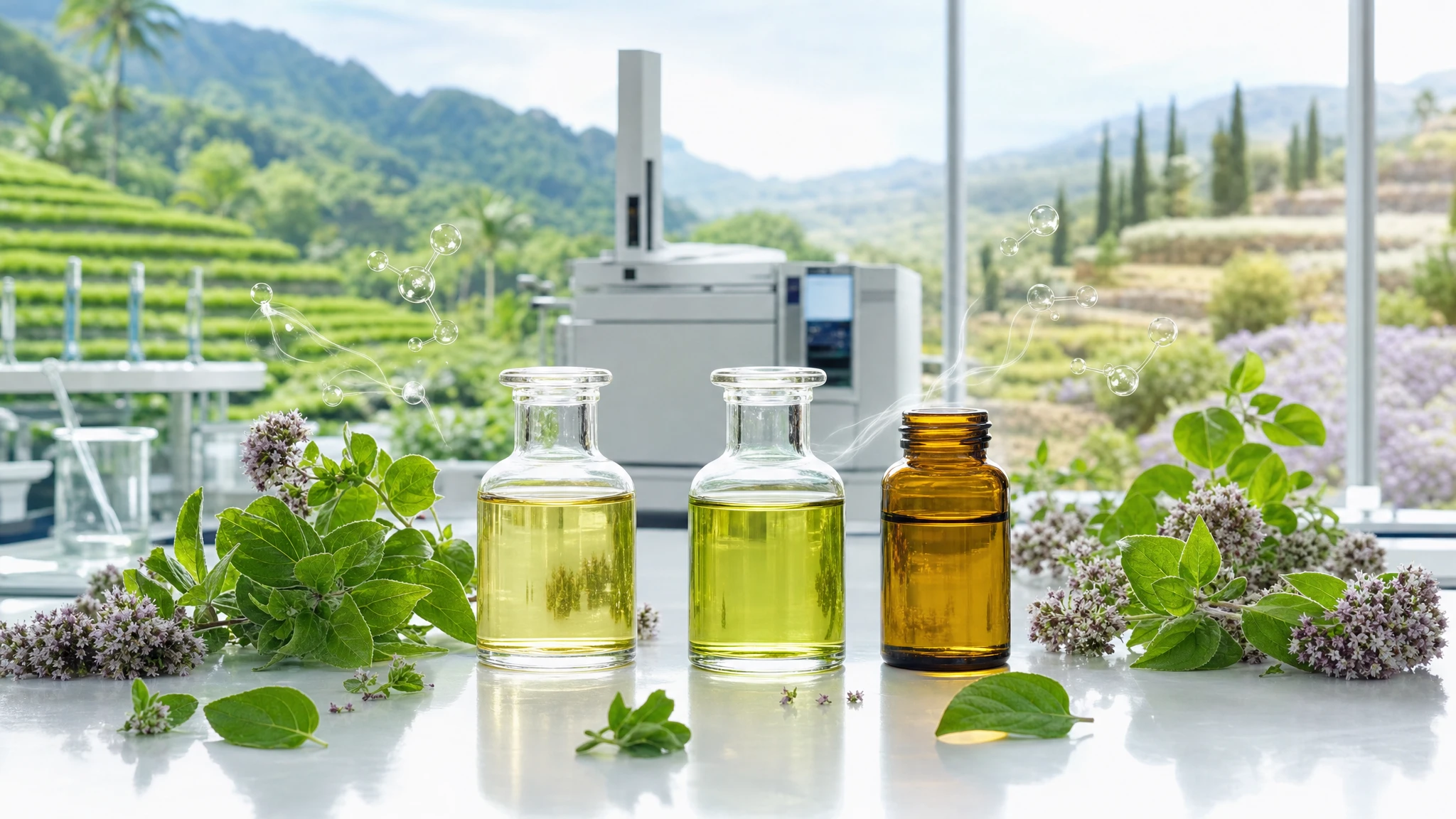
ABSTRACT : WHAT THE SCIENCE SAYS
Research has compared two essential oils of Origanum vulgare from different geographical contexts. The main result is simple: two products with the same botanical name can have different proportions of aromatic compounds. This variability matters especially when it comes to concentrated oils intended for cosmetic formulations.
The authors compared an oil obtained from oregano grown in a tropical mountain area with a commercial oil attributed to the Mediterranean area. They identified the volatile compounds using GC-MS (gas chromatography coupled with mass spectrometry, a method that separates and identifies molecules present in a mixture) and performed in vitro tests on antioxidant activity and on enzymes involved in the degradation of skin components. Carvacrol, a plant-based aromatic compound, was dominant in both oils but more abundant in the tropical sample: 79.5% versus 64.6%. The tropical oil also showed greater inhibition of lipid peroxidation, i.e., the oxidation of fats used as an indicator of chemical damage in the laboratory. In enzymatic tests, it inhibited collagenase, elastase, and hyaluronidase. These results describe a technological potential in vitro, not a proven effect on human skin. Furthermore, the comparison does not allow the differences to be attributed solely to the area of origin, because the plant's genetics, harvesting, storage, and extraction can all contribute to the final profile.
What this research analyzed
The 2020 study by Laothaweerungsawat and colleagues investigated whether two essential oils from the same botanical species could differ in composition and behavior during laboratory tests. An essential oil is a concentrated mixture of volatile molecules responsible for a plant's aroma; it is therefore not the same as the spice used in meals. The authors compared an oil from a tropical mountain region, obtained via hydrodistillation, with a commercial oil sourced from the Mediterranean area.
First, they measured the molecules present using GC-MS. Then, they evaluated three aspects: reducing capacity and radical scavenging in chemical systems; inhibition of lipid peroxidation; and activity against collagenase, elastase, and hyaluronidase. These enzymes can degrade collagen, elastin, and hyaluronic acid, which are substances that contribute to the structure, elasticity, and hydration of the skin. The next step therefore concerns the measured results.
Research data
Chemical Compositions and Anti-Skin-Ageing Activities of Origanum vulgare L. Essential Oil from Tropical and Mediterranean Region
- GC-MS identified 95.8% of the components in the tropical oil and 97.2% in the commercial Mediterranean one.
- Carvacrol was the main compound in both oils: 79.5% in the tropical sample and 64.6% in the commercial sample.
- In the enzymatic test, the tropical oil inhibited collagenase, elastase, and hyaluronidase by 92.0%, 53.1%, and 16.7%, respectively, at the tested concentrations.
What results emerge from the study
The clearest finding is that the two oils were not chemically identical. Carvacrol was predominant in both, but it reached 79.5% in the tropical oil and 64.6% in the commercial one. Other components also differed: p-cymene was 2.6% in the tropical oil and 10.3% in the commercial one; thymol was 1.2% and 3.6%, respectively. This means that the name Origanum vulgare alone does not describe the composition of an oil.
In chemical assays, the tropical oil achieved 38.0 ± 0.8% inhibition of lipid peroxidation, which was higher than that of the other sample. In enzymatic assays, it inhibited collagenase by 92.0 ± 9.7% at 67 µg/mL, elastase by 53.1 ± 13.3% at 25 µg/mL, and hyaluronidase by 16.7 ± 0.3% at 4 µg/mL. The comparison with ascorbic acid was statistically significant for some tests, with a P-value of less than 0.01. These numbers indicate activity in the experimental system, not clinical efficacy.
Why this study is relevant
For those who consider oregano only as a seasoning, the key takeaway is that an essential oil is a distinct and much more concentrated preparation. For those who formulate or evaluate cosmetic products, this work shows that the declared origin and botanical species are not enough to predict the content of carvacrol, thymol, or other compounds.
The scientific relevance does not lie in demonstrating a skin benefit in humans. It lies in documenting that chemical variability can be accompanied by differences in biological tests. Larger studies confirm that chemotypes exist in oregano—that is, groups of plants with different dominant chemical profiles—and that climate, plant material, and cultivation can all contribute to the final result [1][2].
Study limitations and what it does NOT demonstrate
The comparison involves only two oils, not two large groups of samples representative of their respective areas. Furthermore, one sample was a commercial product: the study does not allow for the precise separation of the effect of geographical origin from those of variety, harvesting, storage, distillation, and the production chain. No clinical data on human participants are available, nor are there measurements of skin absorption or tolerability.
Tests on collagenase, elastase, and hyaluronidase use isolated enzymes. They may indicate a preliminary biological interaction, but they do not replicate living skin, where the skin barrier, formulation, dosage, metabolism, and potential irritation are what matter. Nor does the abundance of carvacrol prove that it is solely responsible for the observed activities: essential oils are mixtures. Moreover, studies on populations grown under similar conditions show that genetics can maintain marked differences even without changing the environment [3].
Independent confirmatory evidence
Extensive confirmation of chemical variability comes from Lukas and colleagues, who analyzed 502 O. vulgare plants from 51 European populations. The botanical observational study found oil compound contents ranging from 0.03% to 4.6% and identified three main chemotypes. Plants from Mediterranean areas more frequently showed biosynthetic pathways associated with carvacrol, thymol, or linalool, while those from continental climates more frequently displayed the sabinyl profile. This is direct confirmation of the thesis that the composition is not uniform, but it does not establish a causal relationship for every single environmental factor [1].
Goyal and colleagues cultivated the same plant material in three locations at different altitudes and found thymol to be the main compound, ranging from 31.86% to 52.83%, with differences also observed in antioxidant tests. The field experimental design supports the environment-to-chemical-profile link; however, it remains limited to three sites and a specific plant line [2]. Zinno and colleagues then compared two genotypes belonging to chemotypes rich in carvacrol and thymol, respectively. In tests on bacteria, food matrices, and intestinal cells, the activities varied along with the oil profile. The relationship with the original study is indirect but important: a different composition can modify the behavior measured in the laboratory [4].
Conflicting evidence
The available evidence does not refute that the oil profile varies, but it downplays the idea that geographical origin alone explains it. Verma and colleagues collected 17 populations and then cultivated them under similar conditions. They identified six chemotypes, i.e., six main configurations of compounds, showing that a significant portion of the variability persists when the environment is partially standardized. This indicates a role for the genetic heritage and the population of origin [3].
Napoli and colleagues also observed that, in the same subspecies cultivated in three locations over several years, many components changed with the year, harvest date, and the interaction between year and location. Carvacrol did not follow an identical pattern at all sites. This experimental evidence suggests that the result depends on the complete context, not on a simple geographical label [5].
Comparative overview
Independent studies show real variability, but they also indicate that environment, genetics, and cultivation management act together.
| Publication | Design and model | Main result | Relationship to the analyzed study |
|---|---|---|---|
| Lukas et al., 2015 [1] | Observational study on 502 plants, 51 populations | Three main chemotypes and a geographical gradient in volatile compounds | Direct confirmation of strong chemical diversity |
| Goyal et al., 2021 [2] | Experimental cultivation in three locations | Thymol from 31.86% to 52.83% depending on the site | Supports a contribution from environmental conditions |
| Zinno et al., 2023 [4] | Experimental study on two genotypes and in vitro tests | Carvacrol and thymol chemotypes with different profiles and activities | Links composition and measured biological response |
| Verma et al., 2010 [3] | Study on 17 populations cultivated under similar conditions | Six chemotypes despite the partially standardized environment | Indicates the significant contribution of genetics |
| Napoli et al., 2020 [5] | Multi-year field study in three locations | Components influenced by year, harvest, and location | Shows variability dependent on the context |
Editorial conclusion
The study by Laothaweerungsawat and colleagues shows that two essential oils attributed to Origanum vulgare can have different chemical profiles and different results in in vitro tests. In the tropical sample, carvacrol was more abundant, and certain enzyme inhibition measurements were superior compared to the commercial Mediterranean oil. The main practical implication is the need to avoid treating essential oils as interchangeable products simply because they bear the same botanical name. Independent publications maintain that climate, location, harvesting, and crop management contribute to variability, but they also point to a role for genetics and chemotypes. It is therefore incorrect to attribute the observed differences solely to geographical origin. The data concern chemical composition and laboratory models; they do not demonstrate anti-aging, therapeutic, or preventive effects in humans. Furthermore, for the culinary spice, the conclusions regarding concentrated oils are not automatically transferable.
References
[2] Exploration of Productivity, Chemical Composition, and Antioxidant Potential of Origanum vulgare L. Grown at Different Geographical Locations of Western Himalaya, India
[4] Chemical Composition and Biological Activities of Essential Oils from Origanum vulgare Genotypes Belonging to the Carvacrol and Thymol Chemotypes
[5] Variations of Essential Oil Constituents in Oregano (Origanum vulgare subsp. viridulum (= O. heracleoticum) over Cultivation Cycles
Editorial note
Artificial Intelligence was used solely as a tool to support editorial and documentary work. All content, interpretations, bibliographic citations and conclusions have been verified, reviewed and approved by the author, who assumes full scientific responsibility for them.
The manuscript was also subject to independent peer review prior to publication.
To ensure maximum transparency, the article's complete history — including the dates of submission, review, acceptance and publication, as well as information on the peer review process — is available on the dedicated Article History page.