


Black pepper and piperine: why they are not the same thing despite common confusion
Research shows that black pepper and piperine are not synonymous. The spice is a complex food, while piperine is a specific molecule. For this reason, researchers can isolate, measure, and study it more easily. Analyses and reviews distinguish between three different forms: the food matrix (the combination of food components), the standardized extract, and the pure compound. Data must therefore be read in their context. We cannot automatically transfer them from the molecule to the kitchen.
- Published 19/10/2026
- Updated 26/10/2026
- Reviewed 26/10/2026
- Article history
ABSTRACT : WHAT THE SCIENCE SAYS
The difference between black pepper and piperine seems small, but it changes how we interpret foods, labels, and studies. Black pepper is a spice, meaning it is a complex food used in cooking. Piperine, on the other hand, is a molecule found within it. This distinction matters because a spice is not the same as its main component.
The dosage, the context of the meal, and the form of the product change its practical value. Labels also feature terms like extract or standardized formulation, which are different from common ground pepper. This article explains how to distinguish between food, extract, and active ingredient, avoiding incorrect comparisons. In summary, here are the key points we will cover:
- Black pepper and piperine are not the same thing
- The food matrix (the combination of food components) changes the biological effect
- Studies often examine isolated molecules
- Labels distinguish between spice, extract, and formulation
- Culinary use is different from supplement use
Black pepper and piperine: differences between spice and active ingredient
Understanding the difference between black pepper and piperine helps avoid mistakes when discussing food, spices, and nutraceuticals. The spice is a food containing many compounds. Isolated piperine is a single molecule, selected for studies or products. Let's look at what changes between the composition of pepper, the food matrix, and the pure compound.
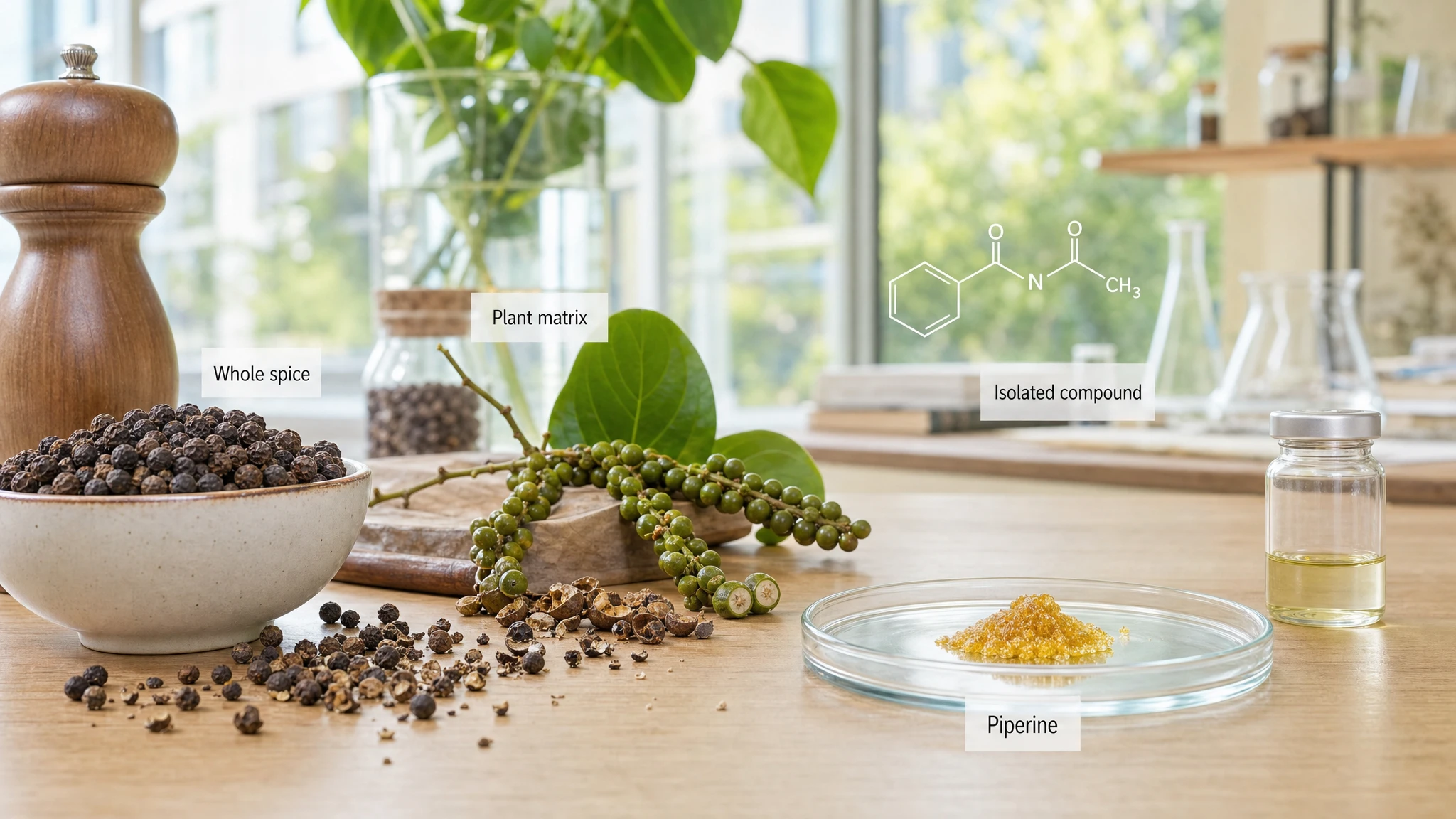
In common parlance, black pepper and piperine often seem to be the same thing, but they are not. Black pepper is a spice obtained from the dried fruit and contains many compounds. Piperine is the most well-known pungent molecule in its chemical profile. This difference clarifies the composition of pepper and its use in food. It also distinguishes a dose used in cooking from that present in a concentrated product.
In practice, saying that black pepper and piperine are the same is a major simplification. The former is a food with structure, aroma, and various components. The latter is a specific bioactive, meaning a compound that acts within the body. It can be studied and measured, or included in a standardized extract, which is a product with a defined quantity.
To properly understand the topic, it is useful to start from a few key points:
- The whole spice contains a complex mixture of different substances.
- An isolated active ingredient is a single molecule, chosen for study.
- The food matrix changes the context in which the compound is consumed.
- Standardization fixes the quantity in extracts, but not in ground pepper.
The following three steps explain, one by one, the differences between a spice, a food matrix, and a technical product.
Why black pepper is not the same as piperine
Black pepper is a complete spice; the pungent molecule is only one of the most studied components. The composition of pepper includes many substances, all present within the same food matrix. Reducing everything to a single molecule does not accurately describe either the food or its common use. The distinction also matters when discussing spices and nutraceuticals. Nutraceuticals are products derived from substances found in foods. Science, in fact, distinguishes the food from the individual compound.
Reviews indicate that the spice contains between 2% and 7.4% piperine. The molecule is therefore present, but it does not make up the entire profile of the spice [1]. Other syntheses identify it as the main bioactive compound and explain why isolating it helps in studying its properties [2] [3]. Studies also distinguish between pepper, extract, and pure compound, because these forms are related but different. Many data points, in fact, concern purified substances, not the whole spice consumed at the table [4] [5] [6].
What changes between a food matrix and an isolated active ingredient
The food matrix includes all the components present within the same food. An isolated active ingredient, on the other hand, is a substance that has been separated and concentrated. It is used for research or as part of a product. This separation allows the molecule to be observed in a more defined and controlled context. In black pepper, this difference matters, because a whole food does not act like a pure molecule. The available quantity, stability, and the context in which the compound is consumed all change.
A review describes piperine as a naturally isolated alkaloid. An alkaloid is a plant-based compound that contains nitrogen. The paper examines its biological and pharmacological properties in this specific form [7]. Another study examines the compound as a formulation ingredient, thus included in standardized products [8]. However, the data must be interpreted with caution. Results regarding the pure bioactive substance do not automatically apply to the spice. The quantity actually changes depending on the preparation, the dose used, and the type of food [9].
Why black pepper in cooking is not equivalent to a supplement
Black pepper used as a condiment and a piperine supplement follow different logics. In the first case, the dose is part of a meal and varies without being standardized. In the second, the product is prepared to provide a defined amount of the active compound. Therefore, the same word cannot refer to both a culinary use and a technical formulation in the same way.
Analyses of black pepper show that the molecule can be measured in food. However, the value changes depending on the method used and the type of sample [10]. Under controlled conditions, some studies have detected activity on human sensory receptors. These proteins detect stimuli. The effect appears at 37.9 μM, with a variation of approximately 1.9, in samples consisting of 5-9 units per concentration [11]. However, laboratory and safety studies set a clear limit. A substance tested in a laboratory or in a formulation is not equivalent to pepper grated onto a dish [12] [13].
Recent research and updates
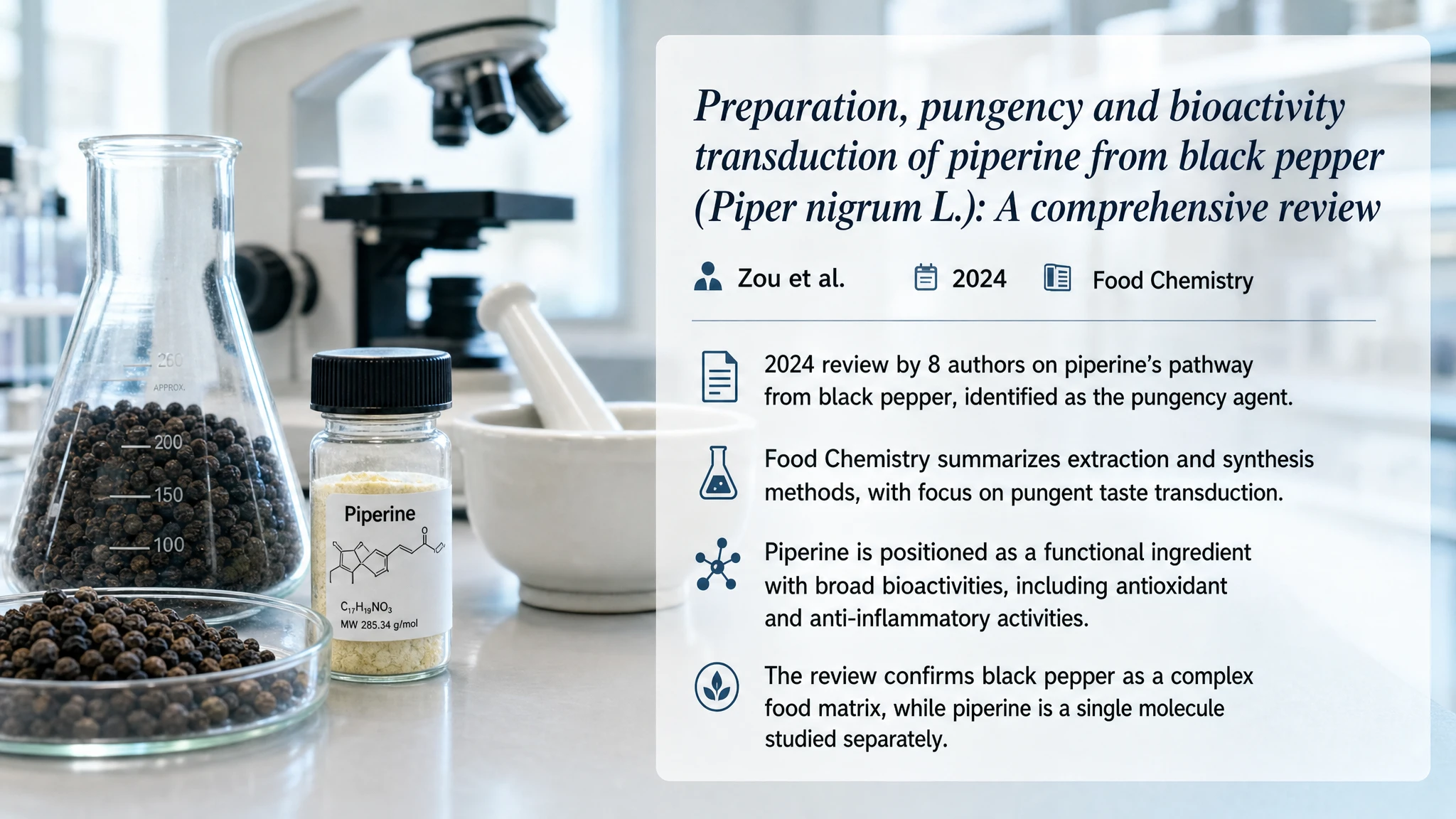
In 2024, Chinese researcher Ruixuan Zou and colleagues published an updated review in Food Chemistry. The work focuses on piperine, the molecule that gives black pepper its pungent taste. The authors explain how this bioactive (a substance with biological effects) is extracted and studied. Furthermore, they describe piperine as a functional ingredient and distinguish it from the whole spice. The review thus clarifies the relationship between black pepper, piperine, and concentrated products, avoiding confusion between the food and the isolated compound.
Preparation, pungency and bioactivity transduction of piperine from black pepper (Piper nigrum L.): A comprehensive review
- The 2024 review, authored by 8 researchers, traces the path of piperine from black pepper and identifies it as the cause of its pungency.
- Food Chemistry summarizes the methods used to extract and create piperine, with a focus on the perception of its pungent taste.
- The study describes piperine as a functional ingredient with various biological activities, including antioxidant and anti-inflammatory effects.
- The review confirms that black pepper is a complex food matrix, while piperine is a single molecule studied separately.
Why piperine is studied more than whole pepper
In biomedical research, ease of measurement helps create clear and repeatable studies. For this reason, an isolated compound attracts more interest than the whole spice. In the relationship between black pepper and piperine, studies often choose the molecule, which is easier to dose and compare. This does not mean, however, that laboratory data describe normal use at the table.
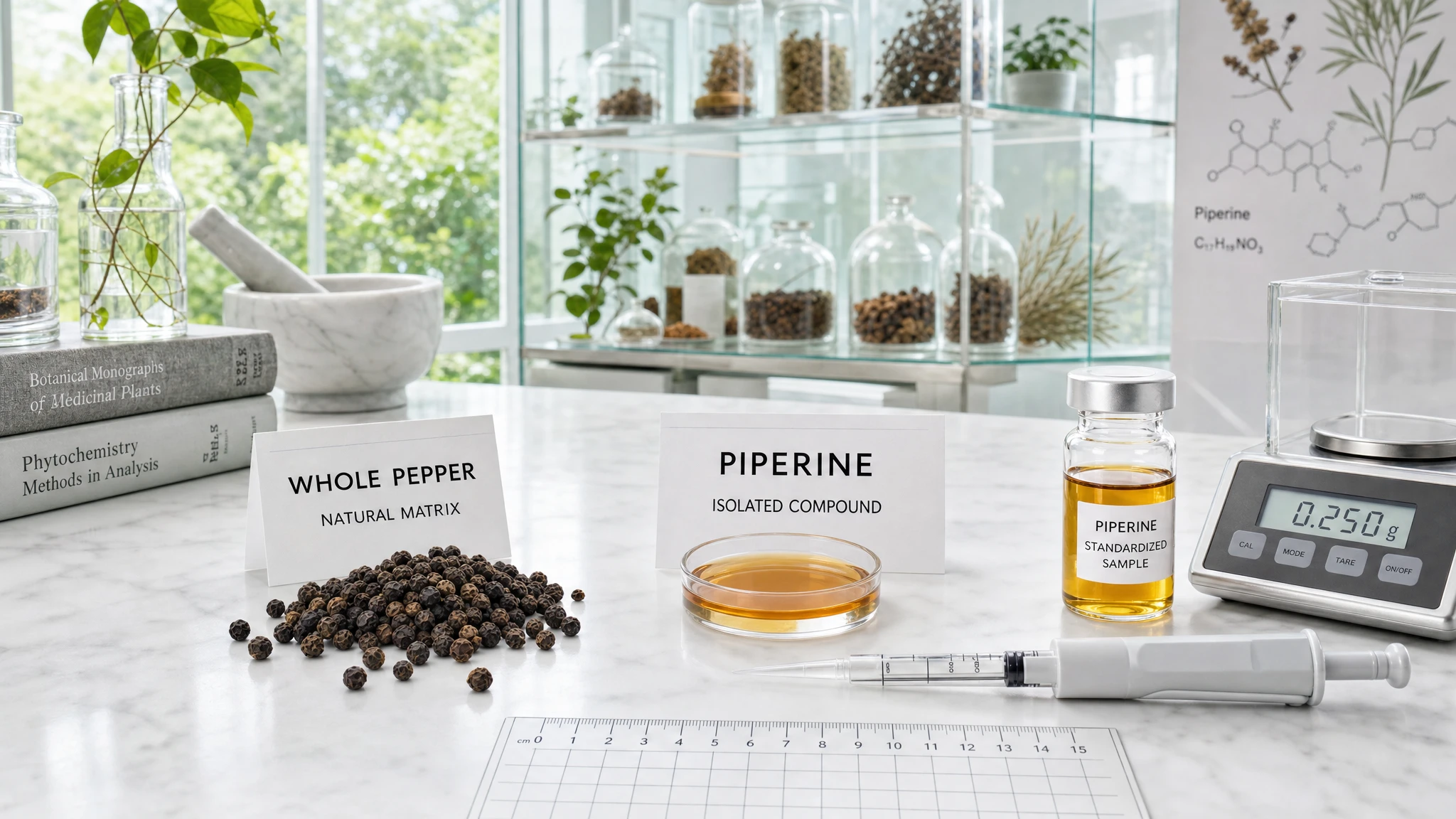
Piperine is studied more than whole pepper because an isolated molecule is easier to dose and compare. Researchers can use an isolated active ingredient—that is, separated from other compounds—in repeatable tests. This limits variations in the food matrix, the set of substances present in food. In the spice itself, the amount of piperine changes according to its origin, processing, and use. The compound facilitates biological study, but it remains far from a real diet.
To interpret these studies, three steps are needed: distinguish what is being measured from what is being eaten, understand how a standard product is created, and remember that a trial is not equivalent to a culinary dose.
This choice explains why many studies examine piperine instead of the black pepper used at the table. Research prefers what it can measure and keep stable. Real food requires more caution: the dose, use, and composition of the product can change the meaning of the results:
- The isolated compound allows for more precise measurements and clearer comparisons between studies.
- Standardization indicates the amount of the bioactive present in the product.
- The whole spice remains a complex mixture with a variable composition.
- The result of a trial does not directly describe dietary use.
When moving from research to practice, it is not just about what black pepper contains. It is also about how that content is measured. The following three topics explain why piperine dominates studies, what changes in a standard product, and why data on the isolated compound does not directly apply to the whole spice.
Why studies prefer piperine over the whole spice
Studies prefer piperine because a single compound is easier to define, dose, and reproduce under controlled conditions. A researcher can weigh the pure molecule with precision. They can then dissolve it in a known amount of liquid. This makes the dose identical in every trial. Each sample, therefore, starts from the same initial conditions. Whole pepper, on the other hand, does not offer this stability. Its composition varies from batch to batch. It changes according to the plant, the climate, and the processing. Even storage time affects the final content. Two samples of black pepper can contain different amounts of piperine. Sometimes the difference is small, other times it is marked. For a scientific study, this variability is a problem. It makes it difficult to compare one experiment with another. A result obtained with one batch might not be repeated with another. The isolated compound eliminates this obstacle. It allows the same test to be repeated in different laboratories, with the same expected result. This strengthens the reliability of scientific conclusions.
This is why pharmacological and biomedical literature often works with the isolated active ingredient, while whole pepper remains the dietary starting point.
How standardization changes the meaning of a product
Standardization changes the meaning of a product because it indicates how much piperine is actually present and makes it clearer what the reader is taking. In a standardized extract, the quantity of the declared component is known and therefore more comparable across batches, studies, and formulations. This value is set using precise laboratory analyses. Those reading the label thus know how much active ingredient they are actually receiving. The situation is different from pepper used as a spice. Here, the concentration depends on the composition of the starting material. It also depends on the production process used to obtain it. Two packages of black pepper, therefore, may contain different amounts of piperine. Without a standard measure, the actual content remains uncertain. For this reason, standardized supplements allow for a more reliable comparison between products and studies.
An analytical comparison between UV and HPLC in black pepper shows that quantification requires specific methods to reliably estimate the compound's content [14].
Why results on piperine should not be automatically extended to black pepper
The results do not apply directly to black pepper, because the dosage, absorption, product form, and method of use all change. The evidence helps us understand how a bioactive (a substance that has effects on the body) acts. However, it is not enough to describe the actual consumption of a spice or a nutraceutical (a product containing concentrated substances). Laboratory data therefore remains a simpler model of reality.
Preclinical studies have collected data on safety and tolerability through in vitro (on cells) and in vivo (on animals) tests. The doses reached up to the maximum tolerated dose [13]. These experimental doses often far exceed those of a common meal. Furthermore, in the oral cavity, the compound modulated the taste signal. This shows that the effect depends on a specific biological context, not just its presence [15]. The same compound, in another tissue, may behave differently. Absorption also changes depending on the form of the product taken. A standardized capsule does not behave like the spice on a plate. The limitation is clear: an isolated active ingredient is not equivalent to the whole spice, and the results do not translate directly to the daily diet.
How to recognize black pepper, extract, and piperine on the label
Reading the label helps you understand whether the product contains the spice, an extract, or an isolated active ingredient. These names indicate different products, especially when comparing foods and technical preparations. Here you will find useful signs to distinguish between ingredients, the declared quantity, and the composition of the pepper.
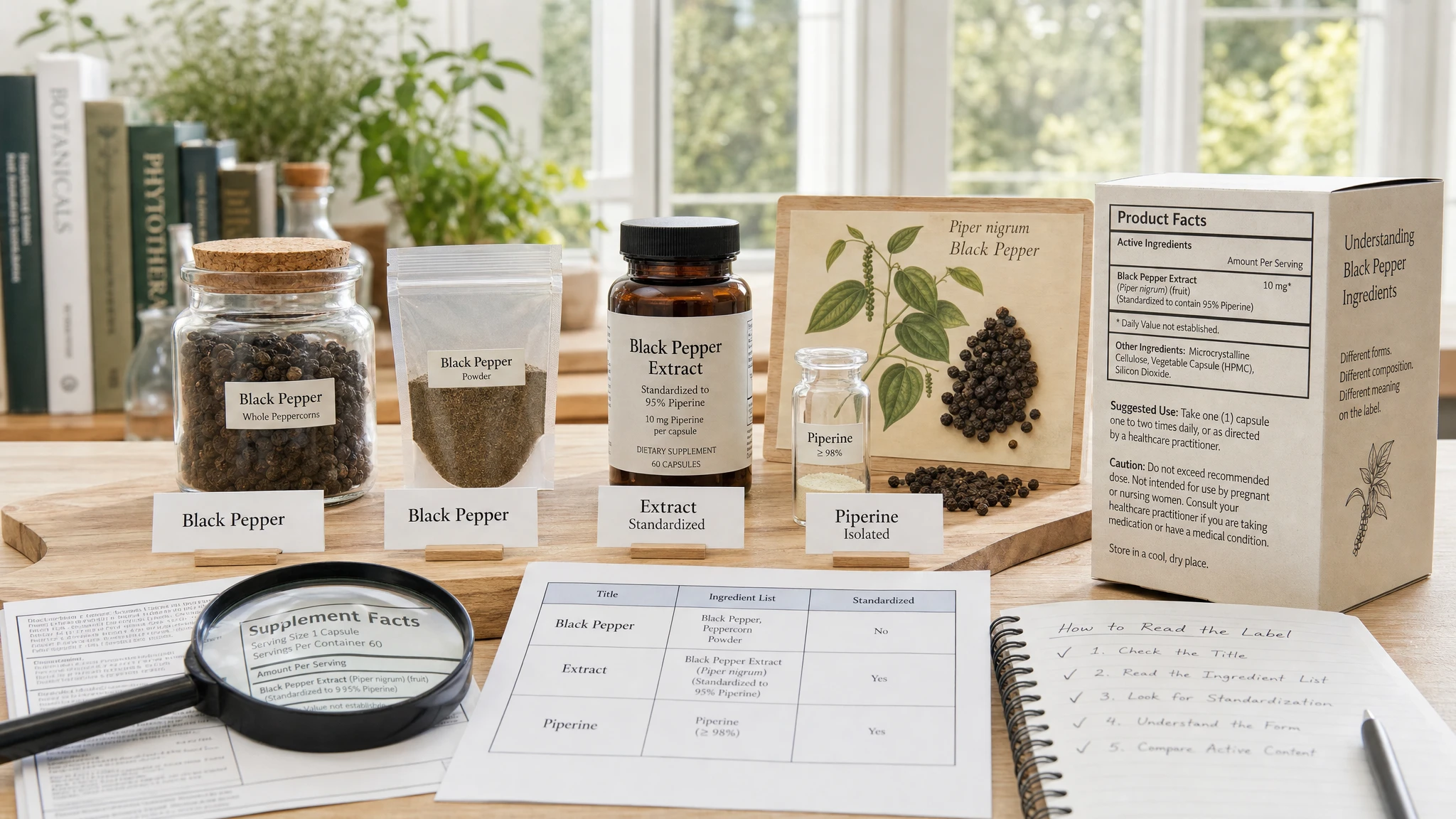
Packaging may use similar words for very different products. To understand what you are buying, it is best to read the name and the list of ingredients. A standardized extract is not the same as culinary black pepper. In fact, it contains a defined amount of certain substances.
In culinary pepper, however, what matters is its culinary use and the food matrix, i.e., the set of components of the spice. This distinction is particularly useful for capsules, technical powders, and nutraceutical formulations.
This check does not judge the product, but helps to understand its real function. Spices, extracts, and concentrated ingredients follow different logics regarding composition and formulation. Reading the label therefore avoids misunderstandings between foods and nutraceuticals. It also clarifies whether you are buying a spice or a more targeted preparation.
To find your way around, you need to check the trade name, the piperine indicated separately, and any standardization. The titration indicates the declared amount of a specific compound. These signs help you read the label:
- Recognize when the label indicates culinary black pepper.
- Distinguish an extract from a spice for culinary use.
- Understand if piperine is an isolated active ingredient.
- Correctly interpret titration, standardization, and technical wording.
To read the packaging well, it is best to start with three clues: name, list of ingredients, and technical terms. These data show whether the product contains black pepper, an extract, or piperine indicated separately.
How to tell if a label contains black pepper or extract
The first thing to look at is the name on the packaging. If black pepper appears, it usually refers to the spice intended for culinary use. The whole or ground spice contains hundreds of compounds that work together. If, on the other hand, black pepper extract appears, the product has been obtained by concentrating certain components of the spice. An extraction process selects and enriches specific molecules, such as piperine. The result is a preparation with a different composition than the original spice.
This difference is important because it changes the relationship between culinary use and technical formulation. An extract can have a much higher concentration of piperine than peppercorns. For this reason, it is often found in capsules or supplements, not in the spice aisle. The practical limitation is that the trade name alone is not enough: it should always be read in conjunction with the ingredient list and the form of sale. Only then can you understand whether the product is intended for cooking or for targeted support.
What standardized piperine means on the packaging
The term standardized piperine indicates that the compound's content has been made predictable and controlled. In nature, the amount of piperine in black pepper can vary significantly. It depends on the plant variety, the climate, and the cultivation method. With standardization, the manufacturer declares a defined quantity of isolated active ingredient. They no longer rely on the natural variability of the spice, but instead guarantee a constant value in every batch.
This information is especially useful for non-food over-the-counter products. In these cases, it is important to know how much bioactive substance is present per dose. It allows for the comparison of different products and for following the provided instructions. The limitation is precisely this: standardized does not mean "the same as culinary pepper." Instead, it means a "defined and verifiable content" of a single molecule. The complex matrix of the spice, with its essential oils and other alkaloids, is not replicated.
Which terms signal a product different from culinary pepper
There are some words that immediately point toward a technical product rather than a table spice. Terms like standardized, extract, or formulation indicate that the content has been designed to have precise characteristics. The term “standardized,” for example, specifies the exact percentage of a compound guaranteed in the product. Capsules, tablets, and powders packaged as supplements also suggest a use different from a normal culinary dose. A broad review on black pepper and piperine describes the compound as a pungent and bioactive constituent, but placed in a context of use much wider than simple cooking [16].
The point to remember is that these labels help distinguish between spices and nutraceuticals. They signal a product designed for a specific goal, not for flavoring dishes. However, they do not explain the final quality of the product on their own. For this reason, the label must be read in conjunction with ingredients, pharmaceutical form, and indication for use. Only the combination of these elements offers a complete picture and avoids misunderstandings.
What to expect from black pepper in the daily diet
In a daily diet, black pepper is primarily a spice, not a measured source of an active ingredient. Its composition changes based on the amount used and the dish. Its effects therefore depend on its culinary use, which is quite different from that of spices and nutraceutical extracts with defined dosages.

In a daily diet, black pepper is part of a food matrix (the combination of foods in a meal). It is therefore found alongside fats, salt, proteins, and other flavorings, which form a complex whole.
In practice, it primarily offers flavor and spiciness, along with variable amounts of bioactive compounds (substances that act within the body). It does not, however, provide a precise and constant dose like a standardized product (with a defined content).
In a home routine, therefore, black pepper should be viewed as a spice with a variable composition. It is not equivalent to a standardized extract (a product with defined doses) or an isolated active ingredient (a single active substance).
This distinction helps in having realistic expectations. Pepper can make meals more enjoyable and varied. Its contribution, however, always changes based on the amount, the meal, and how it is used.
To understand what changes in practical use, it is useful to evaluate three concrete aspects:
- The amount used at the table, which can vary significantly.
- The conditions under which pepper remains a simple condiment.
- The boundary between food use and nutraceutical use with defined dosages.
In everyday use, the quantity, type of meal, and method of use are what matter most. The following two aspects show when black pepper remains a seasoning and when it becomes a formulation with a defined dose.
How the quantity used at the table matters
The amount of black pepper used at the table matters, but in a different way compared to the quantity of a standardized product. In daily cooking, the seasoning is added to taste, so actual exposure varies greatly from person to person and from recipe to recipe. A sprinkle on a plate of pasta may weigh less than half a gram. A spicier preparation, however, can reach a few grams per serving. This variability makes it impossible to predict a fixed intake of piperine, its main bioactive compound.
Institutional sources remind us that spices and herbs add flavor to food without being presented as equivalents to single isolated molecules [17]. This makes it of little use to compare culinary pepper with a precise dose of piperine. Even if habitual consumption may be constant, its practical value remains that of a secondary ingredient, not a controlled source of a bioactive compound. The quantity used at the table, therefore, defines the boundary between a simple aromatic touch and a more significant contribution to the diet.
When black pepper remains just a seasoning
Black pepper remains a simple seasoning when used in the quantities typical of cooking and within common meals. In these cases, its primary purpose is to enhance flavor, not to act as a standardized functional product. The scenario changes when using extracts with a guaranteed percentage of piperine, often at 95% or more. In such an extract, the dose is calculated and constant. In freshly ground pepper, however, the piperine content can fluctuate between 2% and 9% depending on the variety and freshness.
This distinction is useful for maintaining correct expectations: black pepper can enrich the diet from a sensory perspective, but it should not be interpreted as a household equivalent of a concentrated extract. The gap between a seasoning and a technical formulation is primarily a difference in context. At the table, pepper remains an ally of flavor, not a dosed source of an active ingredient.
Summary of scientific evidence
This summary brings together the most representative sources of the list. It includes reviews, analyses, and experimental studies that help distinguish the spice from the isolated compound.
| Publication year | Area studied | What the studies indicate |
|---|---|---|
| 2005 | Piperine activity on human receptors | the isolated molecule produced measurable effects under controlled experimental conditions [11] |
| 2017 | General review on piperine and formulations | the data consistently describe piperine as the main bioactive substance and the subject of isolated formulations [3] |
| 2019 | Systematic review on black pepper | the evidence clearly distinguishes the traditional spice from the pharmacological uses of its main compound [5] |
| 2021 | Black pepper composition and piperine content | studies indicate that black pepper contains a measurable amount of piperine, but is not synonymous with it [1] |
| 2022 | Analytical methods for piperine quantification | specific methods have been described to measure the compound and distinguish it within the food matrix [14] |
| 2024 | Review on extraction and bioactivity of piperine | the evidence indicates that piperine is a functional ingredient distinct from whole pepper [9] |
Editorial review of the evidence
In reading the studies collected here, I found a key point on which the sources agree. Black pepper is a complex food, whereas piperine is a specific molecule. For this reason, researchers can measure and study it more easily. The reviews and analytical studies I have examined confirm this distinction.
Experiments also show that the isolated compound can produce observable effects under controlled conditions. The literature therefore provides solid chemical foundations and methods. However, caution is needed when applying these results to the spice consumed on a daily basis.
The main limitations I encountered stem from the type of evidence available. Reviews and laboratory studies are more numerous than clinical trials on dietary consumption. Furthermore, many studies examine isolated piperine or specific formulations, not common black pepper. Dosages, study models, and measurement methods are not always consistent. Therefore, I believe the results still have partial practical value.
Conclusions and editorial summary
Black pepper and piperine belong to two different levels. The former is a complex spice, the latter an isolated molecule. Researchers can measure the latter with greater precision. This distinction helps in interpreting studies, labels, and data on various formulations.
It is not a matter of choosing between the spice and the compound, but of understanding their different nutritional and experimental value. Piperine is useful in research, while black pepper remains a dietary ingredient. Separating these levels helps to better evaluate the evidence without creating equivalences not supported by the literature. This method also opens the door to further studies on spices, bioactive substances, and foods.
Final critical note
The evidence I have analyzed clearly distinguishes the spice from the compound, but it does not explain every step from the laboratory to the table. Much of the data is derived from reviews, analyses, or experimental models. These data primarily describe piperine, not the effects of black pepper in a real-world diet.
Doubts remain regarding the effective dose, differences between products, and the role of the food matrix (the combination of food components). Labels also have limitations, as they do not explain the method of use and preparation on their own. Therefore, caution is needed when interpreting this information.
References
[1] Piperine: A review of its biological effects
[2] Determination and risk characterisation of bio-active piperine in black pepper and selected food containing black pepper consumed in Korea
[3] Piperine—The Bioactive Compound of Black Pepper: From Isolation to Medicinal Formulations
[5] A systematic review on black pepper (Piper nigrum L.): from folk uses to pharmacological applications
[8] Phytochemical and pharmacological attributes of piperine: A bioactive ingredient of black pepper
[9] Preparation, pungency and bioactivity transduction of piperine from black pepper (Piper nigrum L.): A comprehensive review
[10] Feasibility of rapid piperine quantification in whole and black pepper using near infrared spectroscopy and chemometrics
[11] Effects of piperine, the pungent component of black pepper, at the human vanilloid receptor (TRPV1)
[14] Comparison study of validation parameters and measurement uncertainty of rapid analytical methods for piperine in black pepper by ultraviolet spectroscopy and high-performance liquid chromatography
[16] Black Pepper and its Pungent Principle-Piperine: A Review of Diverse Physiological Effects
[17] Food and Nutrition
Editorial note
Artificial Intelligence was used solely as a tool to support editorial and documentary work. All content, interpretations, bibliographic citations and conclusions have been verified, reviewed and approved by the author, who assumes full scientific responsibility for them.
The manuscript was also subject to independent peer review prior to publication.
To ensure maximum transparency, the article's complete history — including the dates of submission, review, acceptance and publication, as well as information on the peer review process — is available on the dedicated Article History page.