


Cinnamomum cassia: composition, species, and plant part matter
In 2019, Chinese researcher Zhang and colleagues published a review in the journal Molecules dedicated to the traditional uses, phytochemical composition, experimental activities, and toxicological aspects of Cinnamomum cassia Presl, a botanical species commonly associated with cassia. The publication helps distinguish the plant's identity from the many preparations obtained from its bark, leaves, and twigs.
- Published 16/11/2026
- Updated 17/11/2026
- Article history
ABSTRACT : WHAT THE SCIENCE SAYS
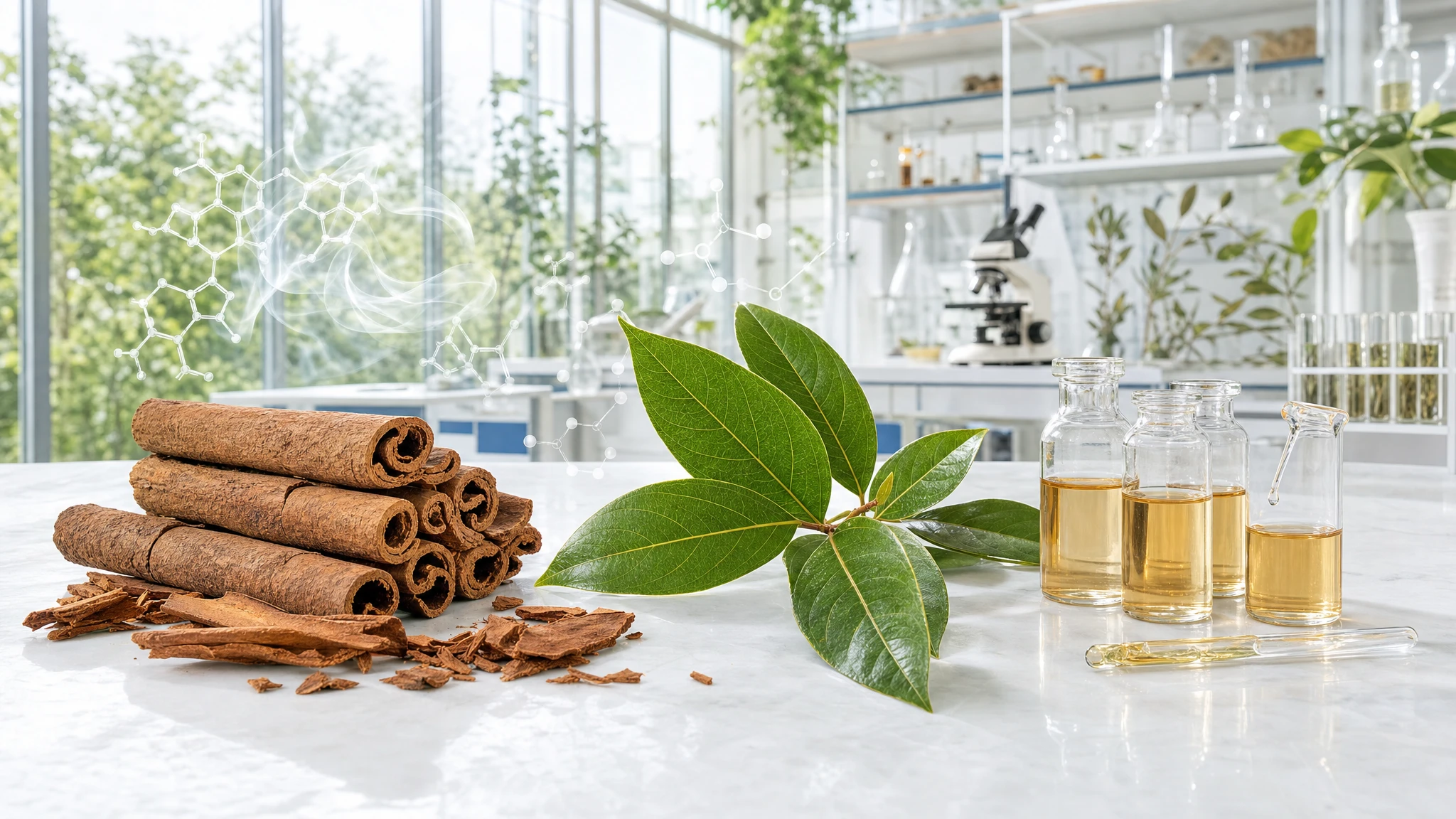
This publication examines Cinnamomum cassia, the species from which cassia is derived, gathering available knowledge on its traditional uses, identified substances, experimental activities, and safety. The most useful point for recognizing the spice is that its composition is complex and varies depending on the plant part analyzed.
The authors' summary describes Cinnamomum cassia as an aromatic tree of the Lauraceae family, used as a spice and in traditional medicine. It is a narrative review of the literature, not an experiment on people or a clinical trial. The authors report that over 160 compounds have been isolated and identified in the species. The main chemical families include terpenoids, phenylpropanoids, glycosides, lignans, and lactones. Simply put, cassia does not contain a single substance responsible for its aroma and biological characteristics: it is a natural mixture of many molecules. Among the phenylpropanoids, cinnamaldehyde is identified as the representative component of the plant; eugenol, cinnamic acid, cinnamaldehyde derivatives, and coumarin are also reported. The review also distinguishes between the bark, leaves, and twigs. This distinction is important because different parts of the same plant do not necessarily have the same chemical profile. The publication reports numerous pharmacological results obtained primarily in cells, animals, or with extracts. Such data may suggest biological hypotheses, but they do not demonstrate clinical benefits in humans. The authors themselves point out gaps regarding side effects, toxicology, and product standardization.
What this research analyzed
The 2019 study by Zhang and colleagues brought together publications on Cinnamomum cassia, an aromatic plant species of the Lauraceae family. For the reader, the initial message is simple: cassia is not a single isolated molecule, but a plant material whose composition depends on the species and the part harvested. The authors organized the substances reported in the literature into chemical groups and distinguished between bark, leaves, and twigs.
In detail, the review lists more than 160 components, including terpenoids (molecules often found in essential oils), phenylpropanoids (aromatic compounds derived from plant metabolism), glycosides, lignans, and lactones. Cinnamaldehyde is described as the representative compound; eugenol, cinnamyl acetate, and coumarin are also reported. The publication also considers traditional uses, experimental studies on biological activities, and toxicological data. The work does not claim to be a systematic literature review with reproducible selection criteria.
Research data
Cinnamomum cassia Presl: A Review of Its Traditional Uses, Phytochemistry, Pharmacology and Toxicology
- This is a narrative review: it does not enroll participants, test a dosage, or compare a treatment with a placebo.
- The authors report over 160 identified compounds, primarily belonging to terpenoids, phenylpropanoids, glycosides, lignans, and lactones.
- The review separates the compounds detected in the bark, leaves, and twigs and calls for the need for verification regarding safety and standardization.
What results emerge from the study
The most robust finding concerns the chemical variety of the species. In practical terms, a preparation obtained from the bark cannot automatically be considered equivalent to one obtained from the leaves or twigs. Zhang and colleagues report, for example, terpenes distributed across different plant parts and numerous phenylpropanoids present in different extracts.
The authors cite data in which cinnamaldehyde and cis-2-methoxycinnamic acid accounted for 42.37% and 43.06%, respectively, of a specific bark oil. These values describe that specific sample and analytical method, not a universal composition of cassia. The review also reports studies on inflammation, metabolism, microorganisms, tumor cells, and the nervous system. However, most of these results come from cellular models, animal studies, or laboratory tests. They indicate activities observed under experimental conditions, not proven therapeutic efficacy in humans.
Why this study is relevant
To understand the differences between products sold as cinnamon, the review's main contribution is linking the botanical name to the chemical matrix. This avoids treating cassia, Ceylon cinnamon, essential oil, extract, and powder as necessarily interchangeable materials. Composition is the upstream factor: it influences aroma, quality control methods, and the interpretation of biological studies.
This approach is also relevant for reading research on health effects with caution. If the species, plant part, extraction solvent, and concentration change, the molecules actually present in the studied product also change. Consequently, a result obtained with a cassia extract cannot be applied to culinary cinnamon or a product from another species without verification. The work therefore provides a descriptive basis, not clinical proof of benefit.
Study limitations and what it does NOT demonstrate
As a narrative review, the 2019 study by Zhang and colleagues gathers many sources but does not provide a single quantitative estimate of the effect of cassia, nor does it offer a systematic assessment of the risk of bias for the included studies. There are no available participants, follow-up durations, comparable dosages, hazard ratios, or other aggregated clinical indicators, because this is not a human trial or a meta-analysis.
The number of identified compounds does not prove that all of them are present in every commercial product, nor that they act together within the body. Similarly, the fact that a molecule shows an effect in a test tube does not demonstrate a clinical effect following dietary consumption. The review does not establish which preparation is preferable, what quantity is safe for everyone, or whether traditional uses are effective for a specific condition. The authors specifically point to toxicology, side effects, and standardization as areas that remain incomplete.
Independent confirmatory evidence
The thesis that different species of the Cinnamomum genus possess distinguishable chemical profiles is supported by Wang and colleagues. The experimental study examined 14 products attributed to four species using high-performance liquid chromatography with high-resolution mass spectrometry, a technique that separates and identifies molecules in a mixture. After verifying the botanical identity, the profiles of C. cassia, C. verum, C. burmannii, and C. loureiroi were found to be separable using multivariate analysis. Coumarin, cinnamaldehyde, and proanthocyanidins varied between species [1]. This is direct confirmation of the need to identify the material, but it concerns a limited number of products, and several identifications remained provisional.
Wu and colleagues specifically compared the bark of C. cassia and C. verum using metabolomics and statistical analysis. The two groups showed a clear separation; cinnamtannin B1, procyanidin B2, norboldine, and norisoboldine emerged as the most informative markers [2]. This supports the species → chemical profile transition, with direct confirmation but without measuring clinical outcomes. Rana and colleagues, in an experimental analysis of four species, also achieved a separation of samples using physical-functional parameters and chemometric analysis; the first three principal components explained 81.70% of the variability [3]. The confirmation is convergent, but the models classify the analyzed samples and do not replace the botanical identification of each package.
Conflicting evidence
The available evidence does not deny the differences between species, but it shows that the chemical profile is not fixed even within C. cassia. Huang and colleagues analyzed nine leaf samples from different areas. The essential oil yield varied from 0.51% to 1.34%; five markers, including trans-cinnamaldehyde, acetophenone, and camphor, distinguished the samples [4]. This limits the idea that a single composition value can represent the entire species.
A second study by Huang and colleagues compared bark oil and leaf oil from the same cassia, obtaining yields of 1.56% ± 0.02 and 0.83% ± 0.01, respectively, across three determinations. 45 compounds were identified in the bark oil and 50 in the leaf oil; the main aromatic contributions did not fully coincide [5]. This is a contextual discrepancy, linked to the plant part and the extraction method, not a refutation of the review. No sufficiently relevant directly conflicting evidence was identified; this does not prove the absence of contrary results.
Comparative overview
The following studies test, clarify, or contextualize the idea that species, plant part, and origin influence the composition of cassia.
| Publication | Model and main data | Relationship with the Zhang study | Key limitation |
|---|---|---|---|
| Wang et al., 2020 [1] | 14 products from four species; 36 characterized metabolites and profile separation | Direct confirmation of chemical differences between species | Limited commercial products; many chemical assignments were tentative |
| Wu et al., 2021 [2] | Cassia and Ceylon bark; metabolomics with discriminant markers | Direct confirmation of the different profile between cassia and Ceylon | Does not evaluate safety, efficacy, or global commercial variability |
| Rana et al., 2021 [3] | Four species; physical-functional analysis and statistical classification | Indirect confirmation of the distinguishability of plant materials | Indicators are not as specific as a complete metabolomic profile |
| Huang et al., 2024 [4] | Nine cassia leaf samples; oil yield between 0.51% and 1.34% | Contextualizes variability within the same species | Studies leaves, not necessarily commercial bark |
| Huang et al., 2025 [5] | Bark and leaf oils; 45 and 50 compounds identified | Contextualizes the role of the plant part | Analysis based on a specific origin and essential oils |
Editorial conclusion
The 2019 review by Zhang and colleagues describes Cinnamomum cassia as a botanical species with a broad and variable composition. The fact that over 160 compounds have been identified helps explain why it is incorrect to reduce cassia solely to cinnamaldehyde. Terpenoids, phenylpropanoids, glycosides, lignans, and other constituents form a complex matrix, distributed differently between the bark, leaves, and twigs. Independent publications confirm that cassia and other Cinnamomum species can be distinguished using chemical and statistical techniques. However, they also highlight a point of caution: origin, plant part, and extraction method alter the detected profile. The experimental results reported in the review are not equivalent to clinical evidence of efficacy in humans. The most useful lesson is therefore botanical and methodological: before interpreting the properties or safety of a cinnamon product, it is necessary to know which species it contains, which plant part was used, and how it was prepared.
References
[1] Metabolomic profiling and comparison of major cinnamon species using UHPLC–HRMS
[2] Comprehensive feature‐based molecular networking and metabolomics approaches to reveal the differences components in Cinnamomum cassia and Cinnamomum verum
[3] Discrimination of Four Cinnamomum Species with Physico-Functional Properties and Chemometric Techniques: Application of PCA and MDA Models
[4] Assessing essential oil composition in Cinnamomum cassia leaves from different regions of China using GC-MS and FTIR spectroscopy
[5] Compounds of Essential Oils from Different Parts of Cinnamomum cassia and the Perception Mechanism of Their Characteristic Flavors
Editorial note
Artificial Intelligence was used solely as a tool to support editorial and documentary work. All content, interpretations, bibliographic citations and conclusions have been verified, reviewed and approved by the author, who assumes full scientific responsibility for them.
The manuscript was also subject to independent peer review prior to publication.
To ensure maximum transparency, the article's complete history — including the dates of submission, review, acceptance and publication, as well as information on the peer review process — is available on the dedicated Article History page.