


Cinnamon in diabetes studies: why species and product change the interpretation
In 2024, Turkish researcher Methiye Mancak and colleagues, in the Turkish Journal of Medical Sciences, analyzed the botanical identity, chemical composition, activity on diabetes-related enzymes, and potential safety aspects of seven commercial cinnamon-derived products. The work demonstrates why the declared species, product form, and analytical controls are inseparable elements when interpreting experimental results.
- Published 19/10/2026
- Updated 21/10/2026
- Reviewed 21/10/2026
- Article history
ABSTRACT : WHAT THE SCIENCE SAYS
Research has compared seven cinnamon products sold in different forms. It verified the botanical species, chemical components, and in vitro activity on enzymes linked to carbohydrate digestion. The central point is simple: an effect measured in the laboratory does not guarantee either clinical efficacy or product safety.
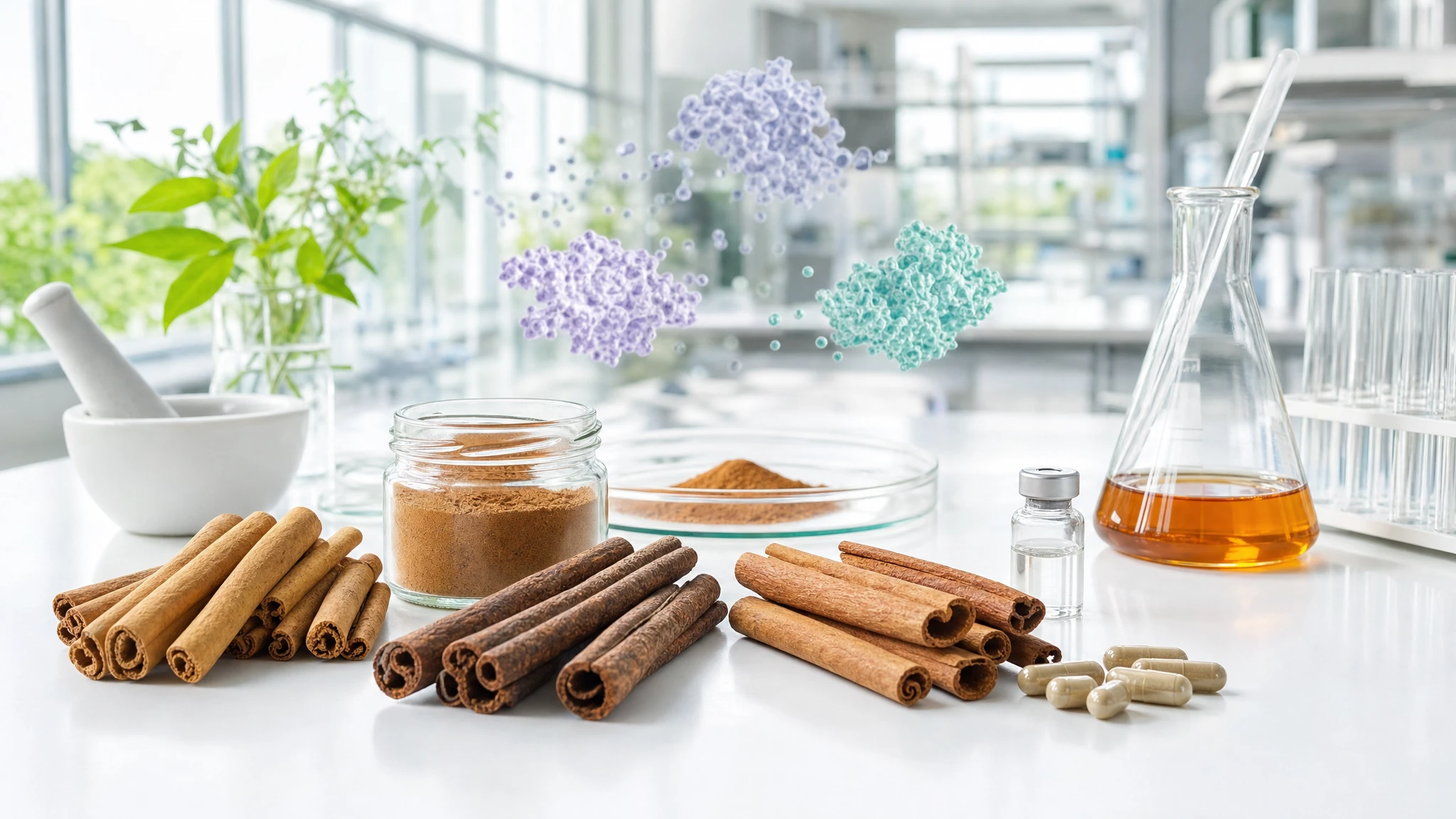
The publication by Mancak and colleagues studied commercial cinnamon samples, including sticks, tea bags, and capsules. The authors first observed the appearance of the products and then evaluated some of their compounds using chromatographic techniques, which are methods that separate and measure the substances present in a mixture. Finally, they verified in vitro whether the extracts hindered α-amylase, α-glucosidase, and aldose reductase, enzymes involved respectively in the digestion of starches, the release of glucose, and some processes associated with diabetes complications. All samples showed some activity on the enzymes, but the composition proved to be highly variable. In the extracts of different species, trans-cinnamaldehyde varied from 7.73 to 333.69 mg/g and coumarin reached up to 43.73 mg/g. Some cassia sticks, Cinnamomum burmannii, and Cinnamomum loureiroi contained high amounts of coumarin. A preparation purchased at an herbalist's shop showed enzymatic activity even without the sought-after cinnamon markers. The research therefore points to a problem of product identification and control, not a demonstration of therapeutic benefit in people.
What this research analyzed
For a person with type 2 diabetes, the practical implication is that two products labeled "cinnamon" can be very different. Mancak and colleagues (2024) did not test a therapy in humans. They conducted an in vitro experimental study, meaning it was performed on extracts and laboratory systems.
The authors examined seven commercial products obtained from Cinnamomum verum, Cinnamomum cassia, Cinnamomum burmannii, and Cinnamomum loureiroi. They used macroscopic and chromatographic analyses to identify material characteristics and measure trans-cinnamaldehyde, coumarin, and o-methoxycinnamaldehyde. They then tested the inhibition of three enzymes. Reducing the activity of α-amylase and α-glucosidase in a test tube may slow the release of sugars from starches in vitro; however, it does not prove that glycemia is reduced in the human body.
Research data
Are cinnamon derivatives effective and safe for diabetes?
- Experimental in vitro study on seven commercial products: sticks, infusion bags, and capsules.
- The extracts inhibited α-amylase, α-glucosidase, and aldose reductase, enzymes involved in carbohydrate metabolism.
- Trans-cinnamaldehyde varied from 7.73 to 333.69 mg/g; coumarin reached 43.73 mg/g in some samples.
What results emerge from the study
The results suggest that biological activity and composition do not always coincide. All samples showed inhibition of the studied enzymes, with varying performance between aqueous extracts, decoctions, and ethanolic extracts. Ethanol made certain components and enzymatic activity more evident, but this reflects the extraction method and not the effect of a beverage or capsule taken by a person.
Trans-cinnamaldehyde, the characteristic aromatic substance in cinnamon, was detected at levels between 7.73 and 333.69 mg/g. Coumarin, a natural compound that can pose safety concerns at high exposure levels, reached up to 43.73 mg/g. The highest levels were observed in some sticks of C. cassia, C. burmannii, and C. loureiroi. An herbal preparation inhibited the enzymes but did not show the main markers being sought: a signal compatible with an as-yet-unidentified composition, not proof of efficacy.
Why this study is relevant
The primary relevance concerns the quality of the product. Before discussing potential metabolic effects, it is necessary to know which species was used, which part of the plant the preparation contains, and which substances are actually present. This information is essential because clinical studies use powders, extracts, and capsules that are not always equivalent.
Research also combines two aspects that are often kept separate: in vitro activity and safety. A sample may interfere with an enzyme while simultaneously containing amounts of coumarin that require caution. Therefore, it is not correct to use laboratory data as proof that a commercial product is suitable for managing type 2 diabetes.
Study limitations and what it does NOT demonstrate
This work does not measure glycated hemoglobin, glycemia, complications, or adverse events in people. It is not a randomized clinical trial and does not allow for the establishment of effective doses, duration of use, or an individual benefit-risk ratio. Enzyme inhibition is an initial mechanistic clue, not a clinical outcome.
The seven samples represent only a small portion of the available products. Furthermore, the composition can change between batches, suppliers, harvests, and storage conditions. The coumarin values describe the analyzed samples and not all cinnamon on the market. The 2024 study by Mancak and colleagues does not even demonstrate that a product lacking the measured markers is adulterated: it signals a composition that requires further verification.
Independent confirming evidence
Evidence in humans primarily confirms the need to distinguish between formulations and contexts, rather than the efficacy of the individual samples analyzed by Mancak. A meta-analysis of 24 randomized trials found average reductions in fasting glycemia, insulin resistance, and glycated hemoglobin compared to controls [1]. This supports the hypothesis that certain preparations may modify metabolic markers, but the heterogeneity between products and studies limits any conclusion applicable to all cinnamon.
In a trial involving people with prediabetes, 54 participants were assigned to either cinnamon or a placebo for 12 weeks. The difference in fasting glycemia between groups was 5 mg/dL, and no serious adverse events emerged [2]. The result supports the plausibility of an effect in a specific formulation, but it does not verify the species, purity, or safety of the commercial products studied by Mancak.
Another randomized study included 109 adults with type 2 diabetes; 89 completed 90 days. In the cinnamon group, glycated hemoglobin decreased by 0.83 percentage points, compared to 0.37 in the control group, with a fairly evident difference between groups [3]. This is a limited clinical confirmation, because the model does not make all available formulations equivalent and does not resolve the standardization problem highlighted in the original work.
Conflicting evidence
Results are not uniform. In a controlled study of 25 postmenopausal women with type 2 diabetes, 1.5 g/day of C. cassia for six weeks did not improve insulin sensitivity, glucose tolerance, or lipid profile compared to placebo [4]. The small sample size and short duration limit generalizability, but they suggest a possible dependence on population, dose, and product.
A meta-analysis of five randomized trials, totaling 282 participants, also found no significant changes in glycated hemoglobin, fasting glycemia, or lipids [5]. This synthesis reinforces the need for caution: effects observed in test tubes or in certain trials are not automatically reproducible. No directly conflicting evidence sufficiently relevant to the chemical characterization of the seven samples was identified; this does not prove the absence of contrary results.
Comparative overview
The following publications help place experimental results within the framework of available evidence in humans.
| Publication | Model and sample size | Main result | Relation to the Mancak study |
|---|---|---|---|
| Moridpour et al., 2024 [1] | Meta-analysis of 24 randomized trials | Average reductions in fasting glycemia, insulin resistance, and glycated hemoglobin | Indirect confirmation of clinical plausibility, with high variability between preparations |
| Romeo et al., 2020 [2] | Randomized trial, 54 people with prediabetes | More stable fasting glycemia and better glucose tolerance | Indirect confirmation for a specific formulation |
| Crawford, 2009 [3] | Controlled trial, 109 adults; 89 completions | Greater reduction in glycated hemoglobin in the cinnamon group | Indirect confirmation, without resolving botanical identity and standardization |
| Vanschoonbeek et al., 2006 [4] | Controlled trial, 25 women with type 2 diabetes | No improvement in insulin sensitivity or glucose tolerance | Discordant result, consistent with context-dependent effects |
| Baker et al., 2008 [5] | Meta-analysis of five trials, 282 participants | No significant change in main glycemic or lipid markers | Discordant result that reinforces interpretive caution |
Editorial conclusion
The 2024 publication by Mancak and colleagues does not evaluate cinnamon as a treatment in patients, but it demonstrates an essential step before any clinical interpretation: knowing precisely what the studied product contains. In the seven samples analyzed, the botanical species, commercial form, trans-cinnamaldehyde, coumarin, and activity on enzymes related to carbohydrate digestion varied significantly. The activity observed in vitro makes an interaction with certain metabolic processes biologically plausible, but it does not equate to a reduction in glycemia or diabetes complications. The trials and syntheses available in humans offer mixed results: some suggest improvements in glycemic markers, while others detect no differences compared to the control. This inconsistency is consistent with different products, doses, species, durations, and populations. The most solid message is therefore methodological: the word "cinnamon" does not automatically identify a comparable preparation or a defined safety profile. No cinnamon product replaces prescribed therapies or clinical monitoring for diabetes.
References
[1] The effect of cinnamon supplementation on glycemic control in patients with type 2 diabetes mellitus: An updated systematic review and dose‐response meta‐analysis of randomized controlled trials
[2] Influence of Cinnamon on Glycemic Control in Individuals With Prediabetes: A Randomized Controlled Trial
[3] Effectiveness of Cinnamon for Lowering Hemoglobin A1C in Patients with Type 2 Diabetes: A Randomized, Controlled Trial
[4] Cinnamon Supplementation Does Not Improve Glycemic Control in Postmenopausal Type 2 Diabetes Patients
Editorial note
Artificial Intelligence was used solely as a tool to support editorial and documentary work. All content, interpretations, bibliographic citations and conclusions have been verified, reviewed and approved by the author, who assumes full scientific responsibility for them.
The manuscript was also subject to independent peer review prior to publication.
To ensure maximum transparency, the article's complete history — including the dates of submission, review, acceptance and publication, as well as information on the peer review process — is available on the dedicated Article History page.