


Curcugen® curcumin extract in knee osteoarthritis: clinical results
In 2021, Australian researcher Lopresti and colleagues, writing in the journal Nutrients, evaluated whether a standardized curcumin extract called Curcugen® could reduce pain and improve certain aspects of physical function in adults with knee osteoarthritis. The research compared the formula with a placebo for eight weeks under controlled conditions. Study DOI
- Published 17/11/2026
- Updated 19/11/2026
- Article history
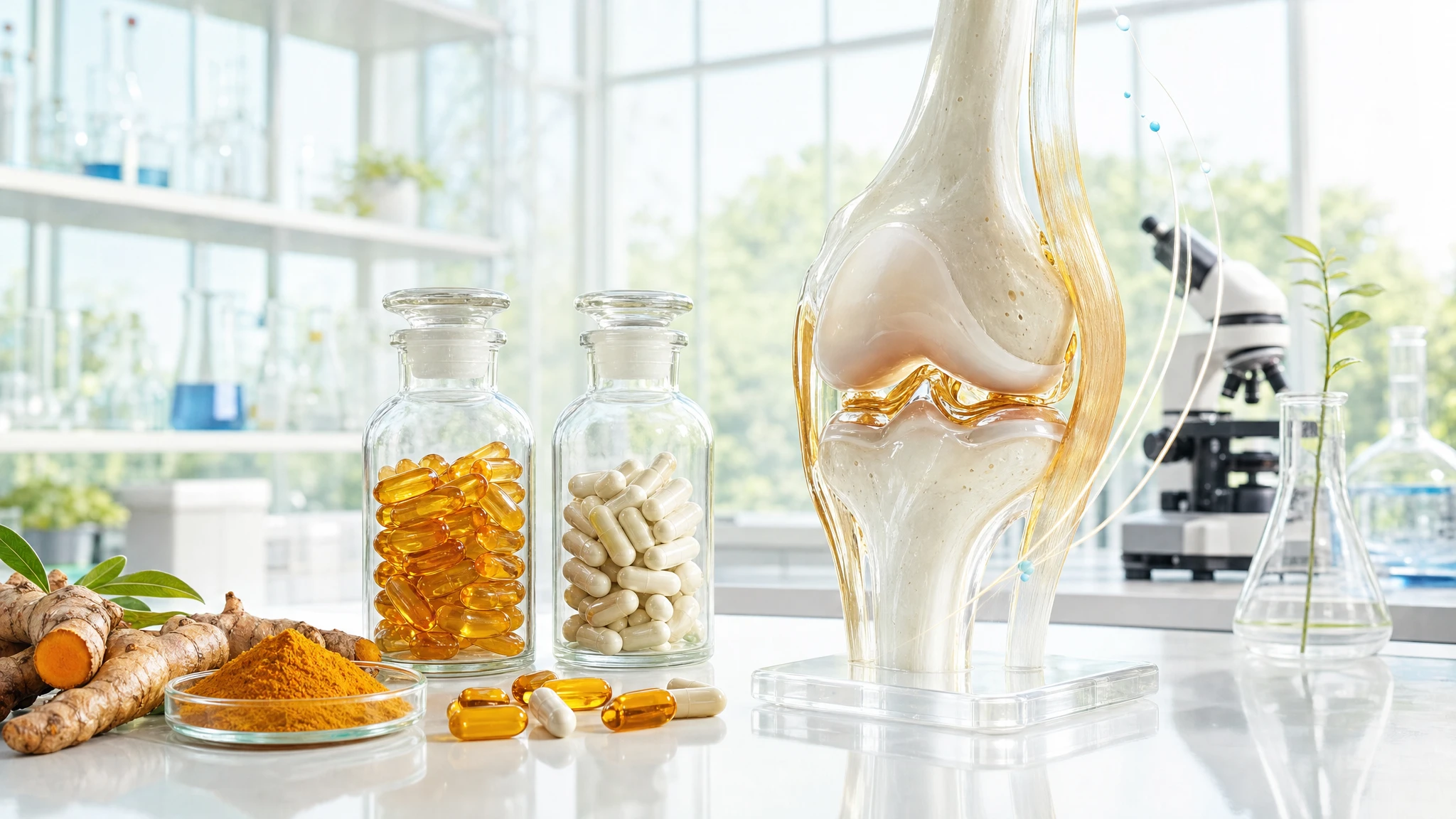
ABSTRACT : WHAT THE SCIENCE SAYS
A controlled clinical study examined a standardized curcumin extract in adults with knee osteoarthritis. After eight weeks, the treated group reported greater pain improvement compared to the placebo group. The data refer to this specific formula, dosage, and duration, not to turmeric used as a spice.
The publication by Lopresti and colleagues evaluated 101 adults with knee osteoarthritis in a randomized, double-blind, placebo-controlled trial. For eight weeks, participants took 500 mg twice daily of Curcugen®, a dispersible extract composed of 50% curcuminoids, or placebo capsules. The primary outcome was pain measured using KOOS, a patient-reported scale that assesses symptoms and the impact of knee problems. The average improvement in the pain score was 11.98 points with the extract and 5.52 with the placebo; the difference between groups was 6.47 points, with a 95% confidence interval from 0.18 to 12.75 and P=0.009. Greater improvements also emerged in numerical pain scores, overall orthopedic assessment, and two functional tests. However, no significant differences were found for stiffness, daily activities, sports, quality of life, chair stand test, or fast walking. Therefore, it cannot be concluded that the extract alters the progression of osteoarthritis or replaces treatments prescribed by a physician.
What this research analyzed
Knee osteoarthritis is a joint condition in which pain, stiffness, and reduced mobility can limit daily activities. Lopresti and colleagues investigated whether a concentrated curcumin formulation could primarily affect symptoms, rather than cartilage reconstruction.
The study design was a randomized, double-blind, placebo-controlled clinical trial: procedures useful for reducing the influence of expectations from both participants and researchers. For eight weeks, 101 people between 45 and 70 years old with knee pain and a clinical diagnosis of osteoarthritis received 500 mg of Curcugen® twice daily or a placebo. Each active capsule contained a 50% extract of curcuminoids, which are bioactive pigments found in turmeric.
The primary outcome was the pain domain of the KOOS, a scale that describes the impact of knee disorders according to the patient. Numerical pain ratings, the Japanese Orthopaedic Association score, quality of life, analgesic use, and practical movement tests were also evaluated. This allows for distinguishing the perception of pain from measured physical capacity.
Research data
An Investigation into the Effects of a Curcumin Extract (Curcugen®) on Osteoarthritis Pain of the Knee: A Randomised, Double-Blind, Placebo-Controlled Study
- Randomized, double-blind, placebo-controlled study: 101 adults took 500 mg twice daily for 8 weeks.
- KOOS pain scores improved by 11.98 points with Curcugen® and by 5.52 with placebo; difference of 6.47 points, P=0.009.
- Timed Up and Go and six-minute walk tests also improved; not all functional or quality-of-life measures showed a significant difference.
What results emerge from the study
The clearest result concerns the pain reported by the participants. After eight weeks, the KOOS pain score increased by 11.98 points in the Curcugen® group and by 5.52 in the placebo group. The mean difference between the groups was 6.47 points, with a 95% confidence interval from 0.18 to 12.75 and P=0.009. In simple terms, the improvement observed was greater with the extract, but the precision of the estimate remains limited.
Pain assessed on a numerical scale also decreased more with Curcugen® compared to the placebo, with P=0.001. The JOA score, a clinical assessment that considers pain during walking and on stairs, joint movement, and effusion, improved more in the active group; the standardized effect size was 0.74. Favorable results were also observed in the timed up-and-go test and the six-minute walk test.
The picture was not uniform. There were no significant differences for stiffness, daily activities, sports, quality of life, chair stand test, and the 40-meter fast walk. The adverse events reported were not serious and occurred in 5 people in the Curcugen® group and in 10 in the placebo group. These data describe short-term tolerability, not long-term safety.
Why this study is relevant
This research is useful because it evaluates an identifiable product, a defined dose, and a comparison with a placebo. Therefore, it does not allow for the generic transformation of dietary turmeric into a treatment for osteoarthritis: a spice contains variable amounts of curcuminoids and does not correspond to the formula used in the study.
The work combines patient-reported measures and functional tests. This is important because a reduction in perceived pain may not always coincide with a change in every physical activity. Here, some mobility indicators showed an advantage, while others did not; the result suggests a possible limited symptomatic benefit, not a general effect on all dimensions of the disease.
The presence of similar results in other small clinical studies makes the narrative biologically and clinically plausible, but the formulations are different. Consequently, the available evidence primarily supports the hypothesis of symptom relief with certain oral extracts, without demonstrating that all turmeric-based products have the same effect.
Study limitations and what it does NOT demonstrate
The study lasted only eight weeks and was conducted at a single center. It does not establish whether the effect persists, increases, or decreases over time. Furthermore, it does not measure long-term clinical events, such as the need for injections, surgical interventions, or the radiological progression of osteoarthritis.
The sample was relatively small and included adults with specific characteristics: significant pain, age between 45 and 70, and a body mass index between 20 and 35. The results may therefore not be transferable to people with more severe disease, different ages, multiple comorbidities, or different therapies.
Funding and the supply of the capsules were provided by the manufacturer; additionally, one co-author worked for the company. The company did not collect or interpret the data according to the authors' statements, but these ties require caution when interpreting the findings. The work does not demonstrate an effect on cartilage, joint inflammation, or the underlying cause of osteoarthritis.
Independent confirmatory evidence
A small, double-blind, randomized study by Panahi and colleagues supported the same core claim: certain curcuminoids may improve pain and function in knee osteoarthritis. It involved 40 people with mild-to-moderate disease over six weeks; 19 received 1,500 mg of curcuminoids per day, and 21 received a placebo. The WOMAC score, the visual analog scale for pain, and the Lequesne functional index improved more in the active group. The relationship with the study by Lopresti and colleagues is direct in terms of symptoms, but the confirmation remains moderate-to-low due to the small sample size and the different formula [1].
Madhu and colleagues examined a Curcuma longa extract free of curcuminoids in 120 people, comparing it with a placebo, glucosamine, and a combination over 42 days. The main result indicated improvements in pain and function as assessed by the visual analog scale and WOMAC. This suggests that different components of the plant can be studied in standardized preparations, but it does not confirm that they act like Curcugen®; the correspondence is therefore indirect [2].
A systematic review with meta-analysis of eight randomized studies found average reductions in pain compared to placebo on both the visual analog scale and the WOMAC. The overall signal is consistent with possible symptomatic relief, but the authors themselves highlighted small sample sizes, heterogeneous products, and insufficient quality for definitive conclusions. This is convergent confirmation, not validation of a specific brand or dose [3].
Conflicting evidence
A randomized study by Wang and colleagues on 70 people with knee osteoarthritis and synovitis-effusion found an improvement in pain with a Curcuma longa extract after 12 weeks, but did not detect significant changes in the volume of synovitis-effusion on MRI or in cartilage composition. This finding does not contradict the possibility of symptomatic relief, but it contrasts with the idea that the benefit regarding pain demonstrates a structural change in the disease [4].
A 2026 critical review evaluated seven systematic reviews on the use of curcuminoids in knee osteoarthritis. While acknowledging a potential benefit and good short-term tolerability, it classified most of the 48 outcome assessments as evidence of very low or extremely low quality. The discrepancy therefore concerns the degree of certainty: positive signals do not yet equate to solid and generalizable clinical proof [5].
Comparative overview
The following research allows for a comparison of the pain signal observed in the study by Lopresti and colleagues with different formulas, samples, and objectives.
| Publication | Design and model | Main result | Relationship with the reference study |
|---|---|---|---|
| Panahi et al., 2014 [1] | Double-blind RCT; 40 adults with knee osteoarthritis | Better pain and function with curcuminoids compared to placebo | Direct confirmation on symptoms; small sample and different dosage |
| Madhu et al., 2013 [2] | Single-blind RCT; 120 people with painful osteoarthritis | Improvements in pain and function with a Curcuma longa extract | Indirect confirmation: extract free of curcuminoids and multiple comparisons |
| Daily et al., 2016 [3] | Systematic review and meta-analysis of 8 RCTs | Aggregated reduction in pain compared to placebo | Convergent confirmation, limited by heterogeneity and small studies |
| Wang et al., 2020 [4] | Double-blind RCT; 70 people with synovitis-effusion | Better pain, no effect on synovitis-effusion or cartilage | Delimits the result: symptoms do not equate to structural modification |
| Chen et al., 2026 [5] | Critical review of 7 systematic reviews | Potential benefit, but quality of evidence often very low | Reduces the certainty and generalizability of the conclusions |
Editorial conclusion
The study by Lopresti and colleagues indicates that eight weeks of Curcugen® at a dose of 500 mg twice daily was associated with greater improvement in knee pain compared to a placebo in adults with osteoarthritis. Some functional outcomes were favorable, but not all measures showed differences. This means that the observed signal primarily concerns symptomatic relief in the short term, not joint healing. Other studies and a meta-analysis find consistent results regarding pain, but they use different extracts, doses, durations, and scales. A trial using magnetic resonance imaging did not detect changes in synovitis-effusion or cartilage, while a recent critical evaluation deems the overall body of evidence still uncertain. The most accurate interpretation is therefore cautious: a specific formulation may have a potential complementary role in managing symptoms, but it is not proven to alter the course of osteoarthritis, nor is it equivalent to culinary turmeric.
References
[1] Curcuminoid Treatment for Knee Osteoarthritis: A Randomized Double‐Blind Placebo‐Controlled Trial
[2] Safety and efficacy of Curcuma longa extract in the treatment of painful knee osteoarthritis: a randomized placebo-controlled trial
[3] Efficacy of Turmeric Extracts and Curcumin for Alleviating the Symptoms of Joint Arthritis: A Systematic Review and Meta-Analysis of Randomized Clinical Trials
[4] Effectiveness of Curcuma longa Extract for the Treatment of Symptoms and Effusion–Synovitis of Knee Osteoarthritis
[5] A critical review of systematic reviews and meta-analyses of curcumin for knee osteoarthritis
Editorial note
Artificial Intelligence was used solely as a tool to support editorial and documentary work. All content, interpretations, bibliographic citations and conclusions have been verified, reviewed and approved by the author, who assumes full scientific responsibility for them.
The manuscript was also subject to independent peer review prior to publication.
To ensure maximum transparency, the article's complete history — including the dates of submission, review, acceptance and publication, as well as information on the peer review process — is available on the dedicated Article History page.