


Fiber during pelvic radiotherapy: a study on intestinal toxicity
In 2017, British researcher Wedlake and colleagues, in The American Journal of Clinical Nutrition, evaluated whether dietary advice for a low, habitual, or high intake of fiber could modify gastrointestinal disorders in people undergoing curative pelvic radiotherapy. The study compared symptoms during treatment and at a one-year follow-up, without isolating a specific food source or a single fiber.
- Published 19/11/2026
- Updated 24/11/2026
- Article history
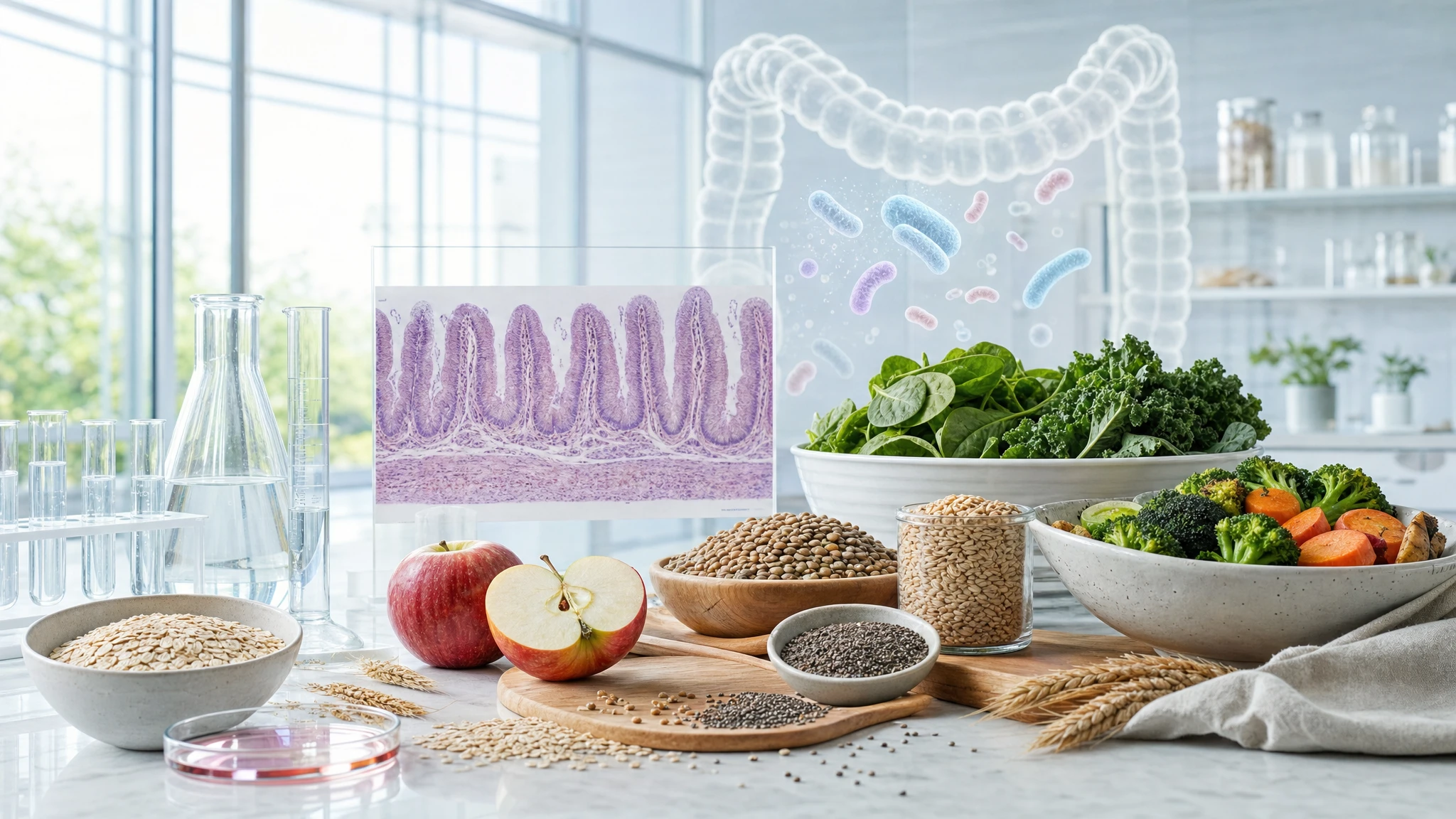
ABSTRACT : WHAT THE SCIENCE SAYS
A randomized clinical trial compared three dietary recommendations for people undergoing pelvic radiotherapy. The group encouraged to increase fiber intake reported less worsening of intestinal symptoms at the end of treatment and after one year compared to the group following their usual diet. The primary outcome, however, did not reach statistical significance.
The authors' summary describes a controlled human study conducted during curative-intent radiotherapy for pelvic tumors. Participants received personalized advice to follow a low-fiber, usual, or high-fiber diet. Fiber was measured as non-starch polysaccharides, i.e., plant carbohydrates other than starch that largely resist digestion in the small intestine. The primary objective was to compare the maximum worsening of intestinal symptoms during treatment, measured using the IBDQ-B scale, a section of a questionnaire dedicated to bowel function and quality of life. This primary comparison showed no statistically significant difference between the groups. However, at the conclusion of radiotherapy, the high-fiber intake group had a lower average worsening compared to the group on their usual diet. The difference remained observable even after one year among those who provided follow-up data. No significant differences emerged in stool frequency or consistency, nor in fecal concentrations of short-chain fatty acids. The work therefore suggests a possible benefit of advice to increase fiber in this context, but does not identify which fiber or which food is responsible for it.
What this research analyzed
Pelvic radiotherapy can irritate the intestinal tissues near the treated area. This can result in diarrhea, fecal urgency, pain, or changes in daily life. Wedlake and colleagues investigated whether modifying dietary fiber intake during treatment could alleviate this deterioration, rather than assuming that reducing it was always beneficial.
This was a randomized clinical trial, a type of study in which participants are assigned to groups using a random procedure to reduce systematic initial differences. The 166 assigned individuals received individual advice for a low-fiber diet, with up to 10 g of NSP per day; a habitual diet; or a high-fiber diet, with at least 18 g of NSP per day. The primary analysis included 161 people. The cancers were gynecological or of the lower gastrointestinal tract, and the radiotherapy could be associated with chemotherapy.
The primary outcome was the change in IBDQ-B from the baseline value to the worst value during treatment. A lower score indicates, in practical terms, a greater impact of intestinal symptoms. The researchers also recorded dietary intake, stool diaries, and short-chain fatty acids in the stool, which are molecules also produced by the bacterial fermentation of certain fibers. The design therefore measures the effect of overall dietary advice, not that of a single food matrix.
Research data
Randomized controlled trial of dietary fiber for the prevention of radiation-induced gastrointestinal toxicity during pelvic radiotherapy
- 166 people were assigned to receive advice for ≤10 g, habitual intake, or ≥18 g per day of NSP.
- The primary outcome, the maximum worsening of the IBDQ-B during treatment, was not significant between groups: P=0.093.
- At the end of radiotherapy and at one year, the high-intake group showed better average bowel scores compared to the habitual group.
What results emerge from the study
In practice, the increase in fiber did not produce a clear signal regarding the worst moment of symptoms during radiotherapy, which was the established primary outcome. The comparison between groups for this measure yielded P=0.093. A P-value above the conventional threshold of 0.05 means that this study does not allow us to exclude with sufficient certainty that the observed difference is compatible with random variability.
The picture was different at the end of treatment. The IBDQ-B score decreased on average by 3.7 points in the high-fiber intake group and by 10.8 points in the habitual intake group; the difference between these two changes was statistically significant, with P=0.011. At one year, among 126 people evaluated, the average change was +0.1 in the high-intake group and −8.4 in the habitual group, with P=0.004. This indicates that intestinal symptoms were, on average, less compromised in participants who had received advice to increase fiber.
Conversely, no significant differences emerged in the frequency of bowel movements, stool consistency, or fecal concentrations of short-chain fatty acids. In the low-fiber and habitual-fiber groups, significant reductions in energy, protein, and fat intake were observed; this suggests that the dietary intervention may have also influenced the overall quality of the diet. Therefore, the result does not prove that a single fiber component explains the observed benefit.
Why this study is relevant
The most useful finding for the reader is that, in this study, recommending a diet rich in fiber did not show a worsening of intestinal symptoms compared to the usual diet. On the contrary, some outcomes measured at the end of radiotherapy and at the follow-up check were more favorable in the high-intake group. This challenges the generalized idea that reducing fiber is automatically the best choice during any pelvic radiotherapy.
The scientific relevance stems primarily from the experimental design and the presence of a control group following their usual diet. Furthermore, the researchers verified that fiber intake actually differed between the groups during treatment, with P<0.001. However, the result concerns a nutritional counseling strategy—that is, personalized advice provided by professionals—rather than a universal prescription of supplements or specific foods.
The study is only indirectly linked to the topic of food structure. Fiber-rich foods provide diverse mixtures of plant components, water, and nutrients. However, Wedlake and colleagues did not compare whole foods with isolated fibers and did not measure the food matrix. Therefore, it is not correct to use these data as direct evidence that a particular food structure prevents radiation toxicity.
Study limitations and what it does NOT demonstrate
The main limitation is methodological: the primary outcome was not statistically significant. The favorable results at the end of treatment and at one year are important, but they should be interpreted as secondary or additional outcomes rather than the primary measure. This reduces the certainty with which one can conclude that increasing dietary fiber prevents intestinal toxicity in all people undergoing pelvic radiotherapy.
The comparison was not blinded: participants and professionals were aware of the dietary advice received. Symptoms were partly patient-reported, so expectations and adherence could have influenced the responses. The one-year follow-up included 126 people, fewer than the 166 initially assigned. Furthermore, the types of tumors treated, radiotherapy techniques, and any concurrent chemotherapy can alter the risk of intestinal disorders.
The study does not demonstrate that all fibers are equivalent, nor that 18 g of NSP per day is appropriate for every patient. It does not identify an optimal individual dose, does not prove a mechanism based on short-chain fatty acids, and does not replace oncological or nutritional assessment. In the presence of stenosis, malabsorption, severe symptoms, or other complications, nutrition requires personalized clinical management.
Independent confirmatory evidence
A small randomized study by Murphy and colleagues supported the most immediate step in the clinical chain: a gelling fiber can reduce diarrhea during pelvic irradiation. Sixty people with pelvic tumors were assigned to either psyllium or no intervention. The psyllium group experienced a lower incidence and severity of diarrhea, with P=0.049 and P=0.030, respectively [1]. The model is human and the outcome is relevant, but it was a pilot study, not blinded, using a symptom scale developed by the authors; it therefore represents direct confirmation but of a limited level.
In a double-blind trial by Itoh and colleagues, 20 people with cervical cancer received hydrolyzed rice bran or a placebo during chemoradiotherapy. Diarrheal symptoms and bowel disturbance scores tended to be more favorable with the intervention [2]. This supports the hypothesis that certain cereal-derived substrates may be compatible with better intestinal tolerance during treatment. However, the very small sample size and the specific context of cervical chemoradiotherapy make this confirmation preliminary and not directly comparable to the overall diet evaluated by Wedlake.
A Cochrane review included four studies on modifications to fiber intake during pelvic radiotherapy. For a high-fiber diet, the analysis reported an improvement in gastrointestinal symptoms and quality of life at one year, but with low-certainty evidence [3]. This summary confirms that the signal observed by Wedlake is consistent with the body of available studies; at the same time, it clarifies that the empirical basis remains small, heterogeneous, and insufficient for significant conclusions.
Conflicting evidence
A multicenter trial by Forslund and colleagues examined a nutritional intervention involving fiber and lactose in people with prostate cancer undergoing radiotherapy. The effect on acute and late bowel symptoms was small and inconclusive up to 24 months [4]. This does not directly contradict Wedlake, because the intervention combined multiple dietary changes, involved a different population, and did not test the same NSP target. However, it shows that the benefit may depend on the type of cancer, the treatment, the composition of the intervention, and how outcomes are measured.
A systematic review focused on people with gynecological cancers included four studies, for a total of 89 participants, and judged the certainty of evidence regarding fiber modifications to be very low [5]. It noted some favorable signals regarding diarrhea and bowel symptoms, but highlighted the risk of bias, imprecision, inconsistency, and indirectness. Compared to the Wedlake study, this assessment does not propose a clear opposite result: rather, it scales back the degree of confirmation and the transferability to clinical practice.
Overall, the conflicting evidence suggests caution. No sufficiently relevant directly conflicting evidence has been identified that demonstrates worsening caused by high fiber intake within the same dietary regimen; this does not prove the absence of contrary results. Larger studies are needed, with comparable dietary protocols and separate evaluations by fiber type, dose, tumor site, and radiotherapy technique.
Comparative overview
The following publications help place the results of the study by Wedlake and colleagues within the context of available evidence.
| Publication | Design and population | Main result | Relationship to the study |
|---|---|---|---|
| Murphy et al., 2000 [1] | Randomized pilot trial, 60 people undergoing pelvic radiotherapy | Psyllium reduced the incidence and severity of diarrhea. | Direct confirmation, but with a small sample and different intervention. |
| Itoh et al., 2015 [2] | Double-blind randomized trial, 20 people with cervical cancer | Favorable signals regarding intestinal symptoms with hydrolyzed rice bran. | Preliminary confirmation in chemoradiotherapy and with a specific fiber. |
| Lawrie et al., 2018 [3] | Cochrane review of 92 trials; four studies on fiber | Possible benefit of a high-fiber diet, with low certainty. | Confirms the signal, but highlights overall uncertainty. |
| Forslund et al., 2020 [4] | Multicenter randomized trial in people with prostate cancer | Small and inconclusive effect on intestinal symptoms. | Indicates dependence on context and combined intervention. |
| Croisier et al., 2021 [5] | Systematic review of four studies, 89 participants | Possible benefits, but evidence judged to be of very low certainty. | Downsizes generalizability without denying the observed signal. |
Editorial conclusion
References
[1] Testing control of radiationinduced diarrhea with a psyllium bulking agent: A pilot study
[2] A Randomized, Double-Blind Pilot Trial of Hydrolyzed Rice Bran versus Placebo for Radioprotective Effect on Acute Gastroenteritis Secondary to Chemoradiotherapy in Patients with Cervical Cancer
[3] Interventions to reduce acute and late adverse gastrointestinal effects of pelvic radiotherapy for primary pelvic cancers
[4] Effects of a nutrition intervention on acute and late bowel symptoms and health-related quality of life up to 24 months post radiotherapy in patients with prostate cancer: a multicentre randomised controlled trial
Editorial note
Artificial Intelligence was used solely as a tool to support editorial and documentary work. All content, interpretations, bibliographic citations and conclusions have been verified, reviewed and approved by the author, who assumes full scientific responsibility for them.
The manuscript was also subject to independent peer review prior to publication.
To ensure maximum transparency, the article's complete history — including the dates of submission, review, acceptance and publication, as well as information on the peer review process — is available on the dedicated Article History page.