


Ginger in type 2 diabetes: a study on glycemia and HbA1c
In 2017, Iranian researcher Makhdoomi Arzati and colleagues, writing in the International Journal of Endocrinology and Metabolism, evaluated whether daily ginger supplementation could modify fasting glycemia, glycated hemoglobin, and lipid profile in adults with type 2 diabetes. The study compared ginger capsules and a placebo over ten weeks. Study DOI
- Published 24/11/2026
- Updated 25/11/2026
- Article history
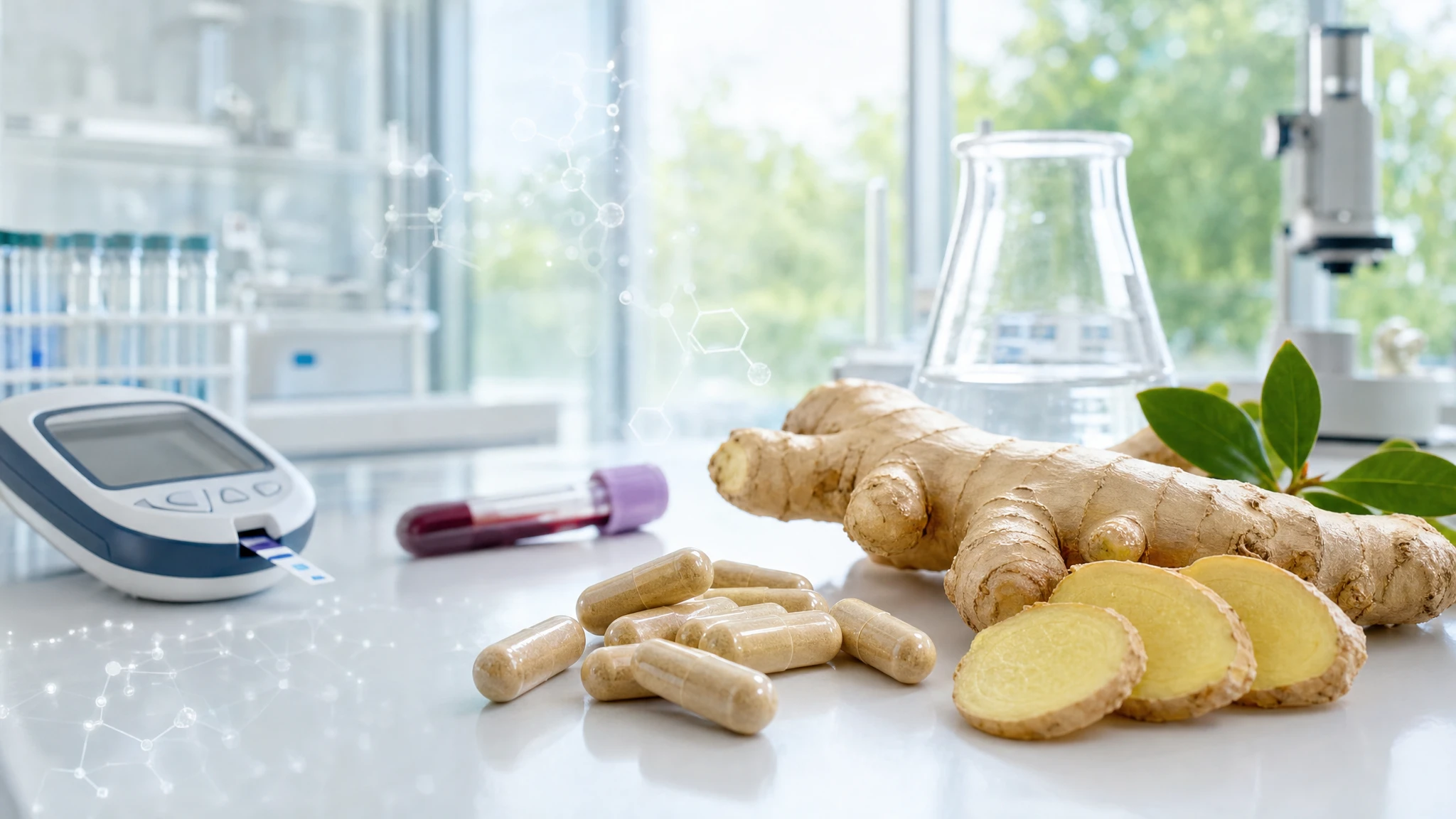
ABSTRACT : WHAT THE SCIENCE SAYS
A clinical study evaluated whether 2 grams of ginger per day, taken for ten weeks, could modify glycemia, glycated hemoglobin, and blood fats in people with type 2 diabetes. The results indicate a favorable signal for glycemia and HbA1c, but not for most lipids.
The authors' summary describes a randomized, double-blind, placebo-controlled study. In this type of research, random assignment reduces the risk that the groups are different from the start; double-blind means that neither participants nor researchers knew who was receiving ginger or the placebo. Fifty people with type 2 diabetes were assigned to either 2,000 mg of ginger daily in capsules or wheat flour capsules for ten weeks. At the end, data from 45 participants were analyzed. Compared to the placebo, the ginger group showed a greater reduction in fasting glycemia and HbA1c, which is the glycated hemoglobin that reflects average glucose exposure over the previous months. The mean changes were −26.30 versus +11.91 mg/dL for glycemia and −0.38 versus +0.22 percentage points for HbA1c, respectively. No significant differences emerged for triglycerides, total cholesterol, LDL cholesterol, or HDL cholesterol. The result supports the hypothesis of a possible short-term metabolic effect, but it does not prove that ginger prevents diabetes complications or replaces therapies and lifestyle changes.
What this research analyzed
For those living with type 2 diabetes, fasting glycemia and HbA1c describe different aspects of the same problem. The former captures blood glucose levels after fasting; the latter indicates average glucose exposure over time. The 2017 study by Makhdoomi Arzati and colleagues evaluated both parameters, along with triglycerides and cholesterol.
The researchers randomly assigned 25 people to ginger and 25 to a placebo. The intervention group took four 500 mg capsules daily, for a total of 2 g per day. Blood samples were taken after 12-14 hours of fasting, both before and after ten weeks. Diet, physical activity, weight, and blood pressure were also monitored. This approach allows for verifying whether the observed change is consistent with the intervention, while remaining limited by the short duration.
Research data
The Effects of Ginger on Fasting Blood Sugar, Hemoglobin A1c, and Lipid Profiles in Patients with Type 2 Diabetes
- 50 participants randomized; 45 completed the analysis: 23 in the ginger group and 22 in the placebo group.
- Intervention: 2,000 mg per day of ginger in capsules for 10 weeks, without changing usual therapies.
- The variation between groups favored ginger for fasting glycemia and HbA1c; major lipids did not change significantly.
What results emerge from the study
The most significant result is an average improvement in both glycemic indicators in the group taking ginger compared to the placebo group. Fasting glycemia changed by −26.30 ± 35.27 mg/dL with ginger and by +11.91 ± 38.58 mg/dL with placebo; the difference was statistically significant, with P = 0.001. Simply put, the treated group experienced a greater average reduction, although individual values were variable.
HbA1c also decreased more with ginger: −0.38 ± 0.35% compared to +0.22 ± 0.29% in the placebo group, with P < 0.0001. The LDL/HDL ratio, a comparison between higher and lower density cholesterol, also decreased. However, no significant differences emerged for triglycerides, total cholesterol, LDL, or HDL when considered individually. Therefore, the results do not show a uniform effect on the lipid profile.
Why this study is relevant
This research is relevant because it compares ginger with a placebo and observes an immediate parameter, glycemia, alongside a more stable indicator, HbA1c. The consistency between the two signals makes the hypothesis of a possible effect on glycemic control more interesting than a single isolated value.
The study also highlights a useful point for a forward-looking interpretation: the possible effect did not automatically extend to all cardiometabolic markers. For the patient, this means that a laboratory change does not in itself equate to fewer complications, better quality of life, or a reduction in medication. Longer and larger-scale data are needed.
Study limitations and what it does NOT demonstrate
The main limitation is the small sample size: only 45 people were included in the final analysis. With small numbers, an average difference can be more easily influenced by individual characteristics and may not represent all people with type 2 diabetes. Furthermore, ten weeks are not enough to establish whether the effect persists in the long term.
The study did not evaluate clinical events such as hospitalizations, cardiovascular complications, kidney damage, or the need to modify treatments. It also does not demonstrate that ginger acts through a precise biological mechanism, nor does it identify who responds best. The publication does not report detailed data on adverse events. Therefore, the results do not authorize the replacement of medications, personalized nutrition, physical activity, or clinical monitoring.
Independent confirming evidence
Another randomized, double-blind, placebo-controlled study evaluated 70 adults with type 2 diabetes for 12 weeks. With 1,600 mg of ginger daily, Arablou and colleagues observed significant improvements in fasting glycemia, HbA1c, insulin, and the HOMA index, an estimate of insulin resistance. This supports the shift from increased blood glucose availability to a possible modification of the insulin response, but it does not prove the cellular mechanism nor a long-term clinical benefit [1].
Two more recent statistical summaries aggregated placebo-controlled trials. Chen and colleagues included 13 studies and 837 participants, estimating an average reduction in fasting glycemia of 16.27 mg/dL and HbA1c of 0.41 percentage points; Li and colleagues reported results in the same direction. These analyses reinforce the consistency of the signal, but the intervals between studies were highly variable: the I² heterogeneity was greater than 85% for glycemia and HbA1c. The overall confirmation is therefore moderate for consistency, but low for certainty and generalizability [2][3].
Conflicting evidence
A systematic review with meta-analysis published in 2024 examined randomized trials in people with type 2 diabetes and found no statistically significant effect of ginger on either fasting glycemia or HbA1c. This conclusion contrasts with the signal from the Makhdoomi Arzati study and other syntheses, indicating that the estimate depends on the selection of studies, statistical methods, and the heterogeneity of the protocols [4].
A randomized trial in people with type 2 diabetes also measured the NF-kB factor, a protein involved in the activation of inflammatory signals. After oral ginger supplementation, its average reduction was not statistically significant; neither body mass index nor waist circumference changed significantly. This is an indirect discrepancy: it does not directly concern HbA1c, but it shows that any metabolic effects are not necessarily accompanied by measurable changes in all biological markers [5].
Comparative overview
Comparison between independent publications and the results of the 2017 study by Makhdoomi Arzati and colleagues.
| Publication | Modello e numerosità | Main result | Relationship to the study |
|---|---|---|---|
| Arablou et al., 2014 [1] | Double-blind RCT; 70 adults with type 2 diabetes | Significant reductions in glycemia, HbA1c, insulin, and HOMA compared to placebo | Direct confirmation of the glycemic signal |
| Chen et al., 2026 [2] | Meta-analysis of 13 RCTs; 837 participants | Mean reduction in glycemia and HbA1c, with high heterogeneity | Quantitative confirmation, with limited certainty |
| Li et al., 2026 [3] | Meta-analysis of 13 RCTs; 837 participants | Mean reductions in glycemia, HbA1c, and triglycerides | Confirmation of direction, not independent of included trials |
| Schumacher et al., 2024 [4] | Systematic review and meta-analysis of RCTs | No statistically significant effect on glycemia or HbA1c | Directly discordant evidence |
| Ebrahimzadeh Attari et al., 2019 [5] | Double-blind, placebo-controlled RCT; sample size not available in the consulted summary | No significant change in NF-kB, BMI, or waist circumference | Indirect discordance on related markers |
Editorial conclusion
The 2017 study by Makhdoomi Arzati and colleagues observed that 2 g of ginger daily for ten weeks was associated, compared to a placebo, with a greater reduction in fasting glycemia and HbA1c in 45 analyzed participants with type 2 diabetes. This finding is biologically and clinically interesting because it concerns both the current glycemic value and the average glucose exposure over time. However, the sample size was small, the observation period was short, and most lipid profile parameters did not improve significantly. Other trials and some meta-analysis studies show compatible results, but a recent review did not confirm a significant overall effect. The most rigorous interpretation is therefore as follows: ginger may have a complementary role in the metabolic control of some individuals, but the evidence remains heterogeneous and does not demonstrate benefits regarding complications. It is not an autonomous therapy and must not replace the clinical management of diabetes.
References
[1] The effect of ginger consumption on glycemic status, lipid profile and some inflammatory markers in patients with type 2 diabetes mellitus
[2] Meta-analysis of the effects of ginger supplementation on glycemic control, blood pressure and lipid profile in patients with type 2 diabetes
[3] A meta-analysis of the effects of Zingiber officinale on metabolic indices among patients with type 2 diabetes
[4] The effect of oral supplementation of ginger on glycemic control of patients with type 2 diabetes mellitus - A systematic review and meta-analysis
Editorial note
Artificial Intelligence was used solely as a tool to support editorial and documentary work. All content, interpretations, bibliographic citations and conclusions have been verified, reviewed and approved by the author, who assumes full scientific responsibility for them.
The manuscript was also subject to independent peer review prior to publication.
To ensure maximum transparency, the article's complete history — including the dates of submission, review, acceptance and publication, as well as information on the peer review process — is available on the dedicated Article History page.