
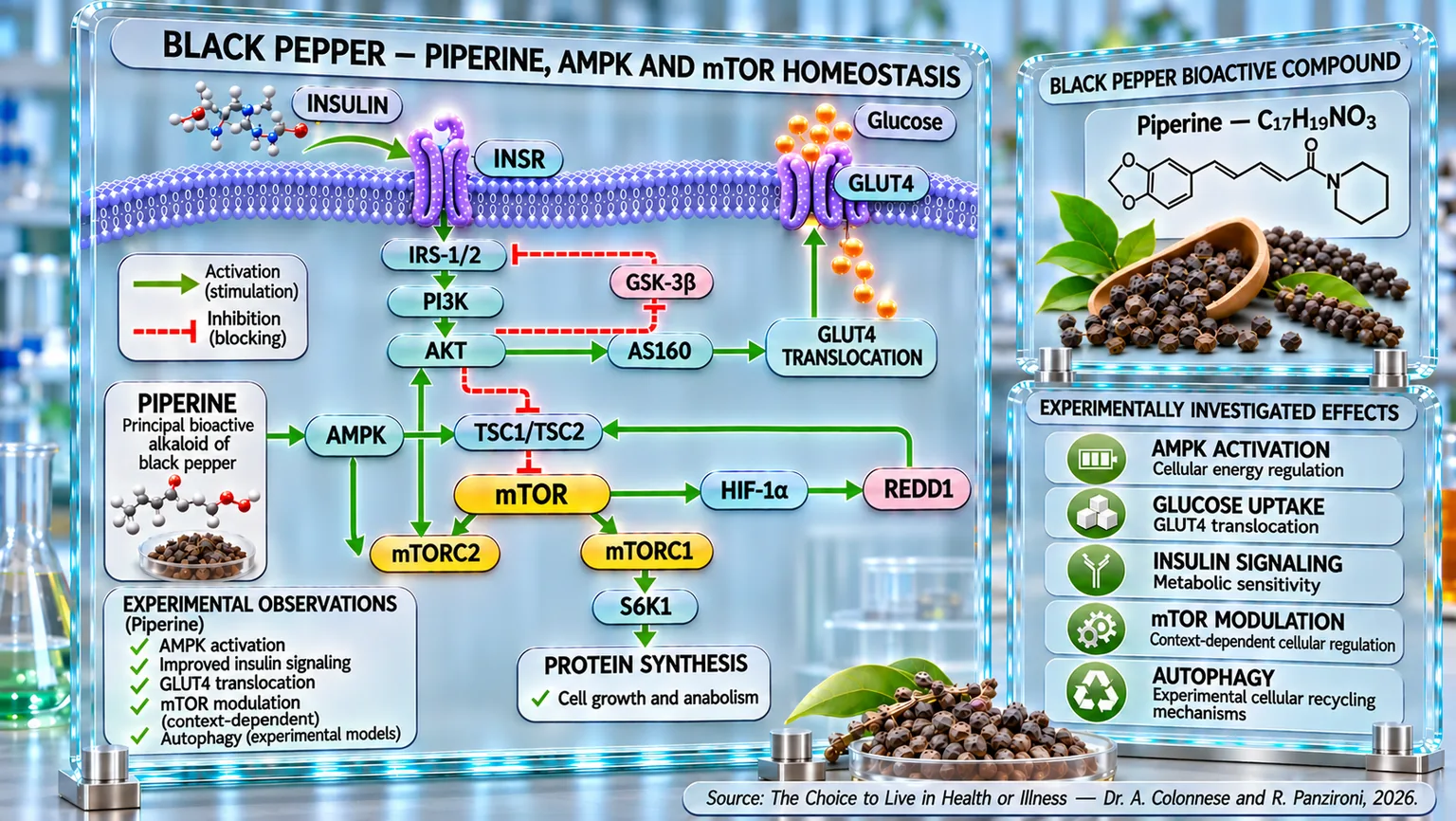
Continuing the discussion on the biological properties of black pepper, it is important to focus on the evidence from clinical studies on humans. While experimental research allows us to understand the cellular and molecular mechanisms of piperine, it is the studies conducted on patients and volunteers that provide more concrete indications regarding the potential metabolic and physiological impact of this spice in real-world practice.
A first element to understand is the specific role that piperine plays in clinical nutrition. Beyond the intrinsic properties of the molecule, one of the most studied aspects concerns its ability to increase the intestinal absorption of other bioactive compounds. This phenomenon is known as the “bio-enhancer” effect. In simple terms, piperine can act as a sort of biological amplifier: although present in relatively small quantities, it is able to increase the bioavailability of other substances that would otherwise be absorbed to a much more limited extent. For this reason, many clinical studies have investigated piperine in combination with other phytocompounds, particularly with curcumin, the main polyphenol in turmeric.
An interesting example comes from a double-blind, randomized clinical trial conducted on patients with non-alcoholic fatty liver disease, a condition that is extremely widespread today and closely linked to visceral obesity, insulin resistance, and dyslipidemia. In this study, sixty patients with moderate or severe fatty liver disease were treated for twelve weeks with a combination of curcumin (500 mg per day) and piperine (5 mg per day) or with a placebo. At the end of the intervention, the group treated with the combination showed significant improvements in several cardiometabolic parameters: reduction in waist circumference, decrease in systolic blood pressure, reduction in total cholesterol and LDL, as well as better control of fasting glycemia. In parallel, reductions in liver enzymes ALT and AST, which are indicators of liver damage, were observed (Sharifi et al., 2023) [6].
A similar picture also emerges in research conducted on patients with type 2 diabetes. In a randomized clinical trial, seventy-one diabetic patients received a daily supplementation of turmeric combined with piperine or a placebo for four months. At the end of the intervention, significant reductions were observed in fasting glycemia, glycated hemoglobin (HbA1c), the HOMA-IR index (an indicator of insulin resistance), and plasma triglycerides. In other words, the combination of the two compounds, piperine and curcumin, produced an overall improvement in metabolic control, suggesting a possible role as a nutraceutical support in the integrated management of diabetes, albeit without replacing standard pharmacological therapies (Figueiredo Neta et al., 2021) [7].
Interesting data also emerge in the context of cardiovascular diseases. In a randomized clinical trial conducted on patients with acute myocardial infarction, supplementation with curcumin combined with piperine for eight weeks led to significant improvements in some metabolic parameters, including a reduction in HbA1c and an improvement in the lipid profile with a decrease in LDL and an increase in HDL: this suggests that the main effect of the supplementation may concern metabolism and systemic inflammation (Tabaee et al., 2021) [8].
Another area in which the curcumin-piperine combination has been studied concerns inflammatory bowel diseases, such as ulcerative colitis and Crohn's disease. In a randomized clinical trial conducted on patients with mild-to-moderate forms of these pathologies, twelve weeks of supplementation with curcumin combined with piperine led to an improvement in body composition, with an increase in lean mass and an increase in the phase angle, a bioimpedance parameter associated with the quality of cellular status. These results are particularly interesting because in inflammatory bowel diseases, it is common to observe a combination of excess adipose tissue and loss of muscle mass, a condition that can worsen the clinical prognosis. The increase in lean mass therefore suggests a possible metabolic and nutritional benefit of the supplementation (Martins et al., 2025) [9].
Alongside chronic supplementation studies, there is also research that has evaluated the acute effects of black pepper directly within meals. In a crossover study conducted on healthy adults, researchers analyzed the effect of adding black pepper and turmeric to a standard breakfast containing carbohydrates. The results showed that the presence of black pepper, alone or in combination with turmeric, significantly reduced postprandial glycemia compared to the control meal. In parallel, participants reported a reduction in perceived hunger and a greater feeling of satiety in the hours following the meal. These effects suggest that some spices can modulate the metabolic response to glucose and influence appetite regulation signals, even when used simply as culinary ingredients (Khan et al., 2024) [10].
Taken together, this evidence suggests that black pepper, and in particular piperine, does not act only as an isolated bioactive compound, but also as a modulator of the efficacy of other nutrients and phytocompounds. It is as if this molecule functions as a “biological facilitator,” capable of increasing the efficiency with which certain substances are absorbed and used by the body. This role explains why piperine is frequently included in nutraceutical formulations intended to improve the bioavailability of molecules that are otherwise poorly absorbed.
Naturally, it is important to interpret these results with caution. Most of the available clinical studies have relatively limited sample sizes and moderate duration, and often analyze piperine in combination with other compounds. However, the overall picture suggests that supplementation containing piperine can influence various aspects of human metabolism, particularly those related to glycemic, lipid, and inflammatory regulation.
In other words, what for centuries has been simply an ingredient in daily cooking reveals itself, in light of modern scientific evidence, to be a small but sophisticated modulator of human metabolism.