
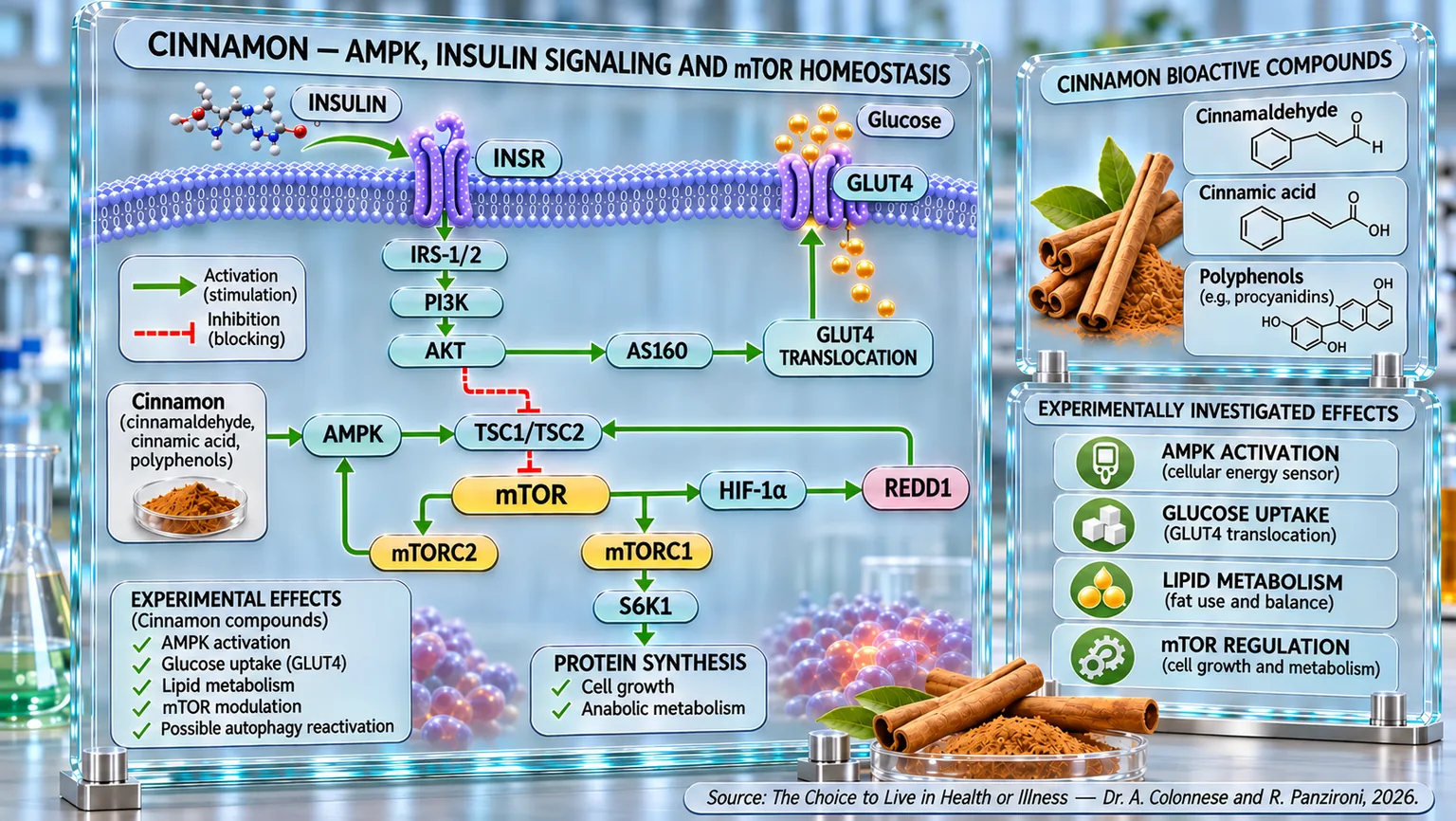
When moving from the study of molecular mechanisms to concrete clinical effects, cinnamon emerges as one of the most studied spices in humans, with a growing number of clinical trials, systematic reviews, and meta-analysis evaluating its impact on metabolism, the cardiovascular system, and glycemic control. This transition is fundamental, as it allows us to understand whether what happens at the cellular level truly translates into measurable real-life benefits.
One of the most investigated areas is that of blood pressure and lipid profile. In a randomized, double-blind, placebo-controlled clinical trial conducted on subjects with stage 1 hypertension, supplementation with 1500 mg of cinnamon per day for 90 days resulted in a significant reduction in 24-hour mean systolic blood pressure and daytime systolic blood pressure, accompanied by an improvement in the lipid profile, with an increase in HDL and a reduction in LDL (Shirzad et al., 2021) [6]. It is interesting to note that the effect on fasting glycemia was not marked in this context, suggesting that in non-diabetic subjects, the action of cinnamon manifests primarily on the vascular and lipid side, as if it were improving the "quality of the pipes" rather than intervening directly on the fuel flowing through them.
The picture becomes even clearer when looking at data on subjects with type 2 diabetes, a condition in which the alteration of glucose metabolism is central. A systematic review with meta-analysis that included 28 randomized clinical trials, for a total of over 3000 participants, showed that cinnamon supplementation significantly reduces fasting glycemia, post-prandial glycemia, HbA1c, and HOMA-IR, indicating a real improvement in insulin sensitivity (de Moura et al., 2025) [7]. In particular, the reduction of HOMA-IR (an index used to estimate insulin resistance and pancreatic β-cell function) suggests that cinnamon does not act simply by "buffering" glycemia, but intervenes further upstream, improving the dialogue between insulin and cells. It is as if insulin no longer has to shout to be heard, being able to return to performing its role with lower and more efficient signals.
A particularly relevant aspect that emerged from this meta-analysis concerns the dose: the most consistent effects on HbA1c (glycated hemoglobin, a blood test that indicates the average glycemia over the last 2-3 months), HOMA-IR, and even body mass index were observed with doses equal to or less than 2 grams per day, suggesting that, even for cinnamon, "more" does not necessarily mean "better" (de Moura et al., 2025) [7]. This is a key point in terms of conscious supplementation that is consistent with one's lifestyle.
Similar results also emerge in specific endocrine-metabolic contexts such as polycystic ovary syndrome (PCOS), a condition characterized by insulin resistance, dyslipidemia, and increased cardiovascular risk. In a systematic review and meta-analysis of randomized clinical trials, cinnamon supplementation led to a significant reduction in body weight, fasting glycemia, and HOMA-IR, along with an improvement in the lipid profile, with a reduction in total cholesterol and LDL (Xiaomei and Xiaoyan, 2024) [8]. In this context, cinnamon seems to act as a "transversal" metabolic modulator, capable of simultaneously influencing glycemia, lipids, and body weight—elements that in PCOS reinforce each other in a vicious cycle.
If we broaden our view to metabolic diseases in general, a dose-response meta-analysis that included 35 clinical trials confirmed that cinnamon supplementation reduces glycemia, serum insulin, total cholesterol, LDL, triglycerides, and waist circumference, while improving HDL and leading to a reduction, albeit modest but significant, in both systolic and diastolic blood pressure (Kutbi et al., 2022) [9]. The data on serum insulin is particularly interesting because it suggests that cinnamon may help reduce chronic hyperinsulinemia, one of the first pathological adaptations of modern metabolism. In other words, cinnamon does not just correct the consequences, but intervenes in one of the mechanisms that precede and fuel metabolic dysfunction.
These observations have been further reinforced by a recent systematic review with meta-analysis and GRADE assessment (a method used to evaluate the quality of available evidence and, for guidelines, the strength of recommendations), which included 49 randomized clinical trials and confirmed significant improvements in glycemia, HbA1c, HOMA-IR, lipid profile, blood pressure, and inflammatory markers such as CRP (Jafari et al., 2025) [10]. The reduction of oxidative stress markers, such as malondialdehyde, also suggests that part of the cardiovascular benefits may derive from an improvement in endothelial function, making vessels more "elastic" and less vulnerable to chronic inflammatory damage.
Taken together, these clinical data outline a coherent picture: cinnamon, when integrated appropriately, acts as a nutraceutical adjuvant capable of improving glycemic control, reducing hyperinsulinemia and insulin resistance, optimizing the lipid profile, and supporting cardiovascular health. However, it is clear that these effects are neither magical nor independent of the context. Cinnamon does not "cure" metabolic diseases on its own, but functions as a positive amplifier of a lifestyle already oriented toward glycemic stability, the reduction of insulin spikes, and the control of chronic inflammation.
In this sense, cinnamon represents an emblematic example of how a traditional spice can interact with the metabolic pathways of our body, offering concrete and measurable support, provided it is inserted within a coherent approach that takes into account overall nutrition, movement, and daily biological rhythm.