
Scientific Book

Ginger

Ginger contains bioactive compounds such as 6-gingerol and 6-shogaol, which are studied for their anti-inflammatory, antioxidant, and metabolic properties. Experimental research describes potential interactions with AMPK, GLUT4, and PI3K/AKT/mTOR, which are involved in the regulation of glucose, inflammation, and cell survival. In the book "The Choice to Live in Health or Disease" ("La scelta di Vivere in Salute o in Malattia"), Dr. A. Colonnese and R. Panzironi delve into these mechanisms and the scientific evidence regarding ginger, distinguishing between preclinical observations and results obtained in humans.

Cite this article
Colonnese, A. & Panzironi, R. (2026). Ginger. The Choice to Live in Health or in Disease. https://lifesciencehub.info/en/la-scelta-di-vivere-in-salute-o-in-malattia/ginger
The Choice to Live in Health or in Disease · ISBN 979-12-82692-03-8

DOI lsh.en.libro.35

  • Published 05/11/2026
  • Updated 05/11/2026
  • GINGER
  • 6-GINGEROL
  • 6-SHOGAOL
  • INSULIN RESISTANCE
  • PI3K/AKT/MTOR
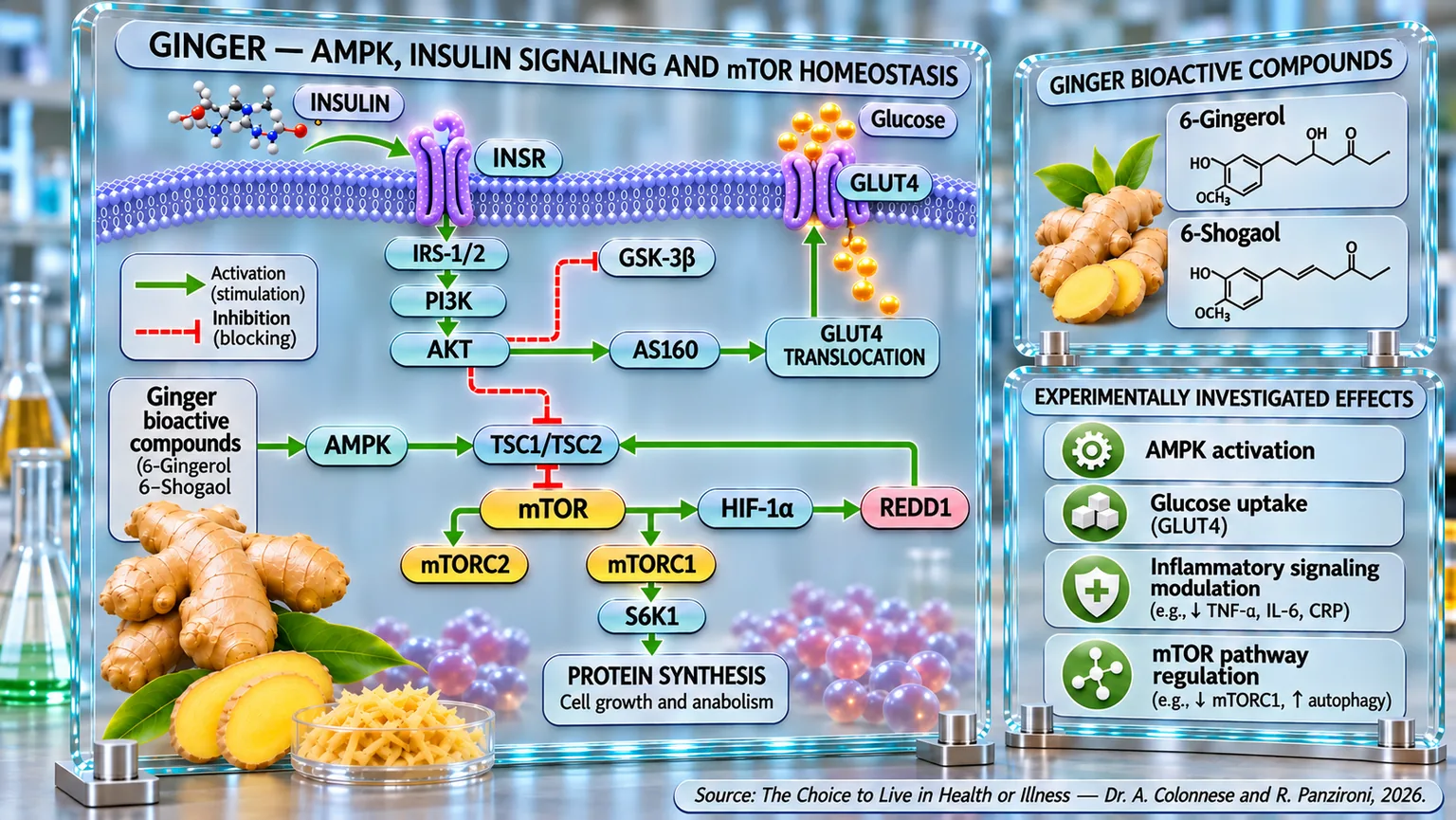
Infographic featuring ginger, the structures of 6-gingerol and 6-shogaol, and a molecular network including AMPK, PI3K/AKT, GLUT4, and mTOR.
Diagram of the experimentally studied interactions of ginger's bioactive compounds, 6-gingerol and 6-shogaol: activation of AMPK, insulin signaling INSR–IRS-1/2–PI3K–AKT, GLUT4 translocation, and regulation of TSC1/TSC2–mTOR. The arrows connect these nodes to glucose transport, protein synthesis, and the modulation of inflammatory signals.

ABSTRACT

Ginger contains gingerols and shogaols, bioactive compounds studied for their antioxidant and anti-inflammatory properties. In the book "La scelta di Vivere in Salute o in Malattia" (The Choice to Live in Health or Disease), Dr. A. Colonnese and R. Panzironi explore their involvement in metabolic regulation and cellular processes associated with chronic diseases. Research describes a potential reduction in oxidative stress and inflammatory mediators, including TNF-α, IL-6, and C-reactive protein, with implications for cardiovascular and neurological health.

At the molecular level, experimental studies indicate that 6-gingerol can activate AMPK in muscle tissue, involving AS160 and promoting the translocation of GLUT4 to the cell membrane. This process supports glucose uptake and links energy availability to insulin sensitivity. In tumor models, 6-shogaol attenuates PI3K/AKT/mTOR signaling, which is associated with apoptosis and the modulation of autophagy. AMPK can also counteract mTORC1 under specific conditions. Further preclinical observations link the regulation of PI3K/AKT to the protection of the intestinal barrier and the reduction of inflammation-induced permeability.

Clinical studies on type 2 diabetes report improvements in glycemia, glycated hemoglobin, and insulin sensitivity. Favorable results regarding the HOMA-IR index have also emerged in women with gestational diabetes and diabetic patients on hemodialysis. In people with obesity or metabolic syndrome, potential benefits regarding lipids, blood pressure, and waist circumference have been observed, although meta-analysis results remain heterogeneous. Oncological observations, including those regarding colorectal carcinoma, remain experimental; similarly, potential applications in inflammatory bowel diseases and autoimmune conditions require further confirmation.

Overall, ginger represents a potential complementary support for the regulation of inflammation and glucose metabolism. The correspondence between preclinical mechanisms and benefits in humans needs to be further clarified. Its use does not replace a balanced diet, physical activity, or appropriate medical therapies. Further studies will need to define which populations may benefit most and distinguish the effects of the various bioactive compounds.

Ginger and its intrinsic properties

Ginger (Zingiber officinale Roscoe) is one of the most widely used spices in the world, not only for its pungent and fresh aroma but also for its nutritional value and medicinal properties. It is a perennial herbaceous plant belonging to the Zingiberaceae family, primarily cultivated in tropical and subtropical regions. Its most commonly used part is the rhizome, an underground structure rich in bioactive compounds. Its origins date back to Southeast Asia, but today the main producing countries include India, China, Nigeria, Indonesia, and Thailand. Throughout history, ginger has been used in traditional Asian and Middle Eastern medicine to treat digestive, inflammatory, and respiratory disorders. Only recently, however, has scientific research begun to clarify the molecular mechanisms underlying these properties.

From a chemical perspective, ginger contains a wide range of bioactive compounds, including gingerols, shogaols, paradols, and other phenolic derivatives. Among these, 6-gingerol is the predominant form in fresh ginger, while 6-shogaol is primarily formed during drying and heating processes. Although these molecules differ in structure, they share a fundamental characteristic: the ability to interact with numerous cellular targets. It is as if ginger possesses a “versatile chemical language,” capable of communicating with different biological systems simultaneously, thus explaining its multitarget action (Ma et al., 2021) [1].

One of the most studied aspects concerns ginger's ability to modulate oxidative stress. In our body, the production of reactive oxygen species is a physiological process, but when this balance is disrupted, progressive damage to cells and tissues occurs. Clinical evidence shows that ginger supplementation is associated with a significant improvement in key redox biomarkers, such as an increase in total antioxidant capacity and defensive enzymes, along with a reduction in lipid peroxidation products. In other words, ginger does not just “quench” free radicals; it appears to strengthen the body's entire defense system, making it more resilient to metabolic stress (Morvaridzadeh et al., 2021) [2].

This antioxidant action is closely linked to a systemic anti-inflammatory effect. Indeed, inflammation and oxidative stress feed into each other in a vicious cycle that characterizes many modern chronic diseases. Randomized clinical trials have shown that ginger can significantly reduce inflammatory markers such as C-reactive protein, TNF-α, and interleukin-6, suggesting a modulatory effect on the main immune pathways involved in chronic inflammation (Rjabi et al., 2025) [3]. It is as if ginger acts as an “inflammatory tone regulator,” returning the immune system to a state of balance.

These properties become particularly relevant when observing complex pathologies such as neurodegenerative diseases. Conditions like Alzheimer's and Parkinson's share common mechanisms, including oxidative stress, neuroinflammation, and the accumulation of abnormal proteins. Ginger compounds appear to intervene at multiple levels of this pathological cascade: on one hand, they reduce oxidative damage, and on the other, they modulate the inflammatory response and influence neurotransmitter systems. This “multitarget” approach is particularly interesting because neurodegenerative diseases do not depend on a single factor, but on a complex network of biological alterations (Arcusa et al., 2022) [4].

At the same time, interest in ginger also extends to the cardiovascular field. Cardiovascular diseases still represent one of the leading causes of global mortality and share several risk factors, such as inflammation, oxidative stress, dyslipidemia, and insulin resistance. Ginger compounds appear to act on all these fronts: they improve the lipid profile, contribute to glycemic control, reduce blood pressure, and show antiplatelet effects. In this sense, ginger can be seen as a sort of “systemic modulator,” capable of intervening simultaneously on multiple nodes of cardiovascular pathophysiology (Mohammadabadi et al., 2025) [5].

A particularly interesting aspect is precisely this ability to act on multiple systems simultaneously. Unlike many drugs that target a single site, ginger compounds appear to function as a coordinated intervention network, modulating metabolic, inflammatory, and oxidative signals. This behavior reflects a characteristic typical of plant compounds: pleiotropy. It is as if ginger were not a single “key,” but an entire bunch of keys capable of interacting with multiple biological locks.

Overall, current scientific evidence outlines a coherent picture: ginger is not simply an aromatic spice, but a complex source of bioactive molecules with significant systemic effects. However, it is important to emphasize that, despite promising results, there is still significant heterogeneity among studies, linked to differences in dosage, duration, and form of administration. This means that while ginger represents an interesting candidate in the nutraceutical field, further well-designed clinical trials are needed to precisely define the optimal conditions for its use.

Ginger and human supplementation

When moving from the observation of biological mechanisms to clinical applications in humans, ginger shows a particularly interesting profile, especially in the context of metabolic diseases. The picture that emerges from clinical studies is that of a substance capable of intervening at multiple levels simultaneously, not through a single, isolated action, but through an integrated modulation of glucose metabolism, lipid metabolism, and insulin resistance.

In patients with type 2 diabetes, for example, several randomized controlled trials have highlighted how ginger supplementation can significantly improve glycemic control. In one of these studies, conducted on diabetic subjects, the daily intake of ginger led to a reduction in fasting glycemia and HbA1c (a blood test that measures the average glucose concentration over the last 2-3 months), accompanied by an improvement in insulin sensitivity indices such as HOMA-IR (a parameter used to assess insulin sensitivity and diagnose insulin resistance). In practical terms, this means that the body's cells begin to "respond" better to insulin, reducing the need to maintain high levels in the blood (Mozaffari-Khosravi et al., 2014) [6].

A similar result also emerges in obese patients with recently diagnosed diabetes, where ginger supplementation for several weeks led to a simultaneous improvement in multiple parameters: a reduction in fasting glycemia, post-prandial glycemia, and HbA1c, as well as a significant decrease in circulating insulin and insulin resistance. In parallel, an improvement in the lipid profile was observed, with a reduction in total cholesterol, LDL, and triglycerides and an increase in HDL. It is as if ginger acts not on a single "gear," but on the entire metabolic system, bringing it back toward a more balanced condition (El Gayar et al., 2019) [7].

This systemic action becomes even more evident when analyzing subjects with metabolic syndrome, a condition characterized by the simultaneous presence of multiple alterations, including abdominal obesity, dyslipidemia, hypertension, and impaired glycemia. In a controlled clinical trial, supplementation with ginger led to a significant reduction in fasting glycemia, triglycerides, and insulin resistance, accompanied by improvements in blood pressure and anthropometric parameters such as body weight and waist circumference. In other words, ginger seems to act as a "global regulator" of metabolism, simultaneously influencing various cardiometabolic risk factors (Rahimlou et al., 2019) [8].

If we broaden our perspective further, including data from meta-analysis of randomized clinical trials, a coherent but also more nuanced picture emerges. Ginger supplementation is associated with a reduction in body weight, fasting glycemia, and the HOMA-IR index, as well as an increase in HDL cholesterol. However, some parameters, such as BMI or certain lipid fractions, do not always show significant changes. This suggests that the effect of ginger may be more pronounced on specific aspects of metabolism, such as fat distribution and insulin sensitivity, rather than on total body weight (Maharlouei et al., 2019) [9].

A particularly interesting area is that of non-alcoholic fatty liver disease, a condition closely linked to insulin resistance and lipid metabolism. In patients with type 2 diabetes, ginger supplementation has shown positive effects on various metabolic parameters, including the reduction of insulin and HOMA-IR and an increase in HDL. A significant reduction in blood pressure was observed, suggesting an effect on the cardiovascular system as well. However, no significant changes were detected in the structural parameters of the liver in the short term, indicating that the effect of ginger might manifest initially at a functional level rather than a structural one (Ghoreishi et al., 2024) [10].

Taken together, these results outline a clear interpretive model: ginger does not act as a drug "targeted" at a single goal, but as a multifactorial metabolic modulator. It is like intervening in a complex system by simultaneously adjusting multiple levers: glycemia, lipids, inflammation, and insulin sensitivity. This approach is particularly relevant in modern chronic diseases, which rarely depend on a single alteration.

In conclusion, the available clinical evidence indicates that ginger represents a promising nutraceutical support in the management of metabolic diseases, particularly diabetes, metabolic syndrome, and fatty liver disease. However, as with many compounds of natural origin, its role must be interpreted in a broader context that includes diet, lifestyle, and medical therapy, and not as a substitute for these interventions.

Ginger and its uses for treated conditions

When analyzing the effects of ginger in the context of chronic diseases, a central element clearly emerges: its ability to intervene transversally on biological mechanisms shared by many modern diseases, particularly chronic inflammation, oxidative stress, and metabolic dysregulation. In this sense, ginger does not merely act on a single organ or a single pathology, but seems to fit into those “common biological nodes” that link seemingly different conditions.

A particularly relevant area is oncology, where ginger is studied as a chemopreventive agent—that is, to prevent, delay, or reverse the development of a disease, particularly cancer. Tumor transformation, in fact, is not a sudden event, but a progressive process that develops through cumulative DNA alterations, persistent inflammation, and uncontrolled proliferative signals. The bioactive compounds in ginger, such as gingerols and shogaols, appear to interfere with these processes on multiple levels: on one hand, they reduce the activation of pro-inflammatory pathways such as NF-κB, and on the other, they modulate proliferative and apoptotic signals, promoting the death of damaged cells. In other words, it is as if ginger intervenes both in the initial phases of tumor transformation and in the subsequent phases of growth and progression (Lechner and Stoner, 2019) [11].

This view is further reinforced by specific studies on colorectal cancer, where chronic intestinal inflammation represents one of the main risk factors. In this context, ginger shows a combination of effects particularly consistent with the pathophysiology of the disease: reduction of oxidative stress, modulation of the gut microbiota, protection of the intestinal barrier, and direct interference with the proliferation of tumor cells. Furthermore, it has been observed that its compounds can induce cell cycle arrest and activate apoptosis mechanisms, limiting tumor growth and metastatic spread. This set of actions suggests that ginger may act as a “regulator of the intestinal environment,” making it less favorable to tumor development and progression (Xiang et al., 2024) [12].

In parallel, ginger shows a significant role in chronic inflammatory diseases, which represent the common ground upon which many metabolic and degenerative conditions develop. Its bioactive compounds are capable of modulating some of the main inflammation signaling pathways, including NF-κB, by reducing the production of pro-inflammatory cytokines such as TNF-α, IL-6, and IL-1β. This effect has been observed in various clinical conditions, including rheumatoid arthritis, lupus, psoriasis, and inflammatory bowel diseases. In this context, ginger acts as a “biological shock absorber,” capable of attenuating excessive activation of the immune system without suppressing it completely (Ballester et al., 2022) [13].

In inflammatory bowel diseases, in particular, this action appears even more articulated. In addition to reducing inflammation, ginger intervenes at multiple levels of pathophysiology, also contributing to the maintenance of the integrity of the intestinal barrier. Furthermore, its ability to influence signaling pathways such as mTOR suggests a profound action on the cellular mechanisms that regulate growth, inflammation, and stress response. It is as if ginger does not just “turn off inflammation,” but works upstream, rebalancing the entire intestinal system (Lashgari et al., 2022) [14].

This ability to simultaneously modulate inflammation and metabolism also emerges in the context of type 2 diabetes and metabolic syndrome. Aggregate evidence shows that ginger is able to improve glycemic control, reduce HbA1c, and increase insulin sensitivity, with favorable effects also on the lipid profile. This suggests that the action of ginger is not limited to a direct hypoglycemic effect, but involves a broader regulation of the metabolic and inflammatory mechanisms that underlie these pathologies (Zhu et al., 2018) [15].

Overall, what emerges is an extremely consistent picture: ginger acts as a systemic modulator capable of intervening at multiple levels of human pathophysiology. This is not a specific and isolated action, but an integrated regulation of complex biological networks. This approach is particularly relevant in the context of modern chronic diseases, which do not derive from a single defect, but from a progressive and multifactorial dysfunction.

At the same time, it is essential to maintain a critical approach. Most of the strongest evidence comes from preclinical studies or clinical trials with limited samples and relatively short duration. This means that, although the results are promising, large-scale clinical application requires further confirmation, particularly to define optimal dosages, duration of interventions, and possible interactions with pharmacological therapies.

In summary, ginger is configured as one of the spices with the broadest spectrum of biological action among those studied, capable of connecting seemingly distinct areas—metabolism, inflammation, and oncology—through common mechanisms. It is precisely this “systems” view that makes its integration into advanced nutritional strategies particularly interesting.

Ginger and the improvement of insulin resistance

One of the most interesting aspects of ginger concerns its ability to intervene directly in the main biological mechanisms underlying insulin resistance, a condition that represents the pathophysiological core of type 2 diabetes, non-alcoholic fatty liver disease, and metabolic syndrome. In the presence of insulin resistance, peripheral tissues become progressively less sensitive to insulin signaling, forcing the pancreas to maintain chronic compensatory hypersecretion of insulin. This state of persistent hyperinsulinemia fuels inflammation, oxidative stress, lipid accumulation, and continuous activation of the PI3K/AKT/mTOR pathway.

In this context, the main bioactive compounds of ginger, particularly gingerols and shogaols, appear to act as multifactorial metabolic modulators capable of simultaneously improving glucose homeostasis, inflammation, and cellular metabolic function. One of the most interesting clinical findings emerges from studies on gestational diabetes mellitus. In women with impaired glucose tolerance during pregnancy, six weeks of ginger supplementation resulted in a significant reduction in fasting glycemia, serum insulin, and HOMA index compared to the placebo (Hajimoosayi et al., 2020) [16]. This finding is particularly relevant because gestational diabetes is a condition strongly characterized by insulin resistance that is physiologically accentuated by pregnancy.

From a biological perspective, this suggests that ginger does not simply act by lowering glycemia, but rather improves the body's ability to respond correctly to insulin. It is as if the peripheral tissues progressively return to "recognizing" the insulin signal without requiring continuous compensatory pancreatic hypersecretion.

This relationship between ginger and insulin sensitivity emerges even more clearly in patients with type 2 diabetes. In a three-month randomized clinical trial, the daily intake of 3 grams of ginger led to significant reductions in fasting glycemia, HbA1c, circulating insulin, and HOMA-IR index (Shidfar et al., 2015) [17]. In parallel, the treated subjects showed an improvement in total antioxidant capacity and a reduction in two specific markers closely linked to oxidative stress and chronic inflammation.

This step is extremely important because it shows how insulin resistance, inflammation, and oxidative stress represent deeply intertwined processes. Excessive production of reactive oxygen species, in fact, alters insulin signaling and contributes to the maintenance of a chronic low-grade inflammatory state that makes the cellular response to insulin progressively inefficient. Ginger appears to break this vicious cycle by acting simultaneously on glucose metabolism and redox homeostasis (Shidfar et al., 2015) [17].

Even in diabetic patients undergoing hemodialysis, one of the most complex and inflammatory metabolic conditions, ginger supplementation showed favorable effects on glycemic control. In a randomized controlled clinical trial, treated patients showed a significant reduction in fasting glycemia and HOMA-IR index compared to the placebo group (Rostamkhani et al., 2023) [18].

This finding is particularly relevant because patients with end-stage renal disease and diabetes present with a condition of persistent chronic inflammation, severe oxidative stress, and marked alteration of insulin metabolism. The fact that ginger is able to improve insulin sensitivity even in such an advanced pathophysiological context further reinforces the biological plausibility of its metabolic effects (Rostamkhani et al., 2023) [18].

Further experimental evidence on the relationship between ginger and insulin resistance comes from a study conducted on rats fed a diet rich in fat and sucrose. In this model, the administration of 6-gingerol for ten weeks improved glycemia, insulin resistance, and lipid profile, while simultaneously reducing various indicators of inflammation and oxidative stress; these results suggest that 6-gingerol may act on multiple aspects of metabolic dysfunction associated with nutritional excess, linking the improvement of the insulin response to the containment of inflammation and oxidative damage (Essa and El-Metwally, 2026) [19].

The most robust evidence, however, emerges from the most recent "umbrella reviews" of clinical meta-analyses. A massive review comprising 296 randomized controlled trials and over 43,000 participants showed that ginger supplementation significantly improves fasting glycemia, HbA1c, HOMA-IR, and circulating insulin levels (Musazadeh et al., 2026) [20]. In parallel, consistent improvements in inflammatory markers and oxidative stress were observed.

Overall, the available evidence shows that ginger does not act simply as an aromatic spice or natural anti-inflammatory, but as a true modulator of metabolic physiology. Through gingerols and shogaols, this spice appears to improve insulin sensitivity, glucose metabolism, chronic inflammation, and oxidative stress, helping to reduce the metabolic load imposed by persistent hyperinsulinemia.

In this sense, the relationship between ginger and insulin resistance represents one of the most complete examples of how a natural compound can interact with the main biological nodes of modern metabolic diseases, offering physiologically coherent support within a broader strategy based on glycemic stability, the reduction of chronic inflammation, and the improvement of metabolic flexibility.

Ginger and its relationship with mTOR

When delving into the heart of intracellular mechanisms, an aspect emerges that is particularly relevant for understanding the true potential of ginger: its ability to interact with one of the main regulatory pathways of cell growth and metabolism, namely the PI3K/AKT/mTOR axis. This pathway represents a sort of "control center" for the cell, capable of integrating energy, nutritional, and proliferative signals, determining whether the cell should grow, divide, or activate survival programs.

Within this context, one of the most studied compounds in ginger is 6-shogaol, which appears to exert a direct action on this very signaling network. In various tumor models, 6-shogaol has shown the ability to inhibit the activation of AKT, consequently reducing the downstream signal of mTOR. This effect translates into a reduction in cell proliferation and an increase in signals that lead to programmed cell death. In simple terms, it is as if the tumor cell were deprived of the signals that allow it to continue growing uncontrollably (Huang et al., 2021) [21].

This same mechanism has also been observed in other tumor models, such as cervical carcinoma, where 6-shogaol not only reduces the activation of the PI3K/AKT/mTOR pathway but also induces an increase in intracellular oxidative stress. The increase in reactive oxygen species acts as an upstream signal, contributing to the activation of apoptosis. At the same time, a phenomenon of autophagy has also been observed, which in some cases represents an attempt by the cell to survive the stress induced by the treatment. This creates a dynamic balance between cell death and adaptation, suggesting that the final effect depends on the specific biological context (Pei et al., 2021) [22].

A particularly interesting element is that this modulation of the PI3K/AKT/mTOR pathway does not exclusively concern tumor cells, but also extends to inflammatory and metabolic contexts. For example, in the intestinal barrier, 6-shogaol has demonstrated the ability to prevent damage induced by pro-inflammatory cytokines such as TNF-α, precisely through the inhibition of PI3K/AKT signaling. This results in the protection of cell junctions and a reduction in intestinal permeability, a crucial aspect in chronic inflammatory diseases. In this case, the pathway is not simply "turned off," but modulated in such a way as to restore a functional balance (Luettig et al., 2016) [23].

If we broaden our perspective further, it emerges that this action on the mTOR pathway represents one of the most important points of convergence for the biological effects of ginger. In gastrointestinal tumors, for example, the inhibition of the PI3K/AKT/mTOR cascade is associated not only with a reduction in cell proliferation but also with a decrease in the metabolic adaptation capacity of tumor cells, making them more vulnerable. This effect is accompanied by the modulation of other signaling pathways, such as NF-κB, creating a network of interference that simultaneously affects multiple aspects of tumor biology (Chen et al., 2023) [24].

Therefore, 6-shogaol seems to act as a true "multi-target" modulator, capable of interfering not only with mTOR but also with other signaling pathways known as NF-κB. This integrated action makes it possible to influence not only tumor growth but also the microenvironment in which the tumor develops, reducing inflammation, angiogenesis, and metastatic potential. It is as if the molecule does not limit itself to striking the tumor cell, but modifies the entire context that favors its survival (Figueroa-González et al., 2024) [25].

Overall, what emerges is an extremely coherent vision: ginger, through its main bioactive compounds, is able to modulate one of the central nodes of cellular physiology, integrating metabolic, inflammatory, and proliferative signals. This explains why its effects are not limited to a single area but extend to different diseases, which are, however, united by a dysregulation of these same pathways.

At the same time, it is important to emphasize that most of the evidence is derived from preclinical studies. This means that, although the mechanisms are becoming increasingly clear, their translation into the clinical setting requires further confirmation. However, the consistency of the data suggests that the interaction between ginger and the mTOR pathway represents one of the most promising aspects for understanding the nutritional and therapeutic role of this spice in the context of modern chronic diseases.

Ginger, AMPK, and the energy rebalancing of mTOR

If the relationship between ginger and the PI3K/AKT/mTOR pathway already shows significant biological relevance, the picture becomes even more interesting when observing the role of AMPK, the primary cellular energy sensor. As discussed in the previous chapters, AMPK and mTOR represent two opposing yet complementary metabolic programs: when nutrients, glucose, and insulin are abundant, mTOR promotes cell growth, protein synthesis, and energy storage; conversely, when the cell perceives a state of energy stress or reduced ATP availability, AMPK slows down anabolic processes, reactivates autophagy, and promotes the restoration of metabolic homeostasis. In this delicate balance, the main bioactive compounds in ginger appear to act as potent modulators capable of restoring the proper dialogue between these two pathways.

One of the most interesting aspects emerges from studies on 6-gingerol in skeletal muscle cells. In mouse cell models, 6-gingerol significantly increased the phosphorylation of AMPKα2 (a specific variant), resulting in a clear increase in cellular glucose uptake. This effect was completely abolished by both the pharmacological inhibition of AMPK and the gene silencing of AMPKα2, confirming the central role of this kinase in the compound's mechanism of action.

From a biological standpoint, this finding is particularly relevant because it shows that 6-gingerol does not act simply by "improving glycemia," but intervenes directly on the cell's main energy sensor. The activation of AMPKα2 has, in fact, stimulated the cascade involving AS160 (a key protein in human metabolism, which regulates glucose), promoting the expression and translocation of GLUT4 toward the cell membrane (Lee et al., 2015) [26]. In other words, skeletal muscle becomes more efficient at absorbing glucose, reducing the load imposed on insulin and indirectly contributing to limiting the chronic hyperactivation of mTOR.

Also particularly interesting is the involvement of the protein phosphatase PP2A (a fundamental enzyme in human cells that acts as a tumor suppressor). 6-gingerol significantly reduced the activity of PP2A, thereby facilitating the phosphorylation of AMPKα2. This suggests a sophisticated regulatory mechanism through which ginger does not merely "activate" AMPK, but promotes its functional stabilization.

The relationship between AMPK and inflammation emerges with even greater clarity in animal models fed a high-fat diet. In HFD rats, 6-gingerol significantly increased the phosphorylated form of AMPK-α1, while simultaneously reducing the expression of NF-κB, one of the main regulators of chronic inflammation (Hashem et al., 2017) [27]. This effect was associated with an increase in the expression of SIRT-6 and a reduction in resistin, an adipokine strongly involved in insulin resistance.

From a pathophysiological perspective, this step is extremely important because it shows how AMPK regulates not only energy metabolism but also the systemic inflammatory response. When AMPK is reduced, as frequently occurs in obesity and chronic hyperinsulinemia, NF-κB remains constantly active, promoting the production of TNF-α, metabolic inflammation, and progressive alteration of insulin signaling. 6-gingerol, on the other hand, appears to interrupt this pathological circuit, fostering a more stable and less inflammatory metabolic environment (Hashem et al., 2017) [27].

The treated animals, in fact, showed a significant reduction in TNF-α, free fatty acids, and inflammatory markers, accompanied by an improvement in glycemia and a reduction in visceral fat accumulation. It is as if the activation of AMPK by ginger helps the body to progressively exit a state of "permanent metabolic alarm."

An additional level of complexity emerges from studies on non-alcoholic fatty liver disease. In HFD mouse models and cells treated with palmitic acid, 6-gingerol reduced steatosis, inflammation, and oxidative stress through the activation of the LKB1/AMPK pathway (Liu et al., 2023) [28].

The activation of AMPK was accompanied by a reduction in the expression of fundamental components of the metabolic network involved in fat synthesis and an increase in closely related proteins that work in synergy to regulate cellular energy metabolism. In biological terms, this means that the liver is progressively shifted from a mode of lipogenesis and accumulation toward a mode of lipid oxidation and greater energy efficiency.

The relationship between ginger, AMPK, and mitochondrial function emerges even more clearly in models of muscle aging. In elderly rats treated with 6-gingerol, a significant reduction in ectopic lipid accumulation was observed, accompanied by an improvement in mitochondrial function and a reduction in the HOMA-IR index (Liu et al., 2019) [29]. Parallel to this, the treatment increased adiponectin (a hormone produced by adipose tissue that improves insulin sensitivity) and AMPK phosphorylation.

This aspect is extremely important because it links AMPK activation to mitochondrial biogenesis (the process through which cells produce new mitochondria) and metabolic flexibility. Through the adiponectin/AMPK axis, 6-gingerol appears to improve the muscle's ability to oxidize fatty acids and use energy more efficiently. It is as if ginger helps "metabolically aged" muscle recover part of its original energy capacity.

Even the most recent studies on adipocytes confirm this picture. A mixture of gingerols and shogaols significantly increased mitochondrial density, ATP-linked respiration, and maximum respiratory capacity in differentiated adipocytes, simultaneously promoting the activation of AMPK (Preciado-Ortiz et al., 2025) [30]. Concurrently, a reduction in intracellular lipid droplets and an increase in lipolysis were observed.

Overall, the available evidence outlines ginger as one of the most sophisticated natural modulators of the AMPK–mTOR axis. Through the activation of AMPK and the indirect reduction of the pathological hyperactivation of mTOR, its bioactive compounds appear to promote autophagy, lipid oxidation, mitochondrial biogenesis, energy flexibility, and improved insulin sensitivity.

In a context characterized by chronic hyperinsulinemia, nutritional excess, and continuous anabolic stimulation, the relationship between ginger, AMPK, and mTOR therefore takes on a meaning deeply consistent with what was discussed in the previous chapters: helping the cell exit a mode of forced and metabolically dysfunctional growth, returning it toward a condition of greater energy balance, adaptation, and metabolic resilience.

Conclusions

The journey undertaken in this chapter has allowed us to understand how ginger represents much more than a simple aromatic spice. Its properties derive primarily from gingerols and shogaols, bioactive compounds capable of interacting with numerous cellular processes. Scientific research describes its antioxidant and anti-inflammatory effects, associated with the reduction of oxidative stress and mediators such as TNF-α, IL-6, and C-reactive protein. These properties help explain the interest in ginger for cardiovascular and neurological protection, where inflammation and oxidative damage represent significant risk factors.

Starting from these properties, we examined the clinical evidence on supplementation. In patients with type 2 diabetes, several studies report improvements in glycemia, glycated hemoglobin, and insulin sensitivity. Favorable results also emerge in subjects with obesity and metabolic syndrome, with potential benefits on the lipid profile, blood pressure, and waist circumference. Meta-analysis confirm some of these effects, while highlighting results that are not always uniform.

Broadening our view to the pathologies treated, we encountered applications involving inflammation, metabolism, and cell proliferation. In oncology, gingerols and shogaols show experimental effects on tumor growth, apoptosis, and the mechanisms involved in the progression of colorectal carcinoma. Other research describes possible actions on the intestinal barrier and inflammatory mediators, which are of interest in inflammatory bowel diseases and autoimmune conditions.

The connection between these conditions introduces one of the central themes of the chapter: insulin resistance. When tissues respond less effectively to insulin, the pancreas may increase its secretion, promoting compensatory hyperinsulinemia. Clinical studies conducted on diabetic patients, women with gestational diabetes, and diabetic subjects on hemodialysis report improvements in glycemia and the HOMA-IR index. Reviews of meta-analysis also highlight favorable results, suggesting a possible contribution of ginger to metabolic regulation and the containment of inflammation.

But through which cellular mechanisms can these effects develop? The answer involves the PI3K/AKT/mTOR pathway, which is fundamental in the regulation of cell growth and survival. In tumor models, 6-shogaol can attenuate its activity, promoting apoptosis and the modulation of autophagy. Further experimental studies describe protective effects on the intestinal barrier, associated with the regulation of PI3K/AKT and the reduction of permeability caused by inflammation.

These results highlight how the properties of ginger compounds do not only concern cell growth and survival, but can also extend to the mechanisms that regulate the availability and use of energy. In this balance, AMPK, the main cellular energy sensor, assumes particular importance, as it is capable of counteracting, under certain conditions, the activity of mTORC1. In muscle models, 6-gingerol can activate AMPK, involving AS160 and promoting the translocation of GLUT4 toward the cell membrane, thus improving glucose uptake.

Overall, these results suggest that ginger compounds may act on complementary cellular mechanisms, contributing to the regulation of growth, inflammation, and energy balance, although further clinical confirmation is needed.

Thus, the central message of the chapter emerges: ginger contains compounds capable of influencing the mechanisms that link inflammation, insulin sensitivity, and cellular energy balance. The clinical evidence is encouraging, while the molecular mechanisms require further confirmation in humans. Its use can therefore complement a balanced diet, physical activity, and appropriate therapies, without replacing them.

References

[1] A recent update on the multifaceted health benefits associated with ginger and its bioactive components

Ma et al., 2021

Food & Function. 2021;12(2):519-542.

[2] Effect of Ginger (Zingiber officinale) Supplementation on Oxidative Stress Parameters: A Systematic Review and Meta-Analysis

Morvaridzadeh et al., 2021

Journal of Food Biochemistry. 2021;45(2):e13612.

[3] Antioxidant and anti-inflammatory effects of ginger supplementation in adults: a GRADE-assessed systematic review and dose-response meta-analysis of randomised controlled trials

Rjabi et al., 2025

Inflammopharmacology. 2025;33(12):7197–7216.

[4] Potential Role of Ginger (Zingiber officinale Roscoe) in the Prevention of Neurodegenerative Diseases

Arcusa et al., 2022

Frontiers in Nutrition. 2022;9:809621.

[5] Ginger: A Nutraceutical Supplement for the Protection Against Various Cardiovascular Diseases in Clinical Trials

Mohammadabadi et al., 2025

Cureus. 2025;17(3):e80841.

[6] The effect of ginger powder supplementation on insulin resistance and glycemic indices in patients with type 2 diabetes: a randomized, double-blind, placebo-controlled trial

Mozaffari-Khosravi et al., 2014

Complementary Therapies in Medicine. 2014;22(1):9-16.

[7] Effects of Ginger Powder Supplementation on Glycemic Status and Lipid Profile in Obese Patients with Newly Diagnosed Type 2 Diabetes

El Gayar et al., 2019

Obesity Medicine. 2019;14:100094.

[8] Effects of Ginger Supplementation on Anthropometric, Glycemic and Metabolic Parameters in Subjects with Metabolic Syndrome: A Randomized, Double-Blind, Placebo-Controlled study

Rahimlou et al., 2019

Journal of Diabetes & Metabolic Disorders. 2019;18(1):119-125.

[9] The Effects of Ginger Intake on Weight Loss and Metabolic Profiles Among Overweight and Obese Subjects: A Systematic Review and Meta-Analysis of Randomized Controlled Trials

Maharlouei et al., 2019

Critical Reviews in Food Science and Nutrition. 2019;59(11):1753-1766.

[10] The Effects of Ginger (Zingiber officinale Roscoe) on Non-Alcoholic Fatty Liver Disease in Patients with Type 2 Diabetes Mellitus: A Randomized, Double-Blind, Placebo-Controlled Trial

Ghoreishi et al., 2024

Journal of Dietary Supplements. 2024;21(3):294-312.

[11] Ginger and Its Components as Cancer Chemopreventive Agents

Lechner e Stoner, 2019

Molecules. 2019;24(16):2859.

[12] Components and Pharmacodynamic Mechanisms of Ginger (Zingiber officinale) in the Prevention and Treatment of Colorectal Cancer

Xiang et al., 2024

Journal of Ethnopharmacology. 2024;324:117733.

[13] Effect of Ginger on Inflammatory Diseases

Ballester et al., 2022

Molecules. 2022;27(21):7223.

[14] Ginger and Its Constituents: Role in the Treatment of Inflammatory Bowel Disease

Lashgari et al., 2022

Biofactors. 2022;48(1):7-21.

[15] Effects of Ginger (Zingiber officinale Roscoe) on Type 2 Diabetes Mellitus and Components of the Metabolic Syndrome: A Systematic Review and Meta-Analysis of Randomized Controlled Trials

Zhu et al., 2018

Evidence-Based Complementary and Alternative Medicine. 2018;2018:5692962.

[16] Effect of Ginger on Blood Glucose Level of Women with Gestational Diabetes Mellitus (GDM) with Impaired Glucose Tolerance Test (GTT): A Randomized Double-Blind Placebo-Controlled Trial

Hajimoosayi et al., 2020

BMC Complementary Medicine and Therapies, 2020, 20(1):116.

[17] The Effect of Ginger (Zingiber officinale) on Glycemic Markers in Patients with Type 2 Diabetes

Shidfar et al., 2015

Journal of Complementary and Integrative Medicine, 2015, 12(2):165-170.

[18] The Effect of Zingiber officinale on Prooxidant-Antioxidant Balance and Glycemic Control in Diabetic ESRD Patients Undergoing Hemodialysis: A Randomized Double-Blind Clinical Trial

Rostamkhani et al., 2023

BMC Complementary Medicine and Therapies, 2023, 23(1):52.

[19] 6-Gingerol ameliorates high-fat, high-sucrose diet-induced metabolic dysfunction and depressive-like behaviors by attenuating neuroinflammation and oxidative stress

Essa e El-Metwally, 2026

Metab Brain Dis. 2026 Feb 3;41(1):26.

[20] Ginger Supplementation and Metabolic Health: An Umbrella Review of Meta-Analyses of Randomized Studies

Musazadeh et al., 2026

Diabetology & Metabolic Syndrome, 2026;18:158.

[21] Anticancer Effects of 6-Shogaol via the AKT Signaling Pathway in Oral Squamous Cell Carcinoma

Huang et al., 2021

Journal of Applied Oral Science. 2021;29:e20210209.

[22] 6-Shogaol Exhibits Antitumor Effects in Cervical Cancer Through PI3K/Akt/mTOR Pathway

Pei et al., 2021

European Journal of Nutrition. 2021;60(5):2781-2793.

[23] 6-Shogaol Prevents TNF-α-Induced Barrier Dysfunction by Inhibiting PI3K/Akt and NF-κB Signaling

Luettig et al., 2016

Molecular Nutrition & Food Research. 2016;60(12):2576-2586.

[24] Research Progress on Ginger in the Treatment of Gastrointestinal Tumors

Chen et al., 2023

World Journal of Gastrointestinal Oncology. 2023;15(11):1835-1851.

[25] Review of the Antitumor Properties of 6-Shogaol: Mechanisms of Action in Cancer Cells and Future Research Opportunities

Figueroa-González et al., 2024

Food Science & Nutrition. 2024;12(7):4513-4533.

[26] [6]-Gingerol Influences Glucose Metabolism by Dual Regulation via the AMPKα2-Mediated AS160-Rab5 Pathway and Insulin Sensitizing Effects Mediated by AMPK in Skeletal Muscle Cells

Lee et al., 2015

Journal of Cellular Biochemistry, 2015, 116(7):1401-1410.

[27] Effect of 6-Gingerol on the AMPK-NF-κB Axis in High Fat Diet Fed Rats

Hashem et al., 2017

Biomedicine & Pharmacotherapy, 2017, 88:293-301.

[28] 6-Gingerol Ameliorates Hepatic Steatosis, Inflammation, and Oxidative Stress in High-Fat Diet-Fed Mice through Activation of the LKB1/AMPK Signaling Pathway

Liu et al., 2023

International Journal of Molecular Sciences, 2023, 24(7):6285.

[29] 6-Gingerol Improves Ectopic Lipid Accumulation, Mitochondrial Dysfunction, and Insulin Resistance in Skeletal Muscle of Ageing Rats: Dual Stimulation of the Adiponectin-AdipoR1-AMPK/PGC-1α Signaling Pathway via Plasma Adiponectin and Muscle AdipoR1

Liu et al., 2019

Molecular Nutrition & Food Research, 2019, 63(6):e1800649.

[30] A Mixture of Ginger Phenols Improves Mitochondrial Function, Activates AMPK, and Reduces Lipid Accumulation in Adipocytes

Preciado-Ortiz et al., 2025

PLoS One, 2025, 20(6):e0326690.