
Scientific Book

Movement and the balance between work and recovery

A sedentary lifestyle and physical activity profoundly influence energy metabolism, insulin sensitivity, and cardiovascular health. Exercise promotes muscle and mitochondrial adaptations, involving mechanisms such as AMPK and GLUT4, which are fundamental in regulating glucose utilization. In the book "The Choice to Live in Health or Disease," Dr. A. Colonnese and R. Panzironi explore the biological differences between inactivity and movement, illustrating the contribution of physical exercise to metabolic prevention and the maintenance of health.

Cite this article
Colonnese, A. & Panzironi, R. (2026). Movement and the balance between work and recovery. The Choice to Live in Health or in Disease. https://lifesciencehub.info/en/la-scelta-di-vivere-in-salute-o-in-malattia/movement-and-the-balance-between-work-and-recovery
The Choice to Live in Health or in Disease · ISBN 979-12-82692-03-8

DOI lsh.en.libro.19

  • Published 05/11/2026
  • Updated 05/11/2026
  • SEDENTARY LIFESTYLE
  • PHYSICAL ACTIVITY
  • INSULIN RESISTANCE
  • AMPK
  • MTORC1
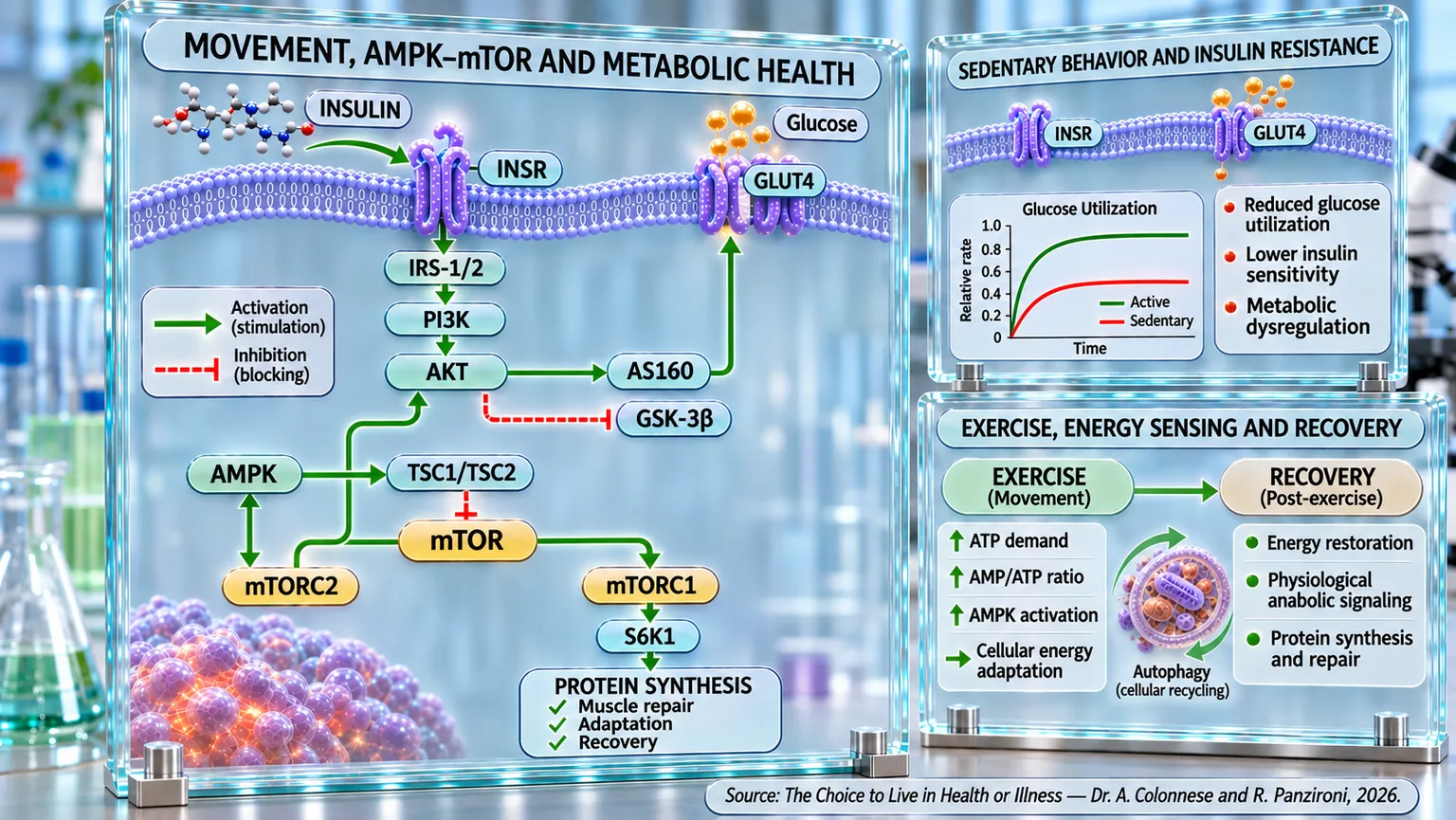
Cellular infographic showing the membrane, insulin receptor, GLUT4, AMPK-mTOR pathways, an activity-sedentary lifestyle graph, and the exercise-recovery sequence in muscle tissue.
Metabolic signaling diagram: insulin and INSR activate IRS-1/2, PI3K, AKT, AS160, and GLUT4; AMPK and mTORC1/2 link energy demand, protein synthesis, and recovery. The panels compare activity and sedentary behavior, associating the latter with reduced glucose utilization and insulin sensitivity, and illustrate the alternation between exercise and recovery.

ABSTRACT

Sedentary behavior represents a biological condition associated with metabolic, cardiovascular, and functional alterations, distinct from the simple absence of exercise. In the book "The Choice to Live in Health or Disease," Dr. A. Colonnese and R. Panzironi analyze the effects of inactivity and movement on insulin sensitivity and cellular energy adaptation mechanisms.

Epidemiological studies associate prolonged sedentary time with higher mortality, especially when immobility accumulates without interruption. Even those who exercise regularly can be affected by many hours spent sitting. Conversely, frequent breaks, light activity, and increases in daily steps are associated with more favorable outcomes, even in elderly or frail individuals. Sedentary behavior also correlates with elevated insulin levels, HOMA-IR, and inflammatory markers; reductions in activity, even brief ones, can compromise insulin sensitivity.

Aerobic, resistance, or combined exercise improves glucose uptake, GLUT4 expression, and mitochondrial function, even independently of weight loss. During muscle contraction, ATP consumption increases the AMP/ATP ratio, activating AMPK. This energy sensor promotes the utilization of glucose and fatty acids, temporarily modulating anabolic processes. Through TSC2, AMPK can reduce mTORC1 activity and promote autophagy and lipophagy, processes involved in the clearance of damaged cellular components and lipid deposits. Recent evidence also explores possible links with ferroptosis and muscle maintenance during aging.

After exertion, energy recovery allows for greater activity of AKT/mTOR signals, which are necessary for protein synthesis, repair, and adaptation. AMPK and mTOR therefore operate according to dynamic regulation, rather than as permanent antagonists. Overall, the evidence indicates that interrupting sedentary behavior and practicing regular movement can support metabolic health through distinct but complementary mechanisms. The repetition of energy consumption and recovery cycles helps explain benefits that go beyond simple caloric expenditure. This perspective values both the frequency of daily movement and the adaptations induced by structured training.

Increased mortality

Sedentary behavior is often perceived as a simple absence of movement, almost a "non-action" devoid of immediate consequences. In reality, from a biological perspective, it represents a very specific physiological state capable of progressively altering the functioning of the metabolism, the cardiovascular system, the brain, and even the mechanisms that regulate cellular survival. The human body, in fact, is designed to move continuously throughout the day. When movement is drastically reduced and the hours spent sitting begin to accumulate, the body slowly enters a state of pathological adaptation. It is as if a car engine were left running for hours without ever actually driving: initially, everything seems normal, but over time, wear, inefficiencies, and hidden damage begin to accumulate.

In recent decades, the increasing automation of work, the proliferation of electronic devices, and the transformation of daily habits have led to an impressive increase in time spent sitting. Today, many people spend a large part of their day between desks, cars, sofas, and screens, often without realizing that this prolonged exposure represents one of the most significant modifiable risk factors for mortality and chronic diseases. The most recent epidemiological evidence shows that sedentary behavior is not simply the opposite of physical activity, but a true independent pathological factor, with specific biological effects that can manifest even in individuals who exercise regularly.

One of the most important analyses on the subject highlighted that physical inactivity is responsible for 6% of coronary heart disease cases worldwide, 7% of type 2 diabetes cases, and 10% of breast and colorectal cancers. Even more striking is the data regarding mortality: approximately 9% of global premature deaths are attributable to physical inactivity, equivalent to over 5.3 million deaths annually in 2008 alone. To understand the scale of these numbers, one only needs to consider that the authors compared the health impact of sedentary behavior to that of cigarette smoking and obesity. It is therefore not just an "unhealthy lifestyle," but one of the world's leading determinants of disease and premature death (Lee et al., 2012) [1].

The reason for this extensive impact lies in the fact that movement does not just serve to burn calories. Muscle contraction represents one of the most important biological signals for the entire organism; when muscles are activated, they improve insulin sensitivity, facilitate glucose utilization, regulate lipid metabolism, stimulate circulation, promote endothelial function, and reduce systemic inflammation. Conversely, when the body remains immobile for many consecutive hours, these mechanisms begin to gradually deteriorate. Skeletal muscle activation is reduced, metabolic glucose management worsens, insulin resistance increases, and numerous cardiovascular and neuroendocrine processes are altered (Bellettiere et al., 2019) [2]; (Ajufo et al., 2025) [3].

One of the most important aspects emerging from recent studies concerns the existence of true biological risk thresholds. Until a few years ago, it was believed that damage simply increased proportionally with the number of hours spent sitting. New analyses based on accelerometers (sensors that measure an object's change in speed over time) have instead shown that beyond certain amounts of sedentary time, the risk tends to increase much more sharply. A vast meta-analysis with over one million participants identified a threshold value near 9 hours of objectively measured sedentary time per day, beyond which all-cause mortality increases significantly. In accelerometer studies, the risk grows progressively: about 22% beyond 9 hours per day, 35% around 10 hours, reaching increases close to 96% in people who spend about 14 hours a day sitting (Ku et al., 2018) [4].

These data become even more concerning in the elderly population. A subsequent meta-regression focused specifically on the elderly showed that the weighted average of sedentary time in this age group exceeds 10 hours per day, thus beyond the threshold considered critical. The authors observed that the risk of mortality increases progressively starting around 10 hours per day, reaching very significant increases at 12 and 14 hours of sedentary time. This means that a large portion of the elderly population lives daily in a biological bracket of increased risk (Ku et al., 2019) [5].

But the problem does not only concern how many hours are spent sitting. The way sedentary behavior accumulates during the day also seems to be of crucial importance. Some studies have shown that remaining immobile for long consecutive periods is much more harmful than frequently interrupting sedentary time with short movement breaks. It is the principle defined as "prolonger versus breaker": two people can spend the same total number of hours sitting, but the one who stands up regularly presents a lower biological risk compared to someone who remains immobile for prolonged periods; in fact, a prospective study conducted on nearly 8,000 U.S. adults showed that subjects with over 12.5 hours of daily sedentary time and long, continuous sedentary episodes had the highest mortality risk. Participants in the most sedentary quartile showed a risk of death over 2.6 times higher than the least sedentary subjects. Even more interesting is the fact that sedentary episodes of 60–90 consecutive minutes were particularly associated with increased mortality, while short interruptions seemed to significantly attenuate the risk (Diaz et al., 2017) [6].

From a physiological point of view, this phenomenon can be understood by imagining blood circulation as a river that requires a constant flow. When the body remains immobile for too long, venous return slows down, mechanical stimulation of the vascular walls decreases, and endothelial function worsens. In parallel, muscle metabolism enters a sort of "power-saving mode," reducing the consumption of glucose and fatty acids. As the hours pass, insulin resistance, systemic inflammation, and oxidative stress progressively increase (Ajufo et al., 2025) [3].

The cardiovascular consequences of these mechanisms are extremely significant. The OPACH study, conducted on over 5,600 elderly women, showed that participants with at least 11 hours of daily sedentary time had a 62% increase in cardiovascular risk compared to less sedentary women. The average duration of sedentary episodes was also strongly associated with cardiovascular events: every additional minute spent in continuous sedentary behavior increased cardiovascular risk by 4%. In practice, the body seems to "count" not only the total hours of inactivity but also how long it remains without receiving motor stimuli.

The strongest associations concerned ischemic heart disease, myocardial infarction, and cardiovascular death. Researchers observed that even simple light activity breaks distributed throughout the day could produce clinically significant benefits. This finding is particularly important because it suggests that prevention does not necessarily require intense workouts or complex sports programs. Even small, frequent movements seem to be biologically relevant (Bellettiere et al., 2019) [2].

The most recent evidence from the UK Biobank has further reinforced these results. In a study of nearly 90,000 participants, subjects with over 10.6 hours of daily sedentary time showed a 45% increase in the risk of heart failure and a 62% increase in cardiovascular mortality. Atrial fibrillation and myocardial infarction were also significantly associated with excessive sedentary behavior (Ajufo et al., 2025) [3].

One of the most surprising aspects emerging from this study concerns the fact that the risk remained high even in subjects who met international physical activity guidelines. In other words, practicing regular physical exercise did not seem sufficient to completely neutralize the negative effects of prolonged sedentary behavior. This concept has profound physiological implications: "being physically active" and "not being sedentary" are not the same thing. A person can train for an hour a day and still spend the rest of the day almost completely immobile. From a biological perspective, the organism still continues to experience long periods of metabolic inactivity.

Time-reallocation analyses have shown that replacing even just 30 minutes of daily sedentary time with other activities significantly reduced cardiovascular risk. This is an extremely important finding because it suggests that small changes repeated over time can produce significant cumulative effects on health (Ajufo et al., 2025) [3].

Sedentary behavior, however, does not only affect the heart and metabolism. The brain also seems to be profoundly influenced by excessive inactivity. A study published in JAMA analyzed nearly 50,000 elderly people without dementia, observing that the risk of developing cognitive impairment increased progressively beyond 10 hours of daily sedentary time. Subjects who spent about 12 hours sitting showed a 63% increase in risk, while in people who reached about 15 hours per day, the risk of dementia was more than tripled (Raichlen et al., 2023) [7].

In this case as well, moderate-to-vigorous physical activity did not completely eliminate the risk. This suggests that the brain may suffer direct effects linked to prolonged inactivity. Hypothesized mechanisms include reduced cerebral blood flow, increased systemic inflammation, worsening of insulin resistance, and increased oxidative stress. It is as if the brain, deprived for many hours of the physiological stimuli associated with movement, slowly begins to lose metabolic and vascular efficiency.

Overall, all this evidence converges toward an extremely clear principle: movement represents a continuous biological need, not an optional activity relegated to a few moments of the day. The human body is not designed to remain seated for consecutive hours. When this happens, glucose metabolism, cardiovascular function, inflammatory regulation, cerebral perfusion, and numerous other physiological systems begin to progressively alter.

For this reason, the prevention of sedentary behavior should not be limited to the simple promotion of structured physical exercise. Scientific evidence suggests that it is equally important to reduce the total time spent sitting and to frequently interrupt periods of inactivity. Even short movement breaks, distributed throughout the day, seem to exert significant biological effects.

Physical activity and reduction in mortality

Physical activity is arguably one of the most powerful biological tools for protecting longevity ever studied in preventive medicine. While a sedentary lifestyle acts slowly like a metabolic brake capable of progressively compromising the body's functioning, movement produces the opposite effect: it reactivates physiological systems, improves cardiovascular efficiency, optimizes energy metabolism, and increases the body's ability to adapt to the biological stresses of aging. It is not simply a matter of "burning calories"; every movement generates a cascade of cellular signals involving muscles, blood vessels, the brain, the immune system, and glucose metabolism.

One of the most surprising aspects to emerge from recent research is that the benefits of physical activity begin much earlier than previously thought. For many years, the dominant message was that only high levels of exercise could produce significant health benefits. New evidence shows, however, that the human body responds positively even to small increases in daily movement. It is as if the organism were biologically "programmed" to benefit from any amount of activity compared to complete immobility.

One of the largest meta-analyses available on the subject has shown that simply increasing the number of daily steps is associated with a progressive reduction in cardiovascular mortality and all-cause mortality. Analyzing over 226,000 participants, the authors observed that every increase of 1,000 steps per day reduced total mortality by 15%, while every increase of 500 steps was associated with a 7% reduction in cardiovascular mortality. Even more interesting is the fact that the benefits began to appear at around 4,000 daily steps, a threshold much lower than the famous "10,000 steps" goal (Banach et al., 2023) [8].

This finding has profound physiological and clinical implications. It means that the human body seems to respond primarily to the transition from inactivity to movement, even when the latter is relatively modest. In sedentary individuals, in fact, even small increases in locomotor activity can improve insulin sensitivity, endothelial function, lipid metabolism, and cardiorespiratory capacity. This is a fundamental concept because it makes prevention much more accessible: one does not need to suddenly become an athlete to achieve significant survival benefits.

A subsequent meta-analysis published in the Journal of the American College of Cardiology further refined these results, showing that measurable benefits on mortality appear at around 2,500 daily steps. Compared to subjects who accumulated about 2,000 steps per day, reaching about 2,517 steps was already associated with a significant reduction in total mortality, while about 2,735 steps reduced cardiovascular risk. The authors also identified an optimal range between approximately 7,000 and 9,000 daily steps, beyond which the benefits tended to progressively stabilize (Stens et al., 2023) [9].

These results challenge the idea that there is a universal "magic" threshold valid for everyone. In reality, the relationship between physical activity and health appears much more like a continuous curve: every increase in movement produces additional advantages, especially in the most sedentary subjects. From a biological perspective, this phenomenon can be explained by considering that movement acts simultaneously on numerous physiological systems. Walking increases glucose consumption by skeletal muscle, improves insulin sensitivity, stimulates circulation, reduces inflammation, and improves mitochondrial function.

A particularly interesting aspect concerns the fact that it is not just the quantity of movement that counts, but also its intensity. A large prospective study of over 403,000 US adults showed that, for the same total volume of physical activity, a higher proportion of vigorous exercise is associated with an additional reduction in mortality. Subjects in whom over 50–75% of total physical activity consisted of vigorous exercise showed a 17% reduction in mortality compared to those who performed only moderate activity (Wang et al., 2021) [10].

This phenomenon is likely linked to the specific biological adaptations induced by intense activity. Vigorous exercise produces more marked increases in VO2max (the maximum amount of oxygen your body can consume in one minute during intense physical activity), improves mitochondrial function more significantly, increases muscle mass, and leads to a more powerful improvement in cardiovascular and metabolic function. In practice, intense activity seems to "train" the body's ability to produce energy and adapt to physiological stresses more deeply.

However, one of the most important messages to emerge from recent research is that even light activity exerts significant protective effects. A meta-analysis based on accelerometric measurements showed that low-intensity activities, such as walking slowly, doing household chores, or simply moving more often throughout the day, significantly reduce the risk of mortality. Compared to subjects who performed less than 3 hours of light activity per day, those who accumulated over 7 hours per day showed a 44% reduction in the risk of death (Ku et al., 2020) [11].

This finding is extremely important, especially for the elderly, frail subjects, or people with physical limitations who cannot perform intense activities. The human body seems to benefit from any form of movement. Even activities considered "too light" according to old exercise paradigms still produce metabolic, cardiovascular, and anti-inflammatory improvements.

From a physiological point of view, the reason is intuitive: skeletal muscle does not rigidly distinguish between "training" and "daily movement." Every muscle contraction represents a metabolic stimulus. Even light movements increase energy expenditure, improve glucose clearance, promote venous return, and counteract the deleterious effects of prolonged sedentary behavior.

The evidence becomes even more relevant in the elderly population. A massive prospective study of nearly 147,000 subjects over 60 showed that high levels of physical activity are associated with a drastic reduction in the risk of cerebrovascular disease and total mortality. Maximum benefits were observed in subjects who accumulated about 2,000–2,500 MET-minutes per week of total physical activity (a standardized unit of measurement used to quantify the total volume of physical activity performed). In particular, all-cause mortality was reduced by approximately 48% in the most active subjects.

Physical activity in the elderly seems to simultaneously counteract multiple mechanisms of biological aging: sarcopenia, chronic inflammation, insulin resistance, vascular deterioration, and loss of functional autonomy. It is as if movement were able to slow down numerous "biological clocks" of aging simultaneously (Yang et al., 2024) [12].

An extremely interesting aspect is that the benefit of physical activity does not decrease with age. On the contrary, it tends to become even more important. An aggregated analysis of over 2 million individuals from four international mega-cohorts demonstrated that the protective effect of physical activity remains stable throughout adult life and appears even more pronounced in the elderly. The authors observed that, while other protective factors such as non-smoking, optimal body weight, or absence of hypertension tend to lose some of their impact with advancing age, physical activity maintains a strong association with survival (Martinez-Gomez et al., 2024) [13].

This phenomenon likely depends on the fact that physical exercise acts simultaneously on many biological systems: cardiovascular, muscular, metabolic, respiratory, immune, and neuroendocrine. Furthermore, since the absolute risk of mortality increases with age, even a similar relative reduction produces much larger absolute benefits in the elderly.

The most recent accelerometric evidence also shows that movement maintains protective effects even in frail subjects. A longitudinal study from the UK Biobank observed that frail individuals with low levels of physical activity had the highest risk of mortality, while any increase in activity, whether moderate-to-vigorous or light, was associated with a significant reduction in risk. Conversely, high levels of sedentary behavior drastically increased the risk of death and reduced life expectancy (Yang et al., 2025) [14].

One of the most encouraging aspects to emerge from these studies is that even relatively small amounts of moderate-to-vigorous activity seem sufficient to partially compensate for the negative effects of sedentary behavior. An individual analysis of four large prospective cohorts showed that prolonged sedentary behavior increased the risk of mortality primarily in subjects who performed less than 22 minutes per day of moderate-to-vigorous activity. In more active subjects, however, the association between sedentary behavior and mortality was greatly attenuated or even absent (Sagelv et al., 2023) [15].

A further particularly important element concerns the fact that the greatest relative benefits seem to occur precisely in the most sedentary and inactive subjects. A prospective study of over 109,000 Chinese adults showed that just 75 minutes of physical activity per week was associated with a significant reduction in mortality. In the elderly, the dose-response curve took on a typical "L" shape: the greatest advantage was observed when moving from complete inactivity to modest levels of movement (Wang et al., 2025) [16].

From a biological point of view, this phenomenon is perfectly consistent with human physiology. A completely sedentary organism is, in fact, in a state of severe metabolic and cardiovascular dysfunction. When even small levels of movement are reintroduced, the relative physiological improvement is enormous. It is a bit like slowly turning on a system that has been off for too long: even minimal reactivation produces immediately relevant effects.

Overall, all this evidence converges toward an extremely clear message: movement is one of the most powerful determinants of human survival. There is arguably no single drug capable of simultaneously influencing so many biological systems with such an extensive impact on longevity. Physical activity improves glucose metabolism, cardiovascular function, brain health, immune function, hormonal balance, and functional capacity. At the same time, it counteracts chronic inflammation, sarcopenia, insulin resistance, and vascular deterioration.

Exercise and insulin resistance

Insulin resistance represents one of the main pathophysiological hubs underlying modern metabolic diseases. It is a condition in which peripheral tissues, particularly skeletal muscle, the liver, and adipose tissue, become progressively less sensitive to the action of insulin. To maintain normal glycemia levels, the pancreas is therefore forced to produce increasingly larger quantities of the hormone, establishing a state of chronic hyperinsulinemia that often precedes the onset of type 2 diabetes by many years.

In recent decades, it has become increasingly clear that physical activity represents one of the most powerful physiological tools to counteract this process. Exercise does not act solely by increasing energy expenditure; it profoundly modifies cellular metabolism, improving the tissues' ability to use glucose, reducing chronic inflammation, and restoring insulin sensitivity.

One of the most relevant aspects emerging from modern research is that sedentary behavior itself seems to represent an autonomous metabolic factor capable of promoting insulin resistance, even independently of levels of moderate-to-vigorous physical activity. A study published in the Journal of Behavioral Medicine showed that time spent sitting is directly associated with increases in insulin, HOMA-IR (a blood test that measures insulin sensitivity and estimates insulin resistance), leptin, and TNF-α (a pro-inflammatory cytokine produced mainly by macrophages), as well as a reduction in the adiponectin/leptin ratio (adipose tissue hormones that participate in the regulation of metabolism and energy balance), which is considered an important indicator of cardiometabolic risk. In particular, time spent in front of screens during leisure time was associated with a worsening of insulinemia and HOMA-IR even after adjustment for age, sex, moderate-to-vigorous physical activity, and body fat percentage (Coughlin et al., 2024) [17].

This data suggests a fundamental concept: it is not enough to "work out" for a few hours a week if the rest of the day is spent almost entirely in a sedentary position. Muscle is, in fact, the main organ responsible for peripheral glucose uptake. When movement is drastically reduced, muscle glucose utilization also decreases, and the insulin response progressively worsens.

Metabolic alterations induced by sedentary behavior can appear surprisingly quickly. A study published in Diabetologia demonstrated that just 14 days of a drastic reduction in physical activity are sufficient to significantly reduce systemic and muscle insulin sensitivity, increase liver fat, worsen the lipid profile, and reduce cardiorespiratory capacity. Participants reduced their habitual activity by an average of over 10,000 steps per day, simultaneously increasing sedentary time by approximately 223 minutes per day (Bowden Davies et al., 2018) [18].

The effect of exercise on insulin sensitivity appears particularly evident in sedentary obese subjects: a study comparing high-intensity interval training (AIT) and non-linear resistance training (NRT) showed that both strategies significantly improved HOMA-IR and reduced fasting insulin after just 12 weeks. Reductions in insulin resistance reached approximately 48.5% in the NRT group and 40.8% in the AIT group.

The authors observed that these improvements occurred independently of significant changes in body weight, suggesting that exercise exerts direct metabolic effects on insulin-dependent tissues. The main mechanisms involved include increased expression of GLUT-4, improvement in post-receptor insulin signaling, an increase in glycogen synthase (an enzyme that promotes the formation of glycogen reserves), and an increase in metabolically active muscle mass (Nikseresht et al., 2014) [19].

Even relatively simple protocols seem to produce relevant benefits. A randomized clinical trial published in Sports Medicine Open demonstrated that 16 weeks of combined aerobic and resistance training significantly reduce fasting insulin and HOMA-IR in sedentary obese adults, regardless of whether the training was periodized or not. A particularly interesting aspect is that metabolic benefits were also observed with moderate-intensity and relatively low-frequency weekly protocols (Streb et al., 2021) [20].

The evidence becomes even more robust in meta-analyses. A systematic review published in Scientific Reports analyzed 24 randomized controlled trials on sedentary non-diabetic adults, demonstrating that combined training significantly reduces glycemia, fasting insulin, HOMA-IR, TNF-α, and C-reactive protein. In particular, fasting insulin showed a very marked reduction, while HOMA-IR decreased significantly.

According to the authors, the synergistic effect of combined training depends on the complementary action of aerobic and resistance exercise. Aerobic training improves lipid oxidation, mitochondrial function, and glucose uptake, while resistance training increases muscle mass and the expression of GLUT-4 transporters. The increase in muscle mass likely represents one of the most important mechanisms through which exercise improves insulin sensitivity (Silva et al., 2024) [21].

In parallel, a large systematic review on overweight and obese adults confirmed that physical activity significantly reduces insulin resistance and intrahepatic fat, with particularly marked effects in subjects affected by type 2 diabetes. High-intensity protocols seemed to produce the greatest benefits thanks to higher recruitment of glycolytic fibers (muscle fibers specialized in the rapid production of energy for intense activities), greater peripheral glucose uptake, and better metabolic flexibility (Battista et al., 2021) [22].

A particularly important aspect is that many of these improvements occur even in the absence of significant weight loss. This point is crucial because it demonstrates that the metabolic benefits of physical activity do not depend exclusively on weight loss. Movement, in fact, exerts direct effects on muscle, liver, and adipose biology.

These effects are evident as early as adolescence. A study published in the Journal of Clinical Endocrinology & Metabolism showed that 12 weeks of moderate aerobic exercise significantly improve both peripheral and hepatic insulin sensitivity in sedentary normal-weight and obese adolescents, even in the complete absence of weight loss. In obese subjects, peripheral insulin sensitivity actually increased by 59%, while hepatic sensitivity improved by 23% (van der Heijden et al., 2009) [23].

These results are particularly relevant because they demonstrate that the improvement of insulin sensitivity can occur very early, already during adolescence. Furthermore, the fact that the benefits manifest even without weight loss suggests that exercise acts directly on the intracellular pathways of insulin signaling.

Pediatric meta-analyses further confirm these data. A systematic review including 28 controlled studies demonstrated that physical activity significantly reduces glycemia, insulin, HOMA-IR, IL-6, CRP, and leptin in overweight or obese children and adolescents, while simultaneously increasing adiponectin levels (Li et al., 2024) [24]. Another meta-analysis published in JAMA Pediatrics highlighted that the most effective approaches are HIIT combined with resistance training and concurrent training. The authors also observed a non-linear dose-response relationship: clinically significant benefits appeared with as little as 900–1200 MET-minutes per week, equivalent to 2–3 weekly 60-minute sessions of moderate-to-vigorous activity. This means that even relatively moderate amounts of exercise can produce important improvements in insulin resistance (García-Hermoso et al., 2023) [25].

A further meta-analysis published in Frontiers in Endocrinology confirmed that aerobic exercise and combined training significantly improve glycemia, insulinemia, HOMA-IR, and body weight in overweight or obese children and adolescents. According to the authors, physical activity simultaneously counteracts numerous pathophysiological mechanisms involved in insulin resistance: oxidative stress, mitochondrial dysfunction, accumulation of free fatty acids, and production of pro-inflammatory cytokines (Kazeminasab et al., 2023) [26].

Overall, all this evidence converges toward an extremely clear conclusion: movement represents one of the most powerful physiological regulators of human insulin sensitivity. Physical activity improves the muscle's ability to use glucose, reduces visceral and liver fat, modulates systemic inflammation, and improves mitochondrial function.

In parallel, sedentary behavior exerts the opposite effect: it rapidly reduces insulin sensitivity, increases adipose accumulation, and progressively favors metabolic dysfunction. Even more importantly, these processes seem to begin very early and are at least partially reversible through the restoration of regular movement.

Exercise, therefore, does not act only as a tool to "burn calories," but as a true biological modulator of glucose metabolism. Every muscle contraction represents a metabolic signal capable of improving the insulin response and counteracting the mechanisms underlying modern metabolic diseases.

Exercise, AMPK and mTOR

Physical activity is one of the most effective tools humans have to preserve health and prevent numerous chronic diseases. Unlike a drug, which generally acts on a specific biological target, physical exercise produces a coordinated response that involves virtually every organ and tissue in the body. Muscles, liver, adipose tissue, the cardiovascular system, the brain, and even the immune system modify their functioning in response to movement, progressively adapting to become more efficient. In fact, every training session represents a stimulus that induces the body to consume energy, activate specific molecular programs, and subsequently rebuild itself in a slightly better condition than the previous one. It is precisely the constant repetition of these adaptations that determines, over time, the benefits we all know: greater strength, better endurance, improved glycemia control, reduction of body fat, and a lower risk of developing numerous metabolic diseases.

To understand how training exerts such profound effects, it is necessary to observe what happens inside the muscle cell the moment contraction begins. Every movement requires energy in the form of ATP, the body's main "energy currency." During exercise, ATP consumption increases rapidly, and consequently, the concentration of its degraded forms, particularly AMP and ADP, rises. This change is immediately sensed by a protein called AMPK (AMP-activated protein kinase), which is now considered the body's primary energy sensor. When energy availability decreases, AMPK goes into action just as a power plant manager would during a sudden increase in energy demand: it temporarily interrupts all non-essential activities and directs resources toward processes capable of rapidly producing new ATP (Jørgensen et al., 2006) [27]; (Richter and Ruderman, 2009) [28].

The activation of AMPK is arguably the most important molecular event induced by physical exercise. This is not a response limited exclusively to skeletal muscle, but a mechanism that simultaneously affects various metabolically active tissues. In the muscle, it rapidly increases glucose uptake through the translocation of GLUT4 transporters to the cell membrane, increases the use of fatty acids as fuel, improves mitochondrial efficiency, and temporarily reduces all processes that require high energy consumption. In parallel, in the liver, it promotes lipid oxidation, limits the synthesis of new fats, and helps maintain stable glycemia during exertion. Adipose tissue also responds to AMPK activation by increasing lipid mobilization and progressively reducing lipotoxicity (cellular damage caused by the excessive accumulation of fats and lipid derivatives), while at the brain level, exercise indirectly improves leptin and insulin sensitivity, contributing to the control of appetite and energy balance (Richter and Ruderman, 2009) [28].

This response can be interpreted as a sophisticated energy-saving program. If, during a power outage, a house automatically turns off non-essential appliances to keep only the essential ones running, in the same way, AMPK temporarily suspends all cellular processes that are most costly from an energy standpoint to focus resources on the production of ATP necessary for muscle contraction. These processes also include protein synthesis, one of the most biologically expensive mechanisms, as it requires enormous amounts of ATP, GTP, amino acids, ribosomes, and messenger RNA. During exertion, therefore, the muscle does not invest energy in building new proteins but concentrates every resource on the immediate production of energy (Jørgensen et al., 2006) [27].

For many years, this phenomenon was misinterpreted as a possible limitation of strength training. In reality, it represents exactly the opposite: an elegant study conducted using serial biopsies of the vastus lateralis muscle (a large muscle on the outer part of the thigh) in healthy volunteers showed that, immediately after a resistance training session, the activity of the AMPKα2 isoform increases by about 75%, while muscle protein synthesis temporarily decreases. Simultaneously, a reduction in the phosphorylation of the 4E-BP1 protein—one of the main regulators of the initiation of messenger RNA translation—is observed, resulting in a slowdown in the production of new proteins. This behavior does not represent a contradiction to the hypertrophic effects of training, but constitutes a refined energy conservation strategy: while the muscle is engaged in exertion, every molecule of ATP must be prioritized for contraction (Dreyer et al., 2006) [29].

The same study highlighted an extremely interesting aspect: the reduction in protein synthesis does not depend on a complete "shutdown" of the mTOR pathway, but rather on a much more sophisticated regulation. Although the phosphorylation of the 4E-BP1 protein decreases significantly during exercise, the phosphorylation of mTOR does not undergo equally marked variations. This suggests that the control of protein synthesis is not entrusted to a single on/off switch, but to a complex network of parallel regulations involving proteins such as TSC2 and other intracellular targets. This has profoundly changed the traditional view of the relationship between AMPK and mTOR, demonstrating that the two pathways are not simply antagonistic, but collaborate dynamically to adapt metabolism to the different phases of training (Dreyer et al., 2006) [29].

In fact, as soon as the exertion ends, the metabolic scenario changes rapidly. With the progressive restoration of energy reserves, AMPK activity decreases, and anabolic signals mediated by AKT and mTOR begin to increase. In this phase, the muscle shifts from energy conservation to the reconstruction of structures damaged during exercise, vigorously reactivating protein synthesis and laying the biological foundations for hypertrophy. It is therefore precisely the alternation between an initial phase of energy saving and a subsequent phase of reconstruction that explains how training manages to simultaneously improve metabolism and increase muscle mass and strength (Dreyer et al., 2006) [29]; (Mingzheng and You, 2025) [30].

The importance of this temporal regulation has been further confirmed by the most recent research dedicated to muscle aging. Today we know that AMPK and mTOR do not function as two systems constantly in competition, but as two conductors who intervene at different moments of the same biological concert. During exercise, AMPK prevails, favoring ATP production, the mobilization of energy substrates, the activation of autophagy, and the improvement of mitochondrial function. Once the session is over, when energy availability is restored and adequate nutrients are present, the physiological activation of mTOR prevails instead, promoting protein synthesis, muscle fiber remodeling, and functional recovery. This orderly succession allows the muscle to adapt without compromising either energy balance or growth capacity (Mingzheng & You, 2025) [30].

The importance of this molecular cascade was also confirmed by a randomized study that compared six weeks of functional resistance training and traditional resistance training in sedentary young men. Although the two protocols used different intensities, both resulted in a significant increase in lean mass, strength, power, and muscle endurance. Functional training, characterized by lower loads and a high number of repetitions, also favored a greater reduction in fat mass, likely due to a higher overall energy cost. Traditional training, performed at higher intensities, resulted in a more marked activation of AMPK (Zuo et al., 2023) [31].

The effectiveness of training becomes even more evident when analyzed in the context of aging. Over the years, skeletal muscle develops progressive anabolic resistance and reduced insulin sensitivity, accompanied by a decrease in mitochondrial function, the accumulation of intramuscular lipids, an increase in oxidative stress, and a loss of the ability to adapt rapidly to energy demands. However, physical exercise represents the most powerful physiological intervention capable of restoring this balance. During aerobic activity, AMPK activation prevails, while in the recovery phase, the physiological activation of mTOR promotes protein synthesis and the maintenance of muscle mass. The integration of aerobic training and resistance training is currently the most effective strategy to simultaneously counteract insulin resistance and sarcopenia (Mingzheng and You, 2025) [30].

In recent years, a further mechanism through which physical activity protects muscle has emerged: the regulation of autophagy. During muscle contraction, the increase in the AMP/ATP ratio activates AMPK, which physiologically inhibits mTORC1 through TSC2. This action reactivates the autophagy-lysosome system, allowing the cell to eliminate damaged mitochondria, aggregated proteins, and lipid droplets accumulated over time. Through so-called lipophagy (degradation of fats stored within the cell), intracellular lipid deposits are also degraded, further improving insulin sensitivity and reducing metabolic inflammation (Zhang et al., 2026) [32].

These observations have been further strengthened by recent experimental studies that have identified the AMPK pathway as one of the main mechanisms through which exercise also protects muscle from ferroptosis, a particular form of cell death characterized by iron accumulation and intense lipid peroxidation. In animal models of sarcopenic obesity induced by a high-fat diet, aerobic training reduced lipid accumulation in the muscle, improved strength, normalized iron metabolism, increased antioxidant defenses, and reactivated AMPK phosphorylation (Ru et al., 2026) [33].

Further confirmation of the centrality of these metabolic pathways comes from studies on human aging. In elderly men, a significant reduction in the activity of the AMPK pathway and mTOR signaling has been observed compared to young subjects, indicating that with age, both the mechanisms responsible for energy production and those involved in protein synthesis are attenuated. This suggests that the benefits of training do not depend on a chronic and permanent activation of metabolic pathways, but on the constant repetition of the stimuli induced by each session, which over time translate into an improvement in muscle function and a slowing of the decline associated with age (Li et al., 2012) [34].

Taken together, these findings profoundly change the way we interpret training. Physical exercise is not simply a means to burn calories, but a biological stimulus capable of reprogramming cellular metabolism. Each session activates an orderly sequence of events: initially, AMPK preserves energy balance by increasing ATP availability and temporarily suspending the most expensive processes through the inhibition of mTOR; subsequently, through the reduction of AMPK and the reactivation of mTOR, the programs for repair, mitochondrial biogenesis, autophagy, and protein synthesis are activated, making the muscle more efficient, stronger, and metabolically more flexible. It is precisely the constant repetition of this cycle of consumption, recovery, and adaptation that explains why training is currently one of the most effective tools for improving insulin sensitivity, preventing obesity, countering sarcopenia, and reducing the risk of the main chronic diseases associated with aging.

Conclusions

Taken together, the scientific evidence analyzed shows that a sedentary lifestyle and physical activity represent two profoundly different biological states. The process begins with sedentary behavior, which is not simply the absence of exercise, but a state capable of altering metabolism, the cardiovascular system, and brain function. Epidemiological studies document an increase in mortality as the hours spent sitting accumulate, which is particularly evident beyond certain daily thresholds. The way in which inactivity is accumulated is also important: long, consecutive sedentary periods are more unfavorable than the same total amount of time broken up by frequent movement breaks.

The next step shows that exercising and interrupting sedentary behavior are not equivalent concepts. Even individuals who meet physical activity recommendations may maintain an increased risk when they spend most of the day immobile. Conversely, replacing part of sedentary time with movement, even light movement, is associated with cardiovascular and metabolic benefits. Evidence on mortality reinforces this relationship: increasing daily steps progressively reduces risk, and the benefits begin as soon as one moves from inactivity to relatively modest amounts of movement. Higher intensities can produce further adaptations, but light activity also retains favorable effects, especially in the elderly and frail individuals.

The third step concerns insulin resistance. A sedentary lifestyle is associated with an increase in insulin, HOMA-IR, and inflammatory mediators, while even short periods of drastic reduction in activity can rapidly decrease muscle and systemic insulin sensitivity. Exercise produces the opposite effect: aerobic, resistance, and combined training improve HOMA-IR, glucose uptake, mitochondrial function, and GLUT4 expression. A particularly significant element is that these improvements can occur even without weight loss, demonstrating a direct action of exercise on the metabolic biology of tissues.

To understand this action, we must reach the cellular level. During contraction, ATP consumption increases and the AMP/ATP ratio rises, activating AMPK, the cell's energy sensor. AMPK promotes glucose uptake through GLUT4, fatty acid utilization, and energy production, while temporarily suspending more costly anabolic processes.

Here, the dynamic relationship between AMPK and mTOR emerges. During exertion, AMPK prevails: the body concentrates resources on ATP production and temporarily limits protein synthesis. Once exercise is finished, with energy restored, AMPK decreases and anabolic signals mediated by AKT/mTOR increase, allowing for protein synthesis, repair, and muscle adaptation. The two pathways, therefore, do not represent simple antagonistic switches, but temporally coordinated systems.

The activation of AMPK during exercise also intervenes on mTORC1 through TSC2, promoting autophagy and lipophagy. The cell can thus eliminate damaged mitochondria, aggregated proteins, and lipid deposits, contributing to improved insulin sensitivity and the reduction of metabolic inflammation. The most recent evidence also links this response to protection against ferroptosis and the maintenance of muscle function during aging.

Overall, a coherent sequence emerges in a sedentary lifestyle: reduced muscle activity → lower glucose utilization → insulin resistance and inflammation; conversely, with physical activity: movement → ATP consumption → AMPK activation → mTORC1 modulation → autophagy and substrate utilization → subsequent physiological reactivation of mTOR → protein synthesis, recovery, and adaptation. It is precisely the repetition of this cycle that explains why movement is not just calorie consumption, but a powerful regulator of insulin sensitivity, muscle function, and metabolic aging.

References

[1] Effect of physical inactivity on major non-communicable diseases worldwide: an analysis of burden of disease and life expectancy

Lee et al., 2012

Lancet, 2012, 380(9838):219-229.

[2] Sedentary Behavior and Cardiovascular Disease in Older Women: The Objective Physical Activity and Cardiovascular Health (OPACH) Study

Bellettiere et al., 2019

Circulation, 2019, 139(8):1036-1046.

[3] Accelerometer-Measured Sedentary Behavior and Risk of Future Cardiovascular Disease

Ajufo et al., 2025

Journal of the American College of Cardiology, 2025, 85(5):473-486.

[4] A cut-off of daily sedentary time and all-cause mortality in adults: a meta-regression analysis involving more than 1 million participants

Ku et al., 2018

BMC Medicine, 2018, 16(1):74.

[5] A Threshold of Objectively-Assessed Daily Sedentary Time for All-Cause Mortality in Older Adults: A Meta-Regression of Prospective Cohort Studies

Ku et al., 2019

Journal of Clinical Medicine, 2019, 8(4):564.

[6] Patterns of Sedentary Behavior and Mortality in U.S. Middle-Aged and Older Adults: A National Cohort Study

Diaz et al., 2017

Annals of Internal Medicine, 2017, 167(7):465-475.

[7] Sedentary Behavior and Incident Dementia Among Older Adults

Raichlen et al., 2023

JAMA, 2023, 330(10):934-940.

[8] Association of Daily Step Count With All-Cause and Cardiovascular Mortality: A Meta-Analysis

Banach et al., 2023

European Journal of Preventive Cardiology, 2023, 30(18):1975-1985.

[9] Relationship of Daily Step Counts to All-Cause Mortality and Cardiovascular Events

Stens et al., 2023

Journal of the American College of Cardiology, 2023, 82(15):1483-1494.

[10] Association of Physical Activity Intensity With Mortality: A National Cohort Study of 403 681 US Adults

Wang et al., 2021

JAMA Internal Medicine, 2021, 181(2):203-211.

[11] Device-Measured Light Physical Activity and Mortality: A Meta-Analysis

Ku et al., 2020

Scandinavian Journal of Medicine & Science in Sports, 2020, 30(1):13-24.

[12] Associations Between Physical Activity and Incident Cerebrovascular Disease or All-Cause Mortality in 146,742 Older Adults: A 13-Year Prospective Cohort Study

Yang et al., 2024

Journal of the American Medical Directors Association, 2024, 25(7):105010.

[13] Physical Activity and All-Cause Mortality by Age Across 4 Multinational Mega Cohorts

Martinez-Gomez et al., 2024

JAMA Network Open, 2024, 7(11):e2446802.

[14] Accelerometer-Measured Physical Activity, Frailty, All-Cause Mortality and Life Expectancy in Middle-Aged and Older Adults: A Longitudinal Study of the UK Biobank

Yang et al., 2025

BMC Medicine, 2025, 23(1):125.

[15] Device-Measured Physical Activity, Sedentary Time, and Risk of All-Cause Mortality: An Individual Participant Data Analysis of Four Prospective Cohort Studies

Sagelv et al., 2023

Nordström A, Saint-Maurice PF, Løvsletten O, Wilsgaard T, Ekelund U, Tarp J British Journal of Sports Medicine, 2023, 57(22):1457-1463.

[16] Dose-Response Relationship Between Physical Activity and All-Cause Mortality in Chinese Adults

Wang et al., 2025

Scientific Reports, 2025, 15(1):43359.

[17] Associations Between Sedentary Behavior, Screen Time, Inflammation and Insulin Resistance Biomarkers

Coughlin et al., 2024

Journal of Behavioral Medicine, 2024, 47(5):828-838.

[18] Short-Term Decreased Physical Activity With Increased Sedentary Behavior Causes Metabolic Derangements and Altered Body Composition

Bowden Davies et al., 2018

Diabetologia, 2018, 61(6):1282-1294.

[19] Effects of Nonlinear Resistance and Aerobic Interval Training on Cytokines and Insulin Resistance in Sedentary Obese Men

Nikseresht et al., 2014

Journal of Strength and Conditioning Research, 2014, 28(9):2560-2568.

[20] Effects of Non-Periodized and Linear Periodized Combined Training on Insulin Resistance Indicators in Adults With Obesity

Streb et al., 2021

Sports Medicine Open, 2021, 7:69.

[21] Effects of Combined Physical Training on Glucose Metabolism and Inflammatory Markers in Sedentary Adults: A Systematic Review and Meta-Analysis

Silva et al., 2024

Scientific Reports, 2024, 14:1936.

[22] Effects of Exercise Training on Cardiometabolic Health in Overweight or Obese Adults

Battista et al., 2021

Obesity Reviews, 2021, 22(Suppl 4):e13269.

[23] Aerobic Exercise Increases Peripheral and Hepatic Insulin Sensitivity in Sedentary Adolescents

van der Heijden et al., 2009

Journal of Clinical Endocrinology & Metabolism, 2009, 94(11):4292-4299.

[24] Effects of Exercise Training on Glucose Metabolism Indicators and Inflammatory Markers in Obese Children and Adolescents: A Meta-Analysis

Li et al., 2024

World Journal of Diabetes, 2024, 15(6):1353-1366.

[25] Exercise and Insulin Resistance Markers in Children and Adolescents With Excess Weight: A Systematic Review and Network Meta-analysis

García-Hermoso et al., 2023

JAMA Pediatrics, 2023, 177(12):1276-1284.

[26] Effects of Exercise Training on Insulin Resistance in Children and Adolescents With Overweight or Obesity: A Systematic Review and Meta-Analysis

Kazeminasab et al., 2023

Frontiers in Endocrinology, 2023, 14:1178376.

[27] Role of AMPK in Skeletal Muscle Metabolic Regulation and Adaptation in Relation to Exercise

Jørgensen et al., 2006

The Journal of Physiology. 2006;574(Pt 1):17–31.

[28] AMPK and the Biochemistry of Exercise: Implications for Human Health and Disease

Richter e Ruderman, 2009

Biochemical Journal. 2009;418(2):261–275.

[29] Resistance Exercise Increases AMPK Activity and Reduces 4E-BP1 Phosphorylation and Protein Synthesis in Human Skeletal Muscle

Dreyer et al., 2006

The Journal of Physiology. 2006;576(Pt 2):613–624.

[30] AMPK/mTOR balance during exercise: implications for insulin resistance in aging muscle

Mingzheng e You, 2025

Molecular and Cellular Biochemistry. 2025;480:5941–5953.

[31] Functional and Traditional Resistance Training Acute and Chronic Effects on Muscular Fitness in Young Men Through the AMPK/PGC-1α/Irisin Signaling Pathway

Zuo et al., 2023

Environmental Health and Preventive Medicine. 2023;28:69.

[32] Exercise as a Metabolic Regulator: Targeting in the AMPK/mTOR–Autophagy Crosstalk to Counteract Sarcopenic Obesity

Zhang et al., 2026

Aging and Disease. 2026;17(4):1904–1915.

[33] Exercise Improves Sarcopenic Obesity Through Inhibition of Ferroptosis and Activation of the AMPK/ACC Pathway

Ru et al., 2026

International Journal of Molecular Sciences. 2026;27(3):1187.

[34] Reduced AMPK-ACC and mTOR Signaling in Muscle From Older Men, and Effect of Resistance Exercise

Li et al., 2012

Mechanisms of Ageing and Development. 2012;133(11–12):655–664.