
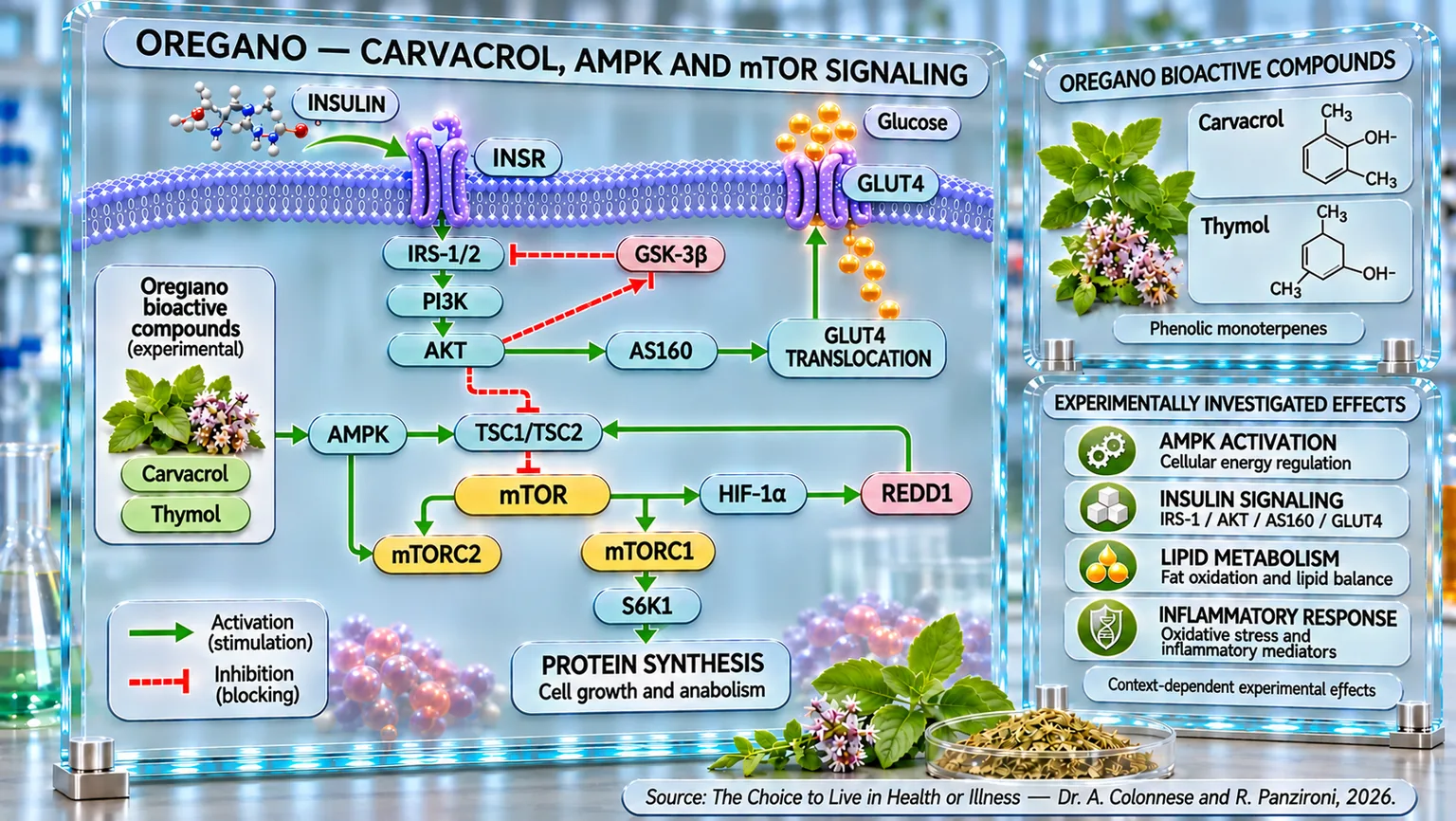
When observing the behavior of carvacrol in various chronic diseases, it becomes clear that this compound does not act on individual symptoms, but rather intervenes in common pathophysiological mechanisms, particularly chronic inflammation, oxidative stress, metabolic dysfunction, and alterations in cell survival signaling. It is precisely this cross-cutting action that makes oregano a spice of particular interest in the context of metabolic and immune medicine.
In diabetes mellitus, carvacrol has established itself as a promising molecule due to its ability to improve glycemic control through multiple levels of regulation. Experimental evidence shows that carvacrol reduces glycemia both by acting on the intestinal absorption of carbohydrates, through the inhibition of digestive enzymes, and by improving insulin sensitivity in peripheral tissues through increased expression of GLUT-4 transporters (Hoca et al., 2024) [6]. At the same time, carvacrol reduces oxidative stress and the production of pro-inflammatory cytokines, two factors that fuel insulin resistance over time. In this sense, its effect is not to "force" glycemia downward, but to lighten the metabolic load that forces the body to maintain chronically high levels of insulin.
This ability to modulate inflammation and oxidative response also becomes particularly evident in the context of asthma, a chronic inflammatory disease of the airways in which oxidative stress, bronchial hyperreactivity, and cytokine imbalance reinforce each other. Carvacrol has been shown to reduce mucus production and bronchial resistance in experimental models of asthma, acting through the inhibition of key inflammatory mediators such as IL-4, IL-5, IL-13, and TNF-α (Neopane and Kushwaha, 2025) [7]. Added to these effects is a moderate bronchodilator action, mediated by the inhibition of calcium channels and the release of nitric oxide, which contributes to improving respiratory function. It is as if carvacrol simultaneously reduces underlying inflammation and excessive airway reactivity, acting on both the cause and the consequences of the pathological process.
Another area where carvacrol shows a particularly solid action is that of gastrointestinal diseases, starting with gastric ulcers. In models of induced ulcers, carvacrol has demonstrated marked gastroprotective activity, reducing the extent of lesions, preserving the mucosal barrier, and normalizing acid secretion (Badr et al., 2023) [8]. This effect is mediated by a reduction in the production of reactive oxygen species and the suppression of inflammatory mediators. In parallel, from a functional point of view, it is as if carvacrol simultaneously reinforces the stomach's defensive "walls" and extinguishes the oxidative fire that undermines its integrity.
The role of carvacrol becomes even more articulated when moving to neurodegenerative diseases, such as Alzheimer's disease and Parkinson's disease. In these contexts, oxidative stress and neuroinflammation represent true drivers of progressive neurodegeneration. Preclinical evidence indicates that carvacrol improves cognitive and motor functions, lowers levels of pro-inflammatory cytokines, and protects neurons (Javed et al., 2023) [9]. Particularly relevant is carvacrol's ability to cross the blood-brain barrier and act directly on the neuronal microenvironment, creating conditions more favorable to survival and synaptic plasticity. In this sense, carvacrol does not merely slow down damage, but contributes to improving the resilience of nervous tissue.
A separate chapter concerns the potential of carvacrol in the oncological context, particularly in gastrointestinal cancers. Preclinical evidence shows that carvacrol reduces tumor proliferation, induces cell cycle arrest and apoptosis, inhibits angiogenesis, and limits invasion and metastasis processes in models of gastric, pancreatic, hepatic, and colorectal carcinoma. It is significant to note that carvacrol shows greater selectivity toward tumor cells compared to healthy ones, suggesting a potential role as a therapeutic adjuvant rather than an indiscriminate cytotoxic agent. The nano-formulation strategies described in the most recent studies aim precisely to improve bioavailability and targeting, making the transition from preclinical research to clinical application more realistic (Patwa et al., 2025) [10].
Taken together, this evidence outlines carvacrol as a multi-target biological modulator, capable of intervening in seemingly different diseases that are united by a common foundation of chronic inflammation, oxidative stress, and metabolic dysregulation. Included in a lifestyle oriented toward glycemic stability, the reduction of hyperinsulinemia, and the containment of low-grade inflammation, oregano does not act as an isolated remedy, but as a spice capable of supporting and strengthening the physiological rebalancing processes that the body struggles to maintain in the modern context.