


Syzygium aromaticum essential oil: a study on the role of eugenol
In 2025, the Algerian researcher Rahim and colleagues, in the Turkish Journal of Biology, evaluated the composition of Syzygium aromaticum essential oil and the contribution of eugenol to its antioxidant, antibacterial, antifungal, insecticidal, and repellent activities in laboratory tests. The study compared the natural mixture with its purified main component.
- Published 06/11/2026
- Updated 10/11/2026
- Article history
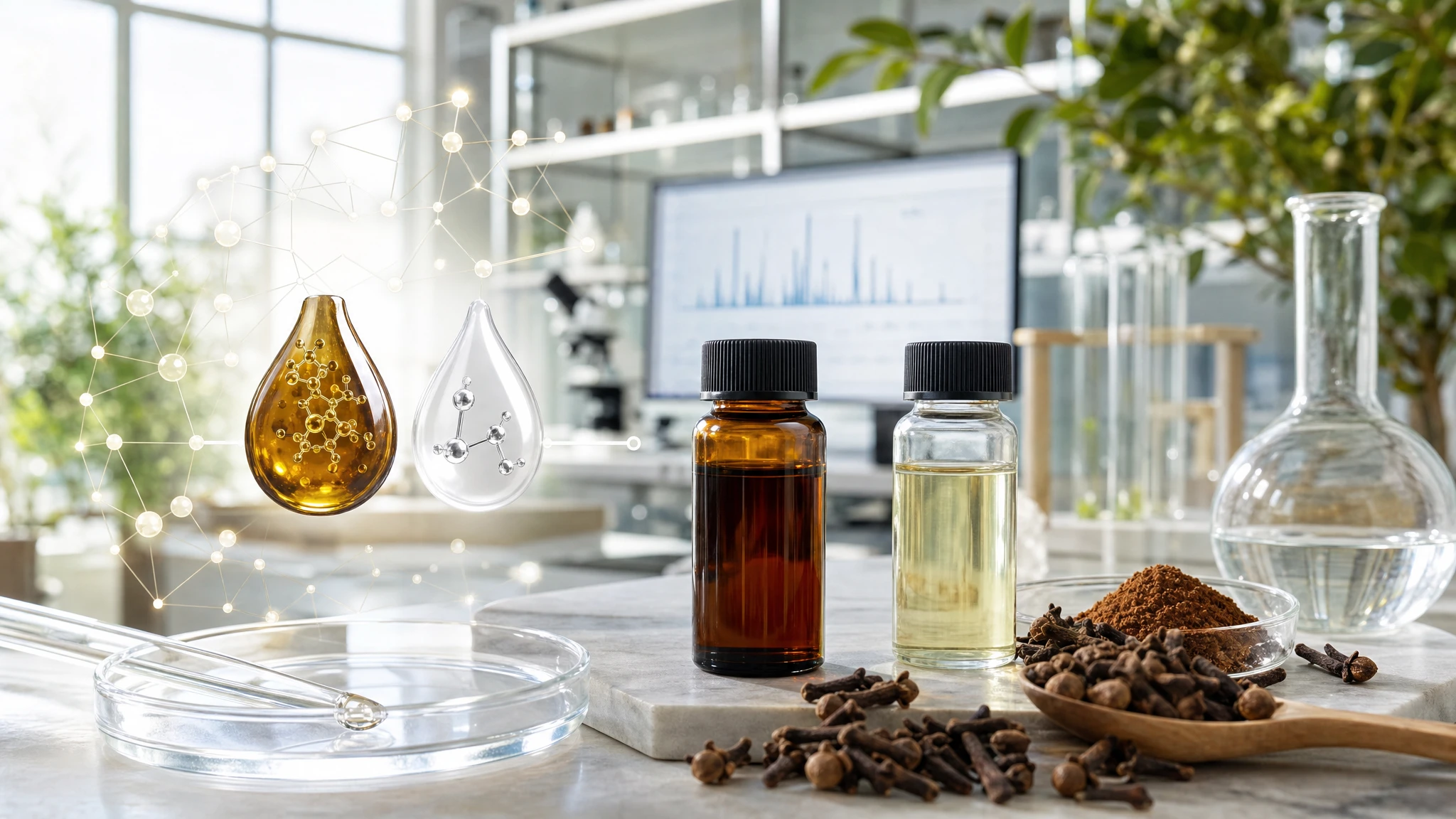
ABSTRACT : WHAT THE SCIENCE SAYS
The research compared the essential oil obtained from Syzygium aromaticum buds with isolated eugenol. It examined the chemical composition, the ability to neutralize radicals in vitro, and activity against microorganisms and insects. The results indicate that while eugenol is important, it does not account for all the properties of the plant mixture.
The authors' summary describes an experimental laboratory study on Syzygium aromaticum essential oil, extracted via hydrodistillation from 50 grams of powdered buds. Gas chromatography-mass spectrometry, or GC-MS (a technique that separates and identifies the molecules present in a mixture), detected 18 compounds. Eugenol was the most abundant at 79.21%, followed by beta-caryophyllene, eugenyl acetate, and humulene. In the DPPH test, which measures the ability to react with a stable radical in a test tube, eugenol showed a lower IC50 value than the oil: 5.60 versus 15.07 micrograms/mL. A lower IC50 indicates that less substance was needed to reduce the test signal by 50%, not that it prevents diseases in humans. Conversely, against bacteria and fungi cultured on plates, the oil produced larger zones of inhibition than eugenol. In tests on the lentil pest Bruchus lentis, both had dose- and time-dependent effects; eugenol was faster at low doses. Computational calculations also proposed possible ways in which eugenol reacts with radicals in aqueous or lipid media. These are molecular predictions, not clinical evidence.
What this research analyzed
Rahim and colleagues investigated whether eugenol, an aromatic molecule from the phenol family, could account for the activities observed in the essential oil of Syzygium aromaticum buds on its own. Essential oil is a concentrated mixture of volatile substances obtained from the plant; it is neither identical to the bud used as a spice nor to pure eugenol.
The team extracted the oil via hydrodistillation—by dragging volatile substances with steam—and measured its composition using GC-MS. They then compared the oil and pure eugenol in tests on molecules, bacterial and fungal cultures, and adults of Bruchus lentis, an insect that damages stored lentils. The activities against microorganisms and insects therefore concern non-human experimental models.
The antioxidant component combined the DPPH test with DFT calculations, or density functional theory, a computational method that estimates how electrons and molecules might react. Simply put, the model evaluates which chemical steps are plausible when eugenol encounters a radical. It does not observe these steps directly within an organism.
Research data
Evaluating the multifaceted bioactivity of Syzygium aromaticum essential oil: the central role of eugenol
- The oil obtained via hydrodistillation had a yield of 8.9% and contained 18 compounds; eugenol accounted for 79.21%.
- In the DPPH test, the IC50 was 15.07 ± 2.12 micrograms/mL for the oil and 5.60 ± 1.91 for eugenol.
- Against Staphylococcus aureus, the inhibition zone was 31.3 ± 0.5 mm for the oil and 21.8 ± 0.3 mm for eugenol.
What results emerge from the study
The most immediate result is that the analyzed oil was dominated by eugenol, but it was not composed solely of this substance. Eugenol accounted for 79.21%; beta-caryophyllene, eugenyl acetate, and humulene were present at 11.60%, 6.27%, and 1.56%, respectively. This profile describes that specific sample and extraction method, not all available clove oils.
In vitro, eugenol and the oil reduced the DPPH signal in a concentration-dependent manner. Eugenol had an IC50 of 5.60 ± 1.91 micrograms/mL, compared to 15.07 ± 2.12 for the oil. However, ascorbic acid and Trolox, used as references, showed lower values. This data indicates chemical reactivity in the test, not a proven antioxidant effect in human tissues.
In plate tests, the oil was more active than isolated eugenol against Bacillus cereus, Staphylococcus aureus, Aspergillus niger, and Trichoderma. For S. aureus, the zones without growth were 31.3 ± 0.5 mm with the oil and 21.8 ± 0.3 mm with eugenol, with the difference reported as significant. This suggests that other components of the mixture may contribute to the effect, but it does not definitively identify synergy.
In the B. lentis model, both treatments increased mortality and repellency with dose and time. At 72 hours, eugenol had an LC50 of 0.008 microliters per insect, versus 0.021 for the oil; the LC50 is the estimated amount capable of causing mortality in 50% of the tested insects. This result is useful for protecting stored products, not for evaluating efficacy or safety in humans.
Why this study is relevant
The primary value of this research lies in the direct comparison between a plant mixture and its predominant molecule. It shows that the contribution of eugenol changes depending on the measured outcome: in the DPPH test and the insect model, it appears particularly relevant, whereas against the four microorganisms studied, the whole oil yielded greater results.
This distinction avoids a frequent oversimplification: stating that a molecule is the most abundant does not mean it alone determines every activity of the mixture. Minor components can modify stability, diffusion in culture media, or interaction with microbial membranes. This is a hypothesis consistent with the comparative data, not a demonstration of the mixture's molecular mechanism.
DFT calculations add a theoretical layer. In an aqueous environment, the authors estimate that a small portion of deprotonated eugenol may react primarily by transferring an electron; in lipid media, they instead predict a greater role for hydrogen atom transfer. These are potential chemical explanations that require experimental confirmation in more complex biological systems.
Study limitations and what it does NOT demonstrate
This is a preclinical laboratory study. It did not involve human participants, did not evaluate the dietary intake of the buds, and did not test the essential oil as a treatment for infection, inflammation, or other clinical conditions. Consequently, it does not allow for the establishment of effective or safe doses for people.
The zones of inhibition on the plate indicate that the growth of specific microorganisms was hindered under the test conditions. They do not equate to a therapeutic effect in a real infection, where tissues, the immune system, metabolism, substance distribution, and possible side effects come into play.
The DPPH test also has an inherent limitation: it measures the reaction with an artificial radical in solution. It does not directly measure oxidative stress in the body. Furthermore, the buds were purchased on the market, and the oil depends on the origin of the raw material, storage, and extraction. The results, therefore, cannot be automatically transferred to every clove-based product.
Independent confirmatory evidence
Initial confirmation of the composition → chemical reactivity chain comes from Kiki, in an experimental study on an essential oil analyzed via GC-MS. Eugenol accounted for 76.78% of the mixture, and the sample showed activity in the DPPH test, with an IC50 of 50 micrograms/mL [1]. The relationship with the study by Rahim and colleagues is direct due to the predominant presence of eugenol and the type of test, but the different quantitative value highlights that activity varies between preparations. This confirmation is moderate and remains limited to in vitro tests.
Teles and colleagues directly compared oil and eugenol in experiments on Staphylococcus aureus. The oil, containing 53.23% eugenol, had a minimum inhibitory concentration, or MIC (the lowest quantity that blocks visible growth), of 50 micrograms/mL; for eugenol, the MIC was 250 micrograms/mL [2]. This data supports the transition from mixture → greater antibacterial activity in that model and strengthens the hypothesis of evidence beyond eugenol. However, it does not demonstrate that the phenomenon occurs for all bacteria or in patients.
Xu and colleagues studied bud oil and eugenol against S. aureus ATCC 25923, a standardized bacterial strain. Both had an MIC of 0.625 mg/mL, and the oil contained 76.23% eugenol; the experiments also detected alterations in the bacterial membrane and cell synthesis processes [3]. This confirmation is direct regarding antibacterial activity and the eugenol-rich profile, but it does not definitively isolate the weight of each compound in the mixture.
Conflicting evidence
The differences between the whole oil and eugenol do not follow a single trend. Biernasiuk and colleagues examined five reference strains and 60 clinical isolates of Candida. The oil and eugenol showed overlapping MIC ranges, equal to 0.25–2 mg/mL; in the 60 isolates, the MIC50 was 0.5 mg/mL for both [4]. This result does not confirm a general superiority of the oil over the isolated component. It remains an in vitro study and does not demonstrate efficacy in human candidiasis.
In a different model, Sempere-Ferre and colleagues compared 300 micrograms/mL of eugenol and oil against three phytopathogenic fungi. Eugenol was found to be more active than the oil in all species and completely inhibited Verticillium dahliae, despite the oil containing 87.3% eugenol [5]. The discrepancy suggests that the effect depends on the fungal species, concentration, and mixture composition. This confirms context-dependency, not evidence applicable to human infections.
Overall, the evidence indicates that eugenol is often important, but it does not allow for the establishment of a rule valid for all biological activities of the essential oil.
Comparative overview
Comparison between independent studies and the research by Rahim and colleagues: all data are derived from experimental models, not clinical trials.
| Publication | Model and main result | Relation to the study by Rahim et al. | Interpretative limitation |
|---|---|---|---|
| Kiki, 2023 [1] | Oil with 76.78% eugenol; DPPH activity with IC50 of 50 micrograms/mL. | Confirms the eugenol-rich profile and reactivity in the anti-radical test. | In vitro test; sample and method not comparable. |
| Teles et al., 2021 [2] | On S. aureus, oil MIC 50 micrograms/mL; eugenol MIC 250 micrograms/mL. | Confirms that the oil can outperform isolated eugenol against a bacterium. | Bacterial culture, not human infection. |
| Xu et al., 2016 [3] | Oil with 76.23% eugenol; MIC of oil and eugenol 0.625 mg/mL against S. aureus. | Confirms antibacterial activity and involvement of the microbial membrane. | Single standardized strain; limited comparison. |
| Biernasiuk et al., 2023 [4] | Five reference strains and 60 Candida isolates; similar activity of oil and eugenol. | Downplays the idea that the oil is always more active than the isolated component. | In vitro study on yeasts, without clinical outcomes. |
| Sempere-Ferre et al., 2026 [5] | Eugenol more active than the oil against three phytopathogenic fungi; complete inhibition of one species. | Shows an opposite outcome, dependent on the fungus and the model. | Plant fungi, not human disease agents. |
Editorial conclusion
The study by Rahim and colleagues compared an essential oil of Syzygium aromaticum with eugenol, its most abundant component. The analyzed sample contained mainly eugenol, but also beta-caryophyllene, eugenyl acetate, and other compounds. In vitro, eugenol reacted more effectively than the oil in the DPPH test. In assays against bacteria and fungi, however, the whole oil produced larger zones of inhibition. In tests on pest insects, both showed dose- and time-dependent activity, with eugenol acting more rapidly at low doses. Independent publications confirm that eugenol is often predominant and biologically active, but they also show different results depending on the microorganism, preparation, and concentration. The most solid finding is therefore the complexity of the mixture: eugenol matters, but it does not automatically replace the oil. All these tests are preclinical. They do not demonstrate therapeutic benefits, dosages, or the safety of the essential oil in people.
References
[1] In Vitro Antiviral Potential, Antioxidant, and Chemical Composition of Clove (Syzygium aromaticum) Essential Oil
[2] GC-MS Characterization of Antibacterial, Antioxidant, and Antitrypanosomal Activity of Syzygium aromaticum Essential Oil and Eugenol
[3] Chemical Composition, Antibacterial Properties and Mechanism of Action of Essential Oil from Clove Buds against Staphylococcus aureus
[4] Clove Essential Oil and Its Main Constituent, Eugenol, as Potential Natural Antifungals against Candida spp. Alone or in Combination with Other Antimycotics Due to Synergistic Interactions
[5] Inhibitory Effects and Mode of Action of Pure Eugenol Versus Clove Essential Oil on Key Phytopathogenic Fungi
Editorial note
Artificial Intelligence was used solely as a tool to support editorial and documentary work. All content, interpretations, bibliographic citations and conclusions have been verified, reviewed and approved by the author, who assumes full scientific responsibility for them.
The manuscript was also subject to independent peer review prior to publication.
To ensure maximum transparency, the article's complete history — including the dates of submission, review, acceptance and publication, as well as information on the peer review process — is available on the dedicated Article History page.