


Syzygium aromaticum: tropical cultivation, buds, and processing according to a recent review
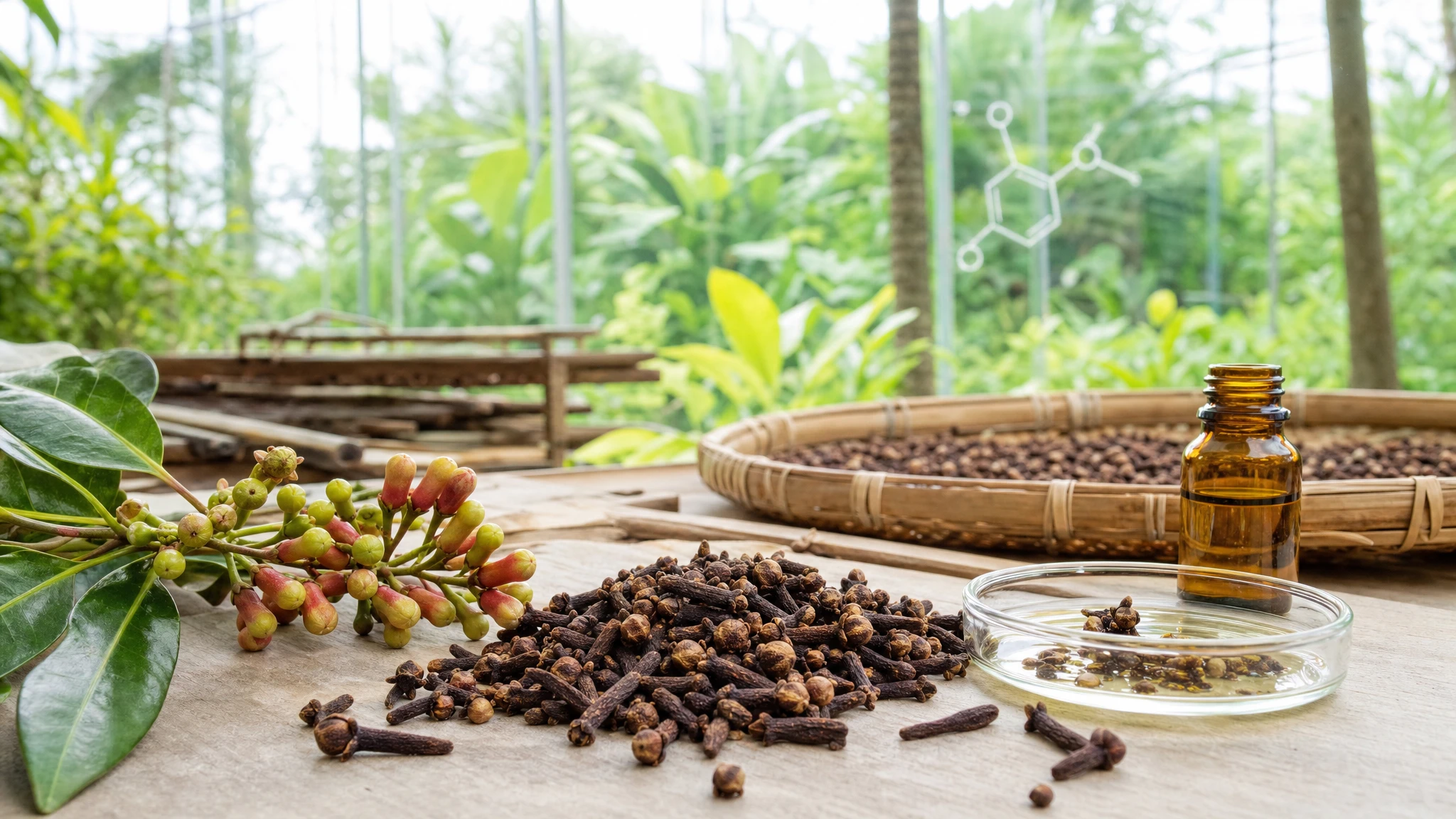
In 2026, South Korean researcher Gil and colleagues published a review in the Chinese Journal of Integrative Medicine on the ethnopharmacological uses and pharmacological activities of Syzygium aromaticum, the plant species from which cloves are obtained. The work connects the botanical description of the plant with research on its composition, herbal preparations, and experimental results reported in the available literature. Study DOI.
- Published 13/10/2026
- Updated 15/10/2026
- Reviewed 15/10/2026
- Article history
ABSTRACT : WHAT THE SCIENCE SAYS
This publication examines Syzygium aromaticum, the plant from which cloves are derived, gathering data on traditional uses, composition, and activities observed in various models. To interpret the spice in the context of quality, the central point is to distinguish between the plant, the dried bud, the essential oil, and the extracts.
The authors' synthesis is a literature review, not a new experiment on humans, animals, or crops. It collects studies dedicated to ethnopharmacological uses—that is, traditional uses documented in different cultures—and the pharmacological activities attributed to Syzygium aromaticum. In the food context, the publication primarily helps to correctly categorize the spice: cloves are flower buds that have been harvested and dehydrated, while essential oil and extracts are more concentrated preparations and are not equivalent to the whole spice. The review describes the presence of aromatic compounds, including eugenol, and reports results from various types of research. These include chemical analyses and preclinical trials, i.e., studies in test tubes, on cells, or on animals. The practical message regarding the quality of the raw material is that botanical origin, the bud's developmental stage, harvesting, drying, and storage can influence the final chemical profile. However, the review does not establish a universal standard that allows for the classification of every commercial batch. Furthermore, the activities observed for concentrated extracts or oils do not automatically demonstrate the effects of the spice when used normally in food.
What this research analyzed
The 2026 study by Gil and colleagues analyzed the literature on Syzygium aromaticum, an aromatic plant from the Myrtaceae family. For the reader, this means evaluating the raw plant material and its various preparations together. The dried buds used as a spice are not the same as the essential oil—a concentrated mixture of volatile substances obtained through extraction—nor are they the same as an extract. The authors reconstructed traditional uses, phytochemical components, and experimental activities reported in the sources. The topic highlighted here primarily concerns cultivation in tropical settings and the fact that the final quality also depends on the stages following the plant's growth.
The publication does not indicate a new quantity of samples, doses, cultivated areas, or agricultural yields, as it is not a primary experimental study. Therefore, it does not provide a direct comparison between controlled climatic conditions. Its contribution lies in integrating diverse sources, a useful step that nonetheless requires verifying separately how well each individual claim is supported by specific experiments.
Research data
Syzygium aromaticum L. (Clove): A Comprehensive Review of Its Ethnopharmacological Uses and Pharmacological Activities
- It is a literature review: it does not present a new clinical trial or a new agricultural study.
- It distinguishes traditional uses from activities studied through chemical analyses and preclinical models.
- The publication was released in February 2026, following its online publication on August 15, 2025.
What results emerge from the study
The overall result is that Syzygium aromaticum should be interpreted as a complex plant matrix. Simply put, the plant produces buds containing aromatic substances, but their profile is not immutable. Harvesting, bud development, dehydration, extraction, and storage can all change the relative quantity of the detected molecules. Among these, eugenol—an aromatic phenolic compound that contributes to the characteristic scent—often appears, but it does not provide a complete picture of the spice's composition.
Gil and colleagues also report activities observed in the literature, including experimental biological tests. These data can describe what happens to extracts or isolated compounds under controlled conditions. However, they do not prove that every commercial product has the same composition, nor that a more intense aroma corresponds to greater biological activity. Hence the need to distinguish between botanical identity, sensory quality, and potential effects studied in the laboratory.
Why this study is relevant
For those who want to understand the origin and quality of the spice, this study is relevant because it avoids a common simplification: attributing all the characteristics of cloves solely to their place of origin. The tropical climate allows the species to grow and the buds to form, but it does not solely define the product that reaches the consumer. The stage at which the bud is harvested and how it is handled after harvest also matter.
Independent literature reinforces this interpretation. Analytical studies show variations in yield and oil composition based on the stage of development, the plant organ, and post-harvest management [1,2,3]. The value of the review is therefore primarily interpretive: it provides a framework for reading these results without turning a chemical difference into an absolute assessment of quality or a potential health benefit.
Study limitations and what it does NOT demonstrate
As a review, the 2026 study by Gil and colleagues depends on the quality, heterogeneity, and completeness of the selected sources. The available bibliography page does not provide an author summary, nor does it allow for the derivation of detailed selection criteria, risk of bias assessment, or quantitative synthesis of the studies. Therefore, it cannot be treated as a systematic review with meta-analysis.
The publication does not demonstrate that a specific tropical region always produces superior cloves. It also does not prove that the composition of the essential oil matches that of the whole bud, or that data obtained in test tubes have a clinical effect in humans. The differences observed between samples may depend on the cultivar, plant age, analyzed organ, developmental stage, extraction method, and storage. For this reason, an association between processing and composition does not, by itself, prove a nutritional or therapeutic benefit.
Independent confirmatory evidence
The chain of evidence begins at the biological moment the bud forms. Alfikri and colleagues conducted an experimental study on oil extracted from the buds of young and mature trees, comparing three stages of development. They observed that yield, eugenol content, and antioxidant activity measured in vitro varied with the phenological stage and the age of the tree; eugenol levels ranged between 68.05% and 82.38% [1]. This directly supports the idea that harvesting and development influence the product, but it does not concern people or overall culinary quality.
The next step is post-harvest. Murni and colleagues analyzed oil from fresh and dried cloves, which were oven-dried and then stored for four months. Eugenol, caryophyllene, and acetyleugenol were the main components; during drying, the proportions of certain chemical classes changed [2]. The result confirms that processing alters the measured profile, without establishing which method is best for all uses.
Finally, Srivastava and colleagues compared oils from buds and leaves from two different production origins. They identified a different number of constituents and confirmed eugenol and beta-caryophyllene as the main components [3]. This is convergent confirmation, but it is indirect regarding the dried buds sold as a spice.
Conflicting evidence
No directly conflicting evidence of sufficient relevance has been identified; this does not prove the absence of contrary results. However, there is data that requires careful evaluation before generalization. Razafimamonjison and colleagues studied the leaves, not the buds, at four stages of development. Oil yield decreased from 5.1% in young leaves to 3.8% in mature leaves, while the percentage of eugenol increased to approximately 90.22% [4].
This does not contradict the review by Gil and colleagues, but it shows that yield and composition do not always follow the same trend and depend on the plant tissue. A higher yield does not necessarily equate to a higher proportion of eugenol. The relationship with the main research is therefore one of qualification: data on leaves cannot be automatically transferred to the buds intended for use as a spice. Furthermore, there is a lack of uniform comparisons between cultivars, drying methods, and storage conditions that would allow for universal conclusions.
Comparative overview
Comparison between independent publications and the botanical and production narrative of the review by Gil and colleagues.
| Publication | Model and analysis | Main result | Relation to the study |
|---|---|---|---|
| Alfikri et al., 2020 [1] | Young and mature tree buds; GC-MS and DPPH tests | Yield, eugenol, and in vitro activity vary with the developmental stage. | Direct confirmation of the role of the harvesting phase. |
| Murni et al., 2017 [2] | Fresh and dried buds; distillation and GC-MS | Drying and storage modify certain oil proportions. | Direct confirmation of the post-harvest role. |
| Srivastava et al., 2005 [3] | Bud and leaf oils; two production origins | Different number of constituents; eugenol and beta-caryophyllene are primary. | Indirect confirmation of variability by origin and organ. |
| Razafimamonjison et al., 2016 [4] | Leaves at four developmental stages; distillation and GC-MS | Yield and eugenol show divergent trends. | Contextual data that limits generalizations to buds. |
Editorial conclusion
The review by Gil and colleagues describes Syzygium aromaticum as a plant species whose interest stems from the use of its dried buds, its aromatic composition, and the variety of preparations that can be obtained. Knowing the place of origin is not enough to understand the quality of the spice. A favorable climate makes cultivation possible, but the stage of development, harvesting, drying, and storage all contribute to the final profile. Independent studies confirm that the yield and composition of the oil can change based on these factors. However, such results come primarily from chemical analyses and experimental trials, not from clinical comparisons in humans. Therefore, they do not allow for the attribution of absolute superiority to a single batch, nor can health benefits be inferred from the intensity of the aroma. The most solid point is botanical and productive: cloves are the buds of a tropical species, and their quality arises from the interaction between the plant and its processing.
References
[1] Yield, Quality, and Antioxidant Activity of Clove (Syzygium aromaticumL.) Bud Oil at the Different Phenological Stages in Young and Mature Trees
[2] Effect of oven drying and storage on essential oil composition of clove (Syzygium aromaticum) from Toli-Toli
[3] Bud and leaf essential oil composition of Syzygium aromaticum from India and Madagascar
[4] Variations in yield and composition of leaf essential oil from Syzygium aromaticum at various phases of development
Editorial note
Artificial Intelligence was used solely as a tool to support editorial and documentary work. All content, interpretations, bibliographic citations and conclusions have been verified, reviewed and approved by the author, who assumes full scientific responsibility for them.
The manuscript was also subject to independent peer review prior to publication.
To ensure maximum transparency, the article's complete history — including the dates of submission, review, acceptance and publication, as well as information on the peer review process — is available on the dedicated Article History page.