
Scientific Book

Cloves

Cloves are a spice rich in bioactive compounds, including eugenol, which is studied for its antioxidant and anti-inflammatory properties. Experimental research explores the potential effects of these molecules on oxidative stress, the regulation of inflammatory mediators, and cell survival processes. In the book "The Choice to Live in Health or Disease," Dr. A. Colonnese and R. Panzironi examine the biological potential of cloves, while considering the limitations of the available clinical evidence.

Cite this article
Colonnese, A. & Panzironi, R. (2026). Cloves. The Choice to Live in Health or in Disease. https://lifesciencehub.info/en/la-scelta-di-vivere-in-salute-o-in-malattia/cloves
The Choice to Live in Health or in Disease · ISBN 979-12-82692-03-8

DOI lsh.en.libro.32

  • Published 05/11/2026
  • Updated 05/11/2026
  • CLOVES
  • EUGENOL
  • NF-ΚB
  • INSULIN RESISTANCE
  • PI3K/AKT/MTOR
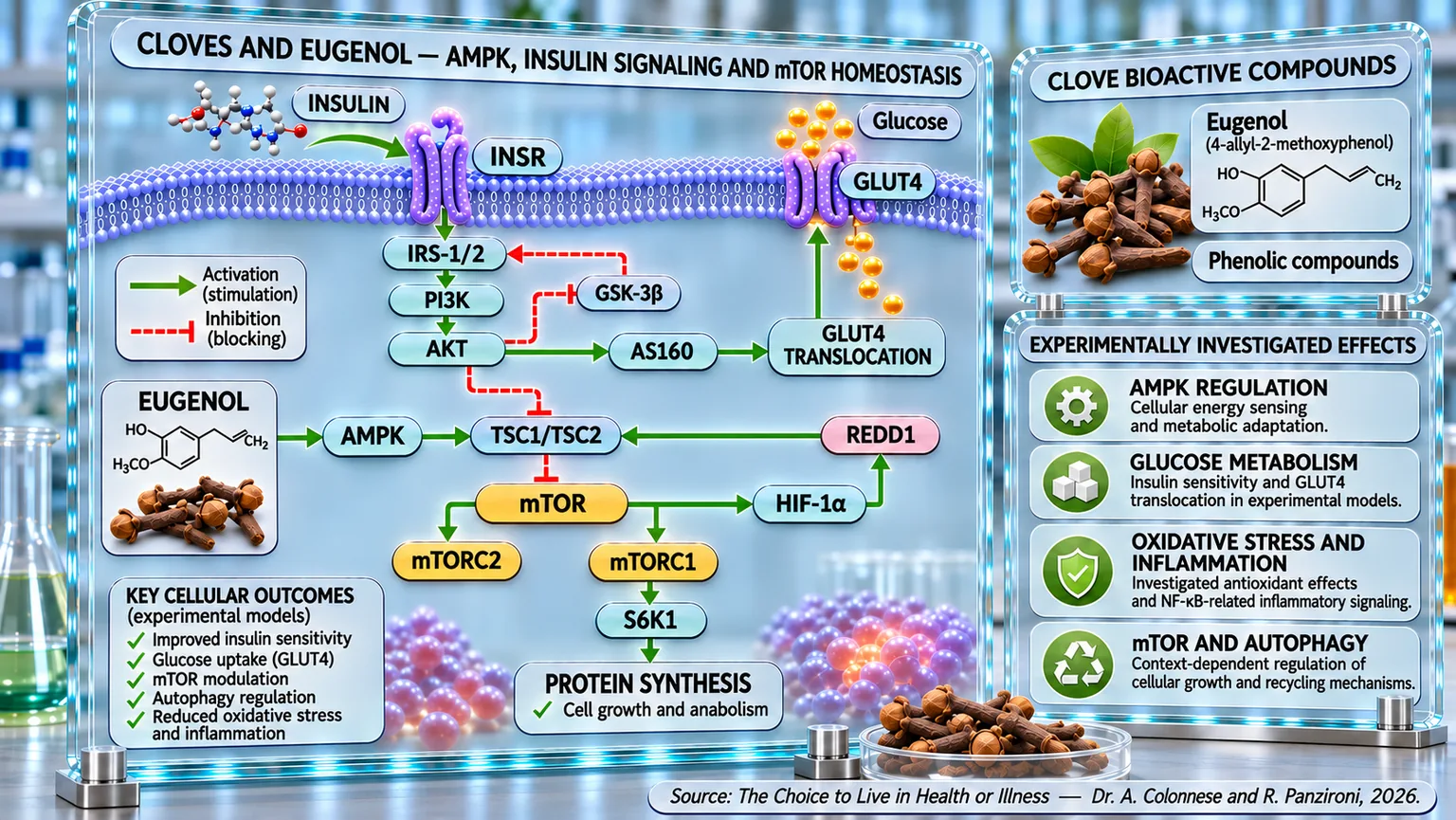
Scientific panels showing the chemical structure of eugenol, cloves, a cell membrane, and green or red arrows between metabolic pathways.
Infographic of cloves and eugenol: it links AMPK activation and IRS-1/2–PI3K–AKT insulin signaling to GLUT4 translocation, while TSC1/TSC2 modulates mTORC1/2, HIF-1α, and protein synthesis; it also summarizes experimental effects on glucose metabolism, autophagy, oxidative stress, and NF-κB-related inflammation.

ABSTRACT

Cloves contain eugenol, a bioactive compound studied for its antioxidant, anti-inflammatory, antimicrobial, and analgesic properties. In the book "La scelta di Vivere in Salute o in Malattia" (The Choice to Live in Health or Disease), Dr. A. Colonnese and R. Panzironi explore the relationships between this spice, glycemic regulation, and cellular protection. Experimental observations indicate that eugenol can attenuate NF-κB activity, the production of inflammatory cytokines, and oxidative stress, suggesting possible implications for metabolism and the immune system.

In animal models, eugenol can promote AMPK activation and GLUT4 translocation in muscle, supporting glucose uptake. The regulation of the AMPK/mTOR balance also plays a role in autophagy, the process of eliminating and recycling damaged cellular components. In tumor models, eugenol and clove extracts attenuate signals from the PI3K/AKT/mTOR pathway, which is associated with reduced proliferation and increased apoptosis and autophagy. However, the direction of energy modulation varies depending on the tissue and experimental conditions.

Clinical evidence remains preliminary: a pilot study found a reduction in postprandial glycemia, especially in the presence of high initial values; another study, conducted with a polyphenolic extract, reported improvements in HOMA-IR, glycemia, and antioxidant defenses. Preclinical research describes effects on adipose tissue, the gut microbiota, and the intestinal barrier, as well as on hepatic steatosis, cerebral ischemia, and reproductive toxicity. Further models explore activity against Candida, skin protection, and benign prostatic hyperplasia. The observed anti-tumor effects do not demonstrate therapeutic efficacy in humans.

Overall, cloves offer a model of interaction between inflammation, insulin sensitivity, and energy homeostasis. Initial clinical observations require confirmation in larger, controlled studies, while molecular results cannot be directly transferred to therapeutic practice. Dietary consumption of the spice can be part of a balanced diet, without replacing established clinical interventions or attributing to it therapeutic properties not yet proven in humans.

Cloves and their intrinsic properties

Cloves have accompanied human history for centuries, not only as an aromatic spice but as a true natural remedy capable of crossing cultures, continents, and traditional medical systems. They are the dried flower buds of the Syzygium aromaticum plant, an evergreen tree native to the Maluku Islands in the Indonesian archipelago, which are not coincidentally known as the ancient “Spice Islands.” In these tropical territories, characterized by a hot-humid climate and rich soils, the plant develops a particularly high concentration of aromatic and bioactive compounds, making cloves one of the most biologically potent spices.

Over the centuries, the cultivation of cloves spread along trade routes toward East Africa and the Indian Ocean, finding ideal conditions in areas such as Zanzibar, Madagascar, and the Comoros, which, along with Indonesia, remain the world's main production hubs today. The quality of the final product depends critically on the timing of the harvest, when the bud is still closed and rich in essential oils, and on the drying methods, which must preserve the integrity of the volatile molecules without degrading them. In this sense, speaking of “organic” cloves does not just mean referring to the absence of pesticides, but to a supply chain that respects the plant's natural cycles and post-harvest processes—elements that are decisive for the final phytochemical profile.

What makes cloves so unique is their extraordinary biological density: unlike many other spices, a single molecule dominates their chemical and functional profile—eugenol—which is responsible for their intense, warm, and pungent aroma, as well as most of the pharmacological properties attributed to this spice. It is precisely the high concentration of eugenol that explains why cloves have been traditionally used as antiseptics, analgesics, digestive aids, and natural preservatives, long before modern chemistry began to study their mechanisms of action.

This combination of geographical origin, cultivation methods, and phytochemical richness makes cloves not just a simple aromatic spice, but a true plant concentrate of biological activity, capable of interacting with fundamental processes such as inflammation, oxidative stress, cellular metabolism, and antimicrobial defenses. It is on this basis that it becomes possible to understand their role in modern chronic diseases and why eugenol is currently at the center of growing scientific interest.

Cloves (Syzygium aromaticum) owe much of their biological properties to this dominant molecule: eugenol, a phenolic compound that can constitute up to 80-90% of the essential oil extracted from the dried flower buds. From a chemical perspective, eugenol is characterized by a structure that gives it marked biological reactivity and the ability to interact with cell membranes, enzymes, and intracellular signaling pathways. It is no coincidence that this molecule has been the subject of growing scientific interest for its broad spectrum of pharmacological activities, ranging from antioxidant and anti-inflammatory action to antitumor, antimicrobial, analgesic, and metabolic effects (Noman et al., 2025) [1]; (Nisar et al., 2021) [2].

One of the most relevant aspects of eugenol is its redox-dependent action, which allows it to behave as an antioxidant or, under specific conditions and concentrations, as a selective pro-oxidant. At low or moderate doses, eugenol neutralizes reactive oxygen and nitrogen species, reducing lipid peroxidation and protecting membranes, mitochondria, and DNA from oxidative damage. This effect is accompanied by an increase in endogenous antioxidant defenses, creating a more stable and less inflamed cellular environment. In simple terms, eugenol acts as a sort of “biological shock absorber,” attenuating the oxidative spikes that accompany many chronic diseases.

This reduction in oxidative stress is accompanied by a marked anti-inflammatory action, mediated by the inhibition of key pathways such as the NF-κB transcription factor and the reduction of the expression of pro-inflammatory cytokines such as TNF-α, IL-1β, and IL-6. Eugenol is also able to modulate enzymes such as COX and LOX (key enzymes in the arachidonic acid cascade, fundamental for pain and inflammation), reducing the synthesis of prostaglandins and leukotrienes, with an effect that explains both its anti-inflammatory and analgesic properties traditionally exploited in dentistry and phytotherapy (Nisar et al., 2021) [2]. This profile is particularly interesting because low-grade chronic inflammation represents the common ground for many of the pathologies discussed in this book.

When observing the behavior of eugenol in more complex pathological contexts, such as tumor diseases, a distinctive characteristic emerges: the ability to simultaneously target multiple fundamental cellular mechanisms. Numerous experimental findings show that eugenol inhibits cell proliferation, induces cell cycle arrest, and activates apoptosis (Zari et al., 2021) [3]; (Noman et al., 2025) [1]. In parallel, eugenol interferes with central signaling pathways for cell growth and survival, including the PI3K/AKT/mTOR insulin pathway, helping to reduce the ability of tumor cells to adapt to conditions of metabolic and inflammatory stress (Zari et al., 2021) [3].

A particularly clear example of this multifactorial action comes from studies on hepatocellular carcinoma, in which eugenol has shown, in in vivo and in vitro models, the ability to reduce tumor, inflammatory, and oxidative markers, improve hepatic architecture, and favorably modulate gene expression related to proliferation, apoptosis, and antioxidant defenses (Zaky et al., 2025) [4]. In this context, eugenol does not act as a single “switch,” but as a regulator that restores balance to a deeply altered system, turning off signals of uncontrolled growth and reactivating those of control and programmed cell death.

Alongside its antitumor activity, eugenol shows robust antimicrobial action, which extends to bacteria, fungi, and parasites. Of particular interest is its antifungal activity against species of the Candida genus. In vitro studies have shown that eugenol and methyleugenol (a natural aromatic compound present in some plants and spices) are effective against clinical isolates and show a marked synergistic effect, without phenomena of antagonism (Ahmad et al., 2010) [5]. This means that eugenol is able to enhance the efficacy of a conventional drug, likely by interfering with membrane permeability, efflux pumps, and the biosynthesis of ergosterol (a natural substance present in fungal cell membranes, fundamental for their structure). It is as if eugenol “opens a breach” in the microorganism's defenses, making it sensitive to treatment once again.

Taken together, these findings show how cloves, through eugenol, represent a spice with profound and systemic biological properties. Their action is not limited to a single target but involves oxidative stress, inflammation, cellular metabolism, proliferation, and antimicrobial response. Included within a lifestyle oriented toward the reduction of chronic inflammation and metabolic hyperactivation, cloves do not act as an isolated remedy, but as modulators of the biological terrain, capable of supporting the rebalancing processes that the body struggles to maintain in the modern context.

Cloves and human supplementation

When moving from the molecular properties of cloves to their application as a nutritional intervention, it becomes clear that eugenol and its derivatives do not act in isolation on a single parameter, but rather exert a systemic action involving glucose metabolism, adipose tissue, gut microbiota, inflammation, and cellular regeneration processes. This makes cloves particularly interesting in the context of chronic metabolic and inflammatory diseases, where multiple systems are simultaneously compromised.

One of the first areas explored is glycemic control and hormonal regulation in type 2 diabetes. In an animal model of diet-induced obesity, dietary supplementation with cloves resulted in a significant reduction in glycemia, accompanied by a decrease in serum leptin levels, a hormone often elevated in contexts of obesity and insulin resistance (Abdulrazak et al., 2018) [6]. This finding is particularly relevant because it suggests that the hypoglycemic action of cloves does not depend solely on an increase in insulin secretion, but on a modulation of insulin sensitivity and adipocyte signaling. In other words, cloves seem to reduce the “metabolic noise” that forces the body to maintain high levels of insulin and leptin to achieve the same biological effect.

This observation finds initial confirmation in humans through a pilot study conducted on healthy volunteers and subjects with slightly elevated fasting glycemia. The daily intake of a water-soluble polyphenolic extract of cloves resulted in a significant reduction in postprandial glycemia after just 12 days, with a more marked and progressive effect in subjects with baseline values between 101 and 125 mg/dL (Mohan et al., 2019) [7]. The most interesting finding is that preprandial glycemia is reduced significantly only in the most metabolically fragile subjects, suggesting a normalizing effect rather than an indiscriminate hypoglycemic one. From a physiological standpoint, this behavior is consistent with the idea of a spice that helps the body better manage glycemic load when the system is under stress, without forcing it when it is already in balance.

In vitro studies associated with this work help to understand the mechanisms underlying these effects. Clove extract increases glucose uptake in myocytes, reduces hepatic glucose production, and inhibits digestive enzymes, slowing down carbohydrate absorption at the intestinal level (Mohan et al., 2019) [7]. It is as if the action of cloves is distributed along the entire glucose pathway, from the intestine to peripheral tissues, avoiding sudden spikes and promoting a more gradual and efficient management.

Alongside glucose metabolism, an increasingly central role is emerging for the gut-microbiota-adipose tissue axis. In mouse models fed a high-fat diet, eugenol has been shown to significantly reduce body weight gain, visceral adipose tissue volume, and adipocyte size, while improving fasting glycemia. These phenotypic changes are accompanied by a profound modulation of the gut microbiota, with an increase in genera associated with a favorable metabolic profile and a reduction in those related to inflammation and obesity. In parallel, transcriptomic analysis of adipose tissue shows a reprogramming of pathways involved in lipid metabolism, thermogenesis, and insulin sensitivity (Li et al., 2022) [8]. This suggests that eugenol does not act only “from the outside,” but communicates directly with adipose tissue metabolism, helping to make it less inflamed and more metabolically flexible.

A further level of complexity emerges when eugenol is combined with other bioactive compounds. A combined supplement based on spermidine (a natural substance present in cells and various foods) and eugenol has been shown to protect human intestinal cells from an induced inflammatory state by reducing the production of reactive oxygen species, attenuating the expression of inflammatory mediators, and, above all, stimulating autophagic flux (Truzzi et al., 2023) [9]. Autophagy, a fundamental process of cellular recycling and maintenance, is often compromised in chronic and autoimmune diseases. The fact that eugenol contributes to reactivating functional autophagy, while also improving the integrity of the intestinal barrier, reinforces the idea of a profound action on the “biological terrain” that precedes and accompanies disease.

Finally, the supplementation of eugenol derivatives shows relevant effects even in contexts that are apparently distant, such as skin photoaging, but which share the same pathophysiological bases of oxidative stress and chronic inflammation. In mouse models exposed to UVB rays, dietary supplementation with isoeugenol reduces wrinkle formation, preserves dermal collagen, limits epidermal thickening, and attenuates skin dryness. Interestingly, these effects are associated with a normalization of the gut dysbiosis induced by chronic UV exposure, suggesting the existence of a gut-skin axis that can be modulated through diet and phytocompounds (Geng et al., 2024) [10]. Once again, it emerges that the action of cloves is not confined to a single organ, but manifests as a systemic regulation of inflammation and the stress response.

Taken together, these studies show that the supplementation of cloves and their main components does not produce isolated, point-like effects, but contributes to reducing metabolic variability, improving glucose management, modulating the microbiota, and reactivating cellular protection and repair processes. Integrated into a lifestyle oriented toward glycemic stability and the reduction of hyperinsulinemia, cloves are therefore configured not as a symptomatic remedy, but as a modulator of the biological context in which chronic diseases take shape and persist over time.

Cloves and their uses for treated conditions

When observing the action of cloves in various chronic conditions, a surprisingly consistent picture emerges: eugenol, their main bioactive component, acts on pathophysiological nodes common to many modern diseases, particularly the alteration of glucose metabolism, the dysfunction of the gut-liver-brain axis, low-grade chronic inflammation, and the overactivation of pro-survival pathways such as PI3K/AKT/mTOR.

In the context of diabetes mellitus, eugenol has demonstrated a marked anti-hyperglycemic effect in established experimental models. In rats with streptozotocin-induced diabetes, the administration of eugenol significantly reduced fasting glycemia and glycated hemoglobin, accompanying these effects with an increase in plasma insulin levels and a normalization of key enzymes of hepatic glucose metabolism (Srinivasan et al., 2014) [11]. This finding is particularly relevant because it suggests that eugenol does not act simply as a direct hypoglycemic agent, but contributes to restoring hepatic metabolic balance, reducing the need for compensatory insulin hyperproduction.

The same logic of rebalancing emerges in metabolic liver diseases. In non-alcoholic fatty liver disease, eugenol has shown the ability to reduce lipid accumulation in the liver, improve serum profiles of triglycerides and cholesterol, and restore hepatic architecture in animal models fed a high-fat diet (Li et al., 2022) [12]. What makes this study particularly innovative is the identification of an integrated neuroendocrine mechanism: eugenol activates the gut-brain-liver axis, strengthening the intestinal barrier, stimulating the vagus nerve, and improving communication between the gut and the liver. It is as if eugenol helps the body to "reorganize metabolic traffic," intervening not only on the liver as a target organ, but on the entire regulatory system.

A central role for eugenol also emerges in the relationship between the gut, microbiota, and opportunistic infections. In a mouse model of intestinal Candida albicans infection, clove essential oil showed potent antifungal and anti-biofilm activity, reducing the fungal load and improving the integrity of the intestinal mucosa (Gao et al., 2025) [13]. In parallel, the treatment resulted in a significant reduction of intestinal inflammatory cytokines, such as IL-6, IL-8, and IL-17A, and a restoration of microbiota diversity, with an increase in beneficial genera such as Lactobacillus and Bifidobacterium. This finding is crucial because it shows how eugenol does not just target the pathogen, but contributes to rebuilding the intestinal ecosystem, reducing the inflammatory environment that favors persistent infections.

The ability of eugenol to modulate inflammation and cell proliferation also becomes particularly evident in benign prostatic hyperplasia (BPH), a condition strongly associated with chronic inflammation, oxidative stress, and the activation of pro-growth pathways. In experimental models of testosterone-induced BPH, eugenol reduced the prostate index, attenuated epithelial hyperplasia, and inhibited the activation of the PI3K/AKT/mTOR pathway, while simultaneously reducing levels of inflammatory cytokines and oxidative markers (Abdali et al., 2025) [14]. Particularly interesting is the link with uric acid, identified as a mediator of prostatic inflammation: eugenol, especially in combination with a uricosuric (a substance that promotes the elimination of uric acid through the kidneys and urine), showed a synergistic effect in reducing pro-survival and proliferation signals, suggesting a potential role even in human clinical conditions characterized by hyperuricemia and chronic inflammation.

Finally, the potential of eugenol in the oncological context has been analyzed systematically in a broad and rigorous review that gathered preclinical evidence on numerous types of tumors (Begum et al., 2022) [15]. Eugenol has proven capable of inducing apoptosis, cell cycle arrest, inhibition of angiogenesis, and reduction of metastases in models of breast, gastric, hepatic, lung, prostate, and skin carcinoma. These effects are mediated by the coordinated modulation of the PI3K/AKT/mTOR pathway, outlining a profile of action that selectively targets pathological cells without showing significant toxicity on healthy tissues. It is important to emphasize that eugenol has also shown positive synergies with conventional chemotherapy drugs, suggesting a possible role as a therapeutic adjuvant, rather than an isolated alternative.

Taken together, these findings show that cloves, through eugenol, do not act on individual diseases in a fragmentary way, but intervene on common biological mechanisms: hyperglycemia, insulin dysfunction, chronic inflammation, microbiota alteration, and mTOR overactivation. Incorporated into a lifestyle oriented toward metabolic stability and the reduction of hyperinsulinemia, they represent not a symptomatic remedy, but a modulator of the pathophysiological terrain upon which chronic diseases develop and are maintained over time.

Cloves and the improvement of insulin resistance

One of the most interesting aspects of cloves concerns their ability to act directly on the biological mechanisms underlying insulin resistance, a central condition in the development of type 2 diabetes, metabolic syndrome, and non-alcoholic fatty liver disease. In the presence of insulin resistance, peripheral tissues become progressively less sensitive to insulin signaling, forcing the pancreas to produce increasing amounts of insulin to maintain stable glycemia. This state of chronic hyperinsulinemia fuels inflammation, mitochondrial dysfunction, lipid accumulation, and continuous activation of the PI3K/AKT/mTOR pathway.

In this context, eugenol and the polyphenols in cloves appear to act as multifactorial metabolic modulators, capable of simultaneously improving glucose homeostasis, oxidative stress, and cellular energy function. One of the most solid pieces of evidence comes from a meta-analysis including 16 preclinical studies on animal models of diabetes, in which treatment with eugenol resulted in a significant reduction in glycemia, an improvement in the lipid profile, and a marked attenuation of oxidative stress. The authors also highlight that eugenol increases cellular glucose uptake through the modulation of the PI3K pathway, suggesting a direct involvement of the main insulin sensitivity pathways (Carvalho et al., 2021) [16].

From a pathophysiological point of view, this finding is particularly important because oxidative stress represents one of the main factors fueling insulin resistance. Excessive production of reactive oxygen species alters insulin signaling, damages mitochondria, and promotes a state of chronic low-grade inflammation. By reducing oxidative damage and improving endogenous antioxidant defenses, eugenol appears to help "defuse" one of the deepest mechanisms of metabolic dysfunction (Carvalho et al., 2021) [16].

This relationship between redox homeostasis (the dynamic balance between oxidizing molecules, such as free radicals, and antioxidant ones) and insulin sensitivity emerges even more clearly in clinical studies conducted on clove polyphenols. In a randomized, controlled, double-blind study conducted on subjects with metabolic syndrome, supplementation with Clovinol®, a polyphenolic extract derived from the clove plant, resulted in a reduction of the HOMA-IR index of over 50%, accompanied by significant improvements in fasting glycemia, post-prandial glycemia, and HbA1c (Thomas et al., 2022) [17]. In parallel, marked increases were observed in intracellular levels of glutathione (a powerful antioxidant produced naturally by cells) and in the activity of the Nrf2 factor, one of the main regulators of the cellular antioxidant response.

This step is extremely relevant because it directly links the improvement of insulin sensitivity to the rebalancing of the intracellular oxidative state. In other words, clove polyphenols do not appear to act simply by "lowering sugar," but by improving the metabolic environment in which insulin signaling must function. It is as if the cell, by reducing its oxidative and inflammatory load, progressively returns to correctly recognizing the insulin message.

The study also showed a significant reduction in IL-1β and TNF-α, two cytokines closely involved in the genesis of insulin resistance. This finding is particularly important because chronic low-grade inflammation represents one of the main links between visceral obesity, hyperinsulinemia, and progressive alteration of glucose metabolism.

Skeletal muscle, the main site of peripheral glucose uptake, also appears to benefit deeply from the action of eugenol. In a mouse model of type 2 diabetes induced by a high-fat diet and streptozotocin, eugenol significantly improved insulin sensitivity, increased muscle glucose uptake, and reduced glycemia. At the molecular level, the compound increased GLUT4 translocation and AMPK phosphorylation in skeletal muscle through the activation of the axis involving AMPK (Jiang et al., 2022) [18].

This mechanism is particularly interesting because it acts independently of the classic insulin pathway mediated by AKT. In conditions of advanced insulin resistance, insulin signaling is compromised; however, the activation of AMPK allows for increased glucose uptake even when the insulin signal is altered. From a biological point of view, it is as if eugenol opens an "alternative route" to allow glucose to enter the cell without further overloading the insulin system.

In parallel, eugenol reduced the expression of certain markers of muscle atrophy and attenuated NF-κB phosphorylation, suggesting an overall improvement in systemic inflammation and muscle energy metabolism. This aspect is particularly important because skeletal muscle represents one of the main target organs of insulin resistance and the loss of metabolic flexibility (Jiang et al., 2022) [18].

Similar results also emerge in studies focused directly on the AMPK-GLUT4 pathway. In diabetic rats treated with eugenol, a significant reduction in glycemia, an improvement in serum insulin levels, and a marked decrease in the HOMA-IR index were observed. Concurrently, eugenol increased the translocation of GLUT4 in skeletal muscle through the activation of AMPK, improving peripheral glucose uptake.

The authors also emphasize that eugenol significantly reduces markers of oxidative stress and major pro-inflammatory cytokines, including IL-6. This finding confirms once again that the effect on insulin resistance does not depend on a single molecular target, but on an integrated regulation of energy metabolism, inflammation, and redox homeostasis (Al-Trad et al., 2019) [19].

Overall, the available evidence shows that cloves do not act simply as an aromatic spice or a generic antioxidant, but as true modulators of metabolic physiology. Through eugenol and bioactive polyphenols, this spice appears to improve insulin sensitivity, increase peripheral glucose utilization, reduce inflammation and oxidative stress, and restore a more efficient energy balance.

In this sense, the relationship between cloves and insulin resistance represents one of the most interesting examples of how a natural compound can interact with the main nodes of modern metabolic pathophysiology, helping to counteract the effects of chronic hyperinsulinemia and the continuous activation of the insulin pathway.

Cloves and their relationship with mTOR

To fully understand the role of cloves in modern chronic diseases, it is essential to focus on their relationship with the PI3K–AKT–mTOR pathway, one of the primary regulatory systems for cell growth, survival, and energy metabolism. mTOR can be considered the “central sensor of abundance”: when nutrients, insulin, and growth signals are high, this pathway remains constantly active, pushing cells toward proliferation, accumulation, and a reduction in recycling processes. In pathological conditions, this chronic activation becomes a cross-cutting risk factor involved in the development of type 2 diabetes, cancer, inflammation, and tissue degeneration.

In this context, eugenol, the main bioactive component of cloves, stands out for its ability to modulate mTOR in a context-dependent manner, reducing its pathological hyperactivation without completely blocking its physiological function. Studies conducted on human colon carcinoma cells have shown that an active fraction extracted from cloves inhibits the phosphorylation of PI3K, AKT, and mTOR in a dose-dependent manner, leading to cell cycle arrest and the induction of apoptosis (Zhao et al., 2021) [20]. The effect was found to be reversible in the presence of IGF-1 (insulin-like growth factor), confirming that the action of the active fraction acts directly along the insulin–PI3K–AKT–mTOR axis, the same axis that is chronically stimulated in states of hyperinsulinemia.

This modulation of mTOR does not lead exclusively to apoptosis but also involves autophagy, a process of cellular maintenance that is strongly inhibited when mTOR is hyperactive. In a 2018 study, also conducted on colon carcinoma cells, the active fraction of cloves simultaneously induced apoptosis and autophagy through the suppression of the PI3K/AKT/mTOR pathway (Liu et al., 2018) [21]. Pharmacological inhibition of autophagy further increased apoptotic cell death, suggesting that autophagy initially represents a cell's attempt to adapt to the stress induced by the treatment. This finding is extremely relevant because it shows that eugenol does not “kill indiscriminately,” but forces the pathological cell to reveal its metabolic fragility, especially when it is dependent on mTOR for survival.

Eugenol's interference with mTOR also emerges in different oncological contexts. In human lung carcinoma cells, eugenol showed a suppressive effect on cell proliferation, migration, and invasion, associated with a significant reduction in AKT phosphorylation and the inhibition of enzymes crucial for metastatic progression (Li and Yang, 2018) [22]. Although mTOR is not always measured directly in this study, the reduction of phosphorylated AKT indicates a functional suppression of the entire PI3K/AKT/mTOR axis, confirming the consistency of the mechanism of action.

A particularly interesting aspect is that the modulation of mTOR by cloves is not limited to the oncological field. In a model of acrylamide-induced testicular toxicity, eugenol showed a markedly protective effect, improving sperm quality, hormonal profile, and tissue integrity (Saleh et al., 2024) [23]. In this case, eugenol did not simply inhibit mTOR, but restored a dynamic balance between AKT and mTOR, promoting functional autophagy and reducing excessive apoptosis. This demonstrates a key point: mTOR is not an “enemy” to be turned off, but a regulator to be brought back into balance, and eugenol seems capable of adapting its action to the pathophysiological context.

The ability of cloves to target the mTOR axis also emerges through innovative biotechnological approaches. The green synthesis of silver nanoparticles (a method that uses natural substances, such as plant extracts, to produce tiny particles) using extracts of Syzygium aromaticum has produced nanostructured systems capable of inducing selective apoptosis in leukemic cells, with a marked reduction in AKT and mTOR activity (Guo et al., 2025) [24]. In this case as well, the insulin pathway is confirmed as the central target through which clove compounds exert their biological action, regardless of the form of administration.

Taken together, these studies outline a coherent picture: cloves, through eugenol and derived bioactive fractions, act as metabolic modulators of mTOR, capable of reducing the pathological hyperactivation of the pathway, reactivating autophagy, limiting uncontrolled cell proliferation, and improving tissue resilience. This behavior is particularly relevant in the modern context, characterized by chronic hyperinsulinemia, nutritional overload, and persistent inflammation, conditions that keep mTOR constantly switched on.

In this sense, cloves cannot be interpreted as a simple anti-tumor or antioxidant agent, but as a metabolically intelligent spice capable of interacting with one of the most central nodes of human pathophysiology. Included within a lifestyle oriented toward the reduction of glycemic variability and hyperinsulinemia, its effect on mTOR contributes to shifting the organism from a mode of forced and dysfunctional growth toward a mode of balance, adaptation, and cellular maintenance.

Cloves, AMPK, and the energy rebalancing of mTOR

If the relationship between eugenol and mTOR is already of significant biological relevance, the picture becomes even more interesting when observing the role of AMPK, the primary cellular energy sensor. As discussed in previous chapters, AMPK and mTOR represent two opposite and complementary metabolic programs: when nutrients, glucose, and insulin are abundant, mTOR promotes growth, protein synthesis, and energy storage; conversely, when the cell perceives metabolic stress or energy deficiency, AMPK slows down anabolic processes, promotes autophagy, and directs metabolism toward energy conservation and cellular survival. In this dynamic balance, eugenol appears to act as a modulator capable of restoring the proper dialogue between these two systems.

One of the clearest examples emerges from studies on cerebral ischemia-reperfusion injury. In experimental models of ischemic stroke, eugenol has been shown to significantly reduce cerebral infarct volume, improve neurological function, and attenuate neuronal apoptosis through the activation of the AMPK/mTOR pathway (Sun et al., 2020) [25]. The most interesting aspect is that eugenol does not merely block mTOR, but induces functional and controlled autophagy, increasing the main molecular biomarkers used to evaluate and measure autophagy. From a physiological perspective, this means that neuronal cells are able to eliminate damaged components and improve their ability to adapt to ischemic stress.

The study also showed that rapamycin, a potent mTOR inhibitor and autophagy activator, further enhances the neuroprotective effects of eugenol, while pharmacological inhibition of AMPK cancels out most of the observed benefits (Sun et al., 2020) [25]. This finding confirms that AMPK represents the true “metabolic switch” through which eugenol coordinates the cellular response. It is as if eugenol helps the cell temporarily exit the forced growth mode imposed by mTOR, allowing it to enter a maintenance and energy survival mode.

This regulation also appears particularly relevant in conditions of chronic metabolic damage. An updated review on the properties of eugenol in ischemia-reperfusion injury highlights that one of the main cytoprotective mechanisms involves the modulation of the AMPK–mTOR axis (Randhawa et al., 2026) [26]. The activation of AMPK reduces cellular energy consumption, limits oxidative stress, and promotes protective autophagy, while the simultaneous inhibition of mTOR hyperactivation allows the cell to better adapt to stress conditions. This concept is particularly important in the modern context, characterized by continuous energy abundance and chronic anabolic overstimulation.

The authors also highlight that eugenol modulates the AMPK axis and the PI3K/AKT pathway, two systems closely linked to cellular survival, mitochondrial function, and the regulation of apoptosis (Randhawa et al., 2026) [26]. From a biological perspective, this suggests that eugenol does not act as a simple “inhibitor” of individual pathways, but as an integrated regulator of the cellular energy response, intervening simultaneously on inflammation, autophagy, metabolism, and mitochondrial protection.

This ability to rebalance AMPK and mTOR also emerges with extreme clarity in hepatic metabolism. In experimental models of fatty liver disease induced by a high-fat diet, eugenol significantly reduced intracellular lipid accumulation, hepatic triglycerides, and fibrotic progression through the activation of AMPK and the concomitant suppression of mTOR. In parallel, a reduction in the expression of SREBP1 (a primary transcription factor that regulates lipid metabolism) and lipogenic enzymes associated with fatty acid synthesis was observed (Jo et al., 2014) [27].

This step is extremely relevant because it directly connects the relationship between AMPK and mTOR with one of the main metabolic problems of chronic hyperinsulinemia: fatty liver disease. When mTOR remains constantly active, the liver is pushed toward continuous lipogenesis (a metabolic process through which the body produces fats, mainly starting from excess nutrients), triglyceride accumulation, and progressive loss of metabolic flexibility. The activation of AMPK by eugenol, on the other hand, represents an opposite metabolic signal: it increases lipid oxidation, reduces fat synthesis, and returns hepatic metabolism to a more energy-efficient mode.

A particularly interesting aspect that emerged from the study is that the effects of eugenol are abolished in the presence of specific AMPK or mTOR inhibitors, confirming the direct involvement of these pathways. In other words, the improvement of fatty liver disease does not derive from a generic antioxidant effect, but from a true metabolic reprogramming mediated by the AMPK–mTOR axis (Jo et al., 2014) [27].

Eugenol also demonstrates an extraordinary adaptive capacity in testicular tissue. In models of reproductive toxicity induced by acrylamide (a chemical contaminant that forms naturally in starchy foods during high-temperature cooking), eugenol improved sperm quality, steroidogenesis, and the integrity of the blood-testis barrier by modulating the AMPK/PI3K/AKT/mTOR pathway. Acrylamide intoxication, in fact, caused severe cellular energy dysfunction, with depletion of ATP (the main energy molecule in our body) and pathological hyperactivation of AMPK. Eugenol restored intracellular energy balance, normalizing metabolism and reducing both aberrant autophagy and excessive apoptosis (Saleh et al., 2024) [23].

This finding is very important because it shows how the action of eugenol is deeply context-dependent. In some pathological conditions, such as fatty liver or ischemic damage, the activation of AMPK and the reduction of mTOR are protective; in other conditions characterized by extreme energy collapse, eugenol instead contributes to restoring a physiological balance between AMPK, AKT, and mTOR, avoiding both excessive anabolic suppression and uncontrolled cell death.

Overall, the available evidence outlines cloves as one of the most interesting spices from the perspective of cellular energy regulation. Through eugenol, this spice can modulate the delicate balance between AMPK and mTOR, promoting autophagy, mitochondrial protection, control of lipogenesis, stress adaptation, and tissue resilience.

In a context characterized by chronic hyperinsulinemia, caloric excess, and continuous anabolic stimulation, the relationship between eugenol, AMPK, and mTOR therefore assumes a meaning extremely consistent with what was discussed in the previous chapters: bringing the cell out of a mode of continuous growth and metabolic dysfunction, restoring its ability to adapt, repair itself, and manage its energy resources more efficiently.

Conclusions

Cloves are a prime example of how a traditional spice can influence numerous biological processes. Our journey began with the properties of eugenol, the main bioactive compound in this spice. Experimental research describes its antioxidant, anti-inflammatory, antimicrobial, and analgesic activities. In particular, eugenol can reduce NF-κB activity, the production of inflammatory cytokines, and oxidative stress, contributing to the protection of cellular structures. Some studies also highlight effects on tumor proliferation and antifungal activity against Candida.

From these properties, we moved on to supplementation to understand what benefits have been observed in humans. A pilot study reported a reduction in post-meal glycemia, especially in subjects with high baseline values. Experimental research also suggests favorable effects on adipose tissue metabolism, the gut microbiota, and the integrity of the intestinal barrier. Other studies describe potential benefits for autophagy and skin protection.

Broadening our view to the conditions addressed, we encountered applications involving various organs. In experimental diabetes, eugenol improves certain glycemic and metabolic parameters. In hepatic steatosis, it reduces lipid accumulation, partly through communication between the gut, brain, and liver. Other research describes effects on intestinal Candida infections and benign prostatic hyperplasia. In oncology, preclinical models show a reduction in cell proliferation and the activation of apoptosis.

The link between these conditions leads to insulin resistance. When cells respond less effectively to insulin, the pancreas may increase its production to keep glycemia stable. In this context, eugenol appears to intervene by reducing inflammation and oxidative stress. A clinical study on a polyphenol extract of cloves reported improvements in HOMA-IR, glycemia, and antioxidant defenses. In animal models, eugenol also promotes the activation of AMPK and the translocation of GLUT4, facilitating glucose entry into the muscle.

But through which cellular mechanisms do these effects develop? The answer involves the PI3K/AKT/mTOR pathway, which is fundamental in regulating cell growth and survival. In various tumor models, clove extracts and eugenol attenuate certain signals in this pathway, limiting proliferation and promoting apoptosis and autophagy. The latter allows cells to eliminate and recycle damaged components. In testicular tissue, however, the modulation of these signals can contribute to cellular protection.

This transition introduces the role of AMPK, the main cellular energy sensor. Experimental studies show that eugenol can regulate the balance between AMPK and mTOR, promoting protective autophagy. Benefits have been observed in models of cerebral ischemia, hepatic steatosis, and reproductive toxicity. The effect, however, depends on the context: in some conditions, AMPK activation is favored, while in others, a more balanced energy activity is restored.

Thus, the central message of the chapter emerges: cloves contain substances capable of interacting with the mechanisms that link inflammation, insulin sensitivity, and energy metabolism. Initial clinical evidence is promising, but many results remain experimental. Their dietary consumption can be part of a balanced lifestyle, without attributing therapeutic properties to the spice that have not yet been proven.

References

[1] Eugenol: An Insight Into the Anticancer Perspective and Pharmacological Aspects

Noman et al., 2025

Food Sci Nutr. 2025 Aug 3;13(8):e70727.

[2] Pharmacological Properties and Health Benefits of Eugenol: A Comprehensive Review

Nisar et al., 2021

Oxid Med Cell Longev. 2021 Aug 3:2021:2497354.

[3] Anticancer Properties of Eugenol: A Review

Zari et al., 2021

Molecules. 2021 Dec 6;26(23):7407.

[4] Anticancer potential of eugenol in hepatocellular carcinoma through modulation of oxidative stress, inflammation, apoptosis, and proliferation mechanisms

Zaky et al., 2025

Discov Oncol. 2025 Jun 12;16(1):1080.

[5] In vitro synergy of eugenol and methyleugenol with fluconazole against clinical Candida isolates

Ahmad et al., 2010

J Med Microbiol. 2010 Oct;59(Pt 10):1178-1184.

[6] Effects of Clove and Fermented Ginger on Blood Glucose, Leptin, Insulin and Insulin Receptor Levels in High Fat DietInduced Type 2 Diabetic Rabbits

Abdulrazak et al., 2018

Niger J Physiol Sci. 2018 Jun 30;33(1):89-93. PMID: 30091738.

[7] Water-soluble polyphenol-rich clove extract lowers pre- and post-prandial blood glucose levels in healthy and prediabetic volunteers: an open label pilot study

Mohan et al., 2019

BMC Complement Altern Med. 2019 May 7;19(1):99.

[8] Eugenol, A Major Component of Clove Oil, Attenuates Adiposity, and Modulates Gut Microbiota in High-Fat Diet-Fed Mice

Li et al., 2022

Mol Nutr Food Res. 2022 Oct;66(20):e2200387.

[9] Spermidine-Eugenol Supplement Preserved Inflammation-Challenged Intestinal Cells by Stimulating Autophagy

Truzzi et al., 2023

Int J Mol Sci. 2023 Feb 18;24(4):4131.

[10] Dietary Isoeugenol Supplementation Attenuates Chronic UVB-Induced Skin Photoaging and Modulates Gut Microbiota in Mice

Geng et al., 2024

Nutrients. 2024 Feb 7;16(4):481.

[11] Ameliorating effect of eugenol on hyperglycemia by attenuating the key enzymes of glucose metabolism in streptozotocin-induced diabetic rats

Srinivasan et al., 2014

Mol Cell Biochem. 2014 Jan;385(1-2):159-68.

[12] Eugenol alleviated nonalcoholic fatty liver disease in rat via a gut-brain-liver axis involving glucagon-like Peptide-1

Li et al., 2022

Arch Biochem Biophys. 2022 Aug 15:725:109269.

[13] Impact of Clove Essential Oil on the Intestinal Flora in Mice Infected with Candida albicans

Gao et al., 2025

Molecules. 2025 May 29;30(11):2372.

[14] Probenecid and Eugenol Mitigate Testosterone Induced Benign Prostatic Hyperplasia by Targeting Uric Acid-Induced Inflammation and Pro-Survival Pathways

Abdali et al., 2025

Prostate. 2025 Nov;85(15):1412-1423.

[15] A comprehensive and systematic review on potential anticancer activities of eugenol: From pre-clinical evidence to molecular mechanisms of action

Begum et al., 2022

Phytomedicine. 2022 Dec:107:154456.

[16] Effect of Eugenol Treatment in Hyperglycemic Animal Models: A Systematic Review and Meta-Analysis

Carvalho et al., 2021

Pharmacological Research, 2021, 165:105315.

[17] Polyphenols of Clove Buds (Syzygium aromaticum L.) Contribute to Attenuate Metabolic Syndrome by Restoring Intracellular Redox Homeostasis and Glucose Metabolism: A Randomized Double-Blinded Controlled Study

Thomas et al., 2022

Journal of Functional Foods, 2022, 98:105273.

[18] Eugenol Improves Muscle Dysfunction in High-Fat Diet and Streptozotocin-Induced Type 2 Diabetic Mice by Alleviating Inflammation and Increasing Muscle Glucose Uptake

Jiang et al., 2022

Frontiers in Nutrition, 2022, 9:1039753.

[19] Eugenol ameliorates Insulin Resistance, Oxidative Stress and Inflammation in High Fat-Diet/Streptozotocin-Induced Diabetic Rat

Al-Trad et al., 2019

Life Sciences, 2019, 216:183-188.

[20] Inhibition effect of active fraction from clove on PI3K/Akt/mTOR signaling pathway to induce apoptosis of human colon cancer HCT116 cells

Zhao et al., 2021

Zhongguo Zhong Yao Za Zhi. 2021 Mar;46(5):1197-1204.

[21] Active fraction of clove induces apoptosis via PI3K/Akt/mTOR-mediated autophagy in human colorectal cancer HCT-116 cells

Liu et al., 2018

Int J Oncol. 2018 Sep;53(3):1363-1373.

[22] Tumor suppressive roles of eugenol in human lung cancer cells

Li e Yang, 2018

Thorac Cancer. 2018 Jan;9(1):25-29.

[23] Eugenol alleviates acrylamide-induced rat testicular toxicity by modulating AMPK/p-AKT/mTOR signaling pathway and blood–testis barrier remodeling

Saleh et al., 2024

Sci Rep. 2024 Jan 22;14(1):1910.

[24] Apoptotic efficacies of AgNPs formulated by Syzygium aromaticum leaf extract on 32D-FLT3-ITD human leukemia cell line with PI3K/AKT/mTOR signaling pathway

Guo et al., 2025

Open Life Sci. 2025 Sep 23;20(1):20251161.

[25] Eugenol Attenuates Cerebral Ischemia-Reperfusion Injury by Enhancing Autophagy via AMPK-mTOR-P70S6K Pathway

Sun et al., 2020

Frontiers in Pharmacology, 2020, 11:84.

[26] Eugenol: A Promising Therapeutic Terpenoid Against Ischemia-Reperfusion Injury

Randhawa et al., 2026

EXCLI Journal, 2026, 25:222-237.

[27] Eugenol Ameliorates Hepatic Steatosis and Fibrosis by Down-Regulating of SREBP1 Gene Expression via AMPK-mTOR-p70S6K Signaling Pathway

Jo et al., 2014

Biological and Pharmaceutical Bulletin, 2014, 37(8):1341-1351.