
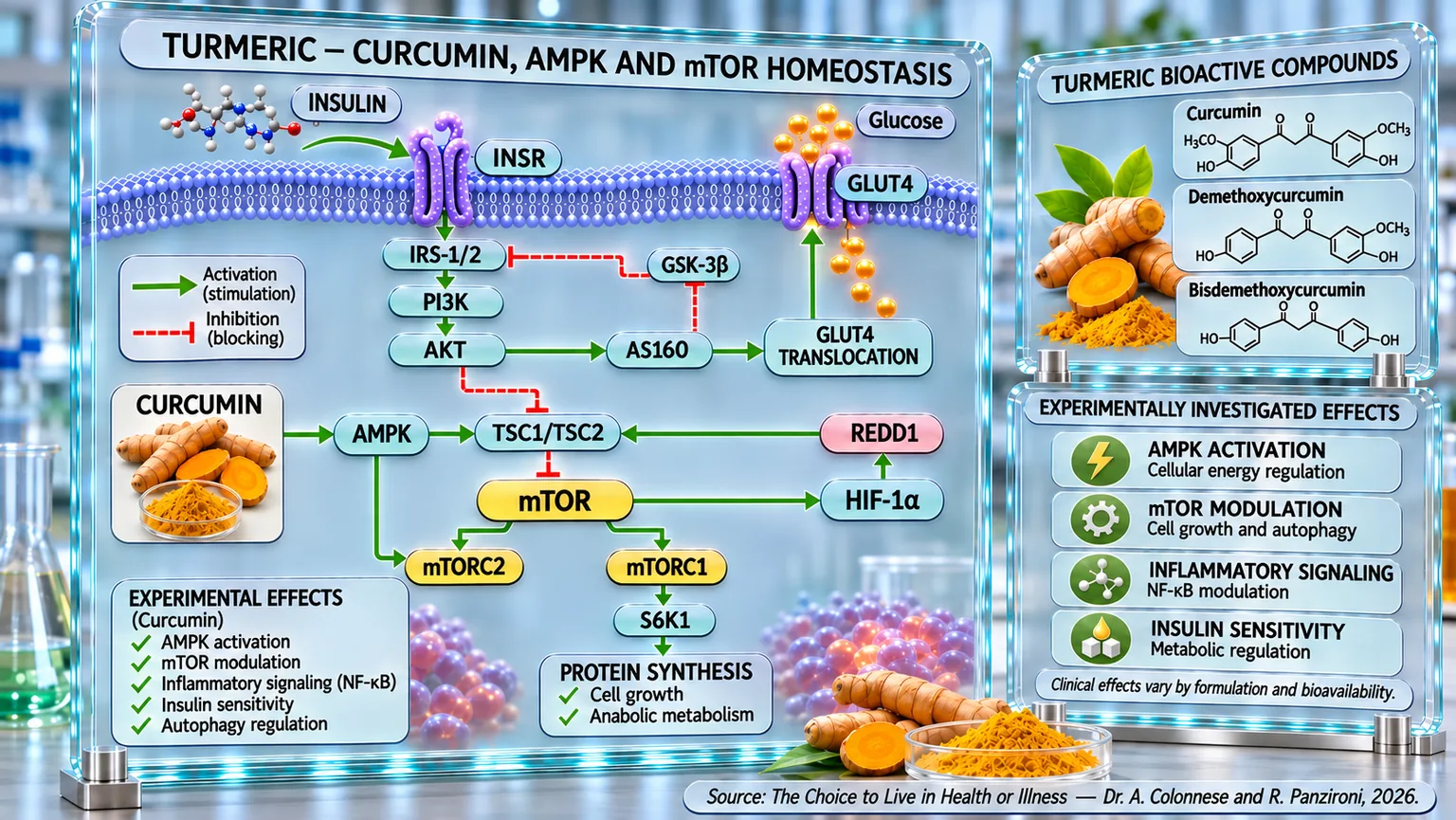
When moving from the molecular properties of turmeric to its practical application in humans, the picture that emerges is surprisingly consistent: the benefits observed in experimental models are also confirmed in controlled clinical studies, especially in the context of chronic metabolic and inflammatory diseases. In this scenario, turmeric and its main constituent, curcumin, act as nutraceutical tools capable of supporting lifestyle and standard therapies, not by replacing them, but by enhancing their efficacy.
One of the most studied areas is glucose metabolism in type 2 diabetes, prediabetes, and metabolic syndrome. An updated systematic review with meta-analysis, which included 28 randomized clinical trials, demonstrated that supplementation with Curcuma longa or its curcuminoids is associated with a significant reduction in fasting glycemia and glycated hemoglobin. On average, fasting glycemia is reduced by approximately 8 mg/dL and HbA1c by approximately 0.13%—a figure that may seem modest but is clinically relevant if maintained over time, as it translates into a reduction in the risk of micro- and macro-vascular complications (Pathomwichaiwat et al., 2023) [6]. It is particularly interesting that these effects were consistent regardless of the formulation used, suggesting that the benefit derives from an underlying biological action rather than a single technological vehicle.
This evidence is reinforced by a dose-response meta-analysis that included 59 randomized clinical trials, showing that supplementation with turmeric or curcumin significantly reduces fasting glycemia, serum insulin, HbA1c, and HOMA-IR. In practical terms, this indicates an improvement in both the average level of circulating glucose and insulin sensitivity, suggesting that curcumin does not act only “downstream” on glycemia, but contributes to making insulin signaling more efficient (Dehzad et al., 2023) [7]. It is as if turmeric helps reduce the metabolic background noise that forces the pancreas to produce more and more insulin to achieve the same effect.
This action becomes even more evident in analyses focused exclusively on type 2 diabetes. A quantitative meta-analysis that included 18 clinical studies for a total of over 1,300 patients showed that curcumin reduces fasting glycemia by over 11 mg/dL and HbA1c by approximately 0.5%, accompanying these effects with a significant reduction in C-reactive protein, a key marker of systemic inflammation (Mokgalaboni et al., 2024) [8]. This finding is particularly relevant because it confirms that the improvement in glycemic control does not occur in isolation, but is part of a broader attenuation of the low-grade inflammatory state that characterizes type 2 diabetes.
A similar picture also emerges in specific endocrine-metabolic contexts such as polycystic ovary syndrome (PCOS), a condition in which insulin resistance, inflammation, and oxidative stress reinforce each other. A systematic review with dose-response meta-analysis showed that curcumin supplementation in women with PCOS significantly improves fasting glycemia, serum insulin, and HOMA-IR, indicating a recovery of insulin sensitivity. It is interesting to note that these benefits manifest even in the absence of a significant reduction in body weight, suggesting that the metabolic effect of curcumin does not depend exclusively on weight loss, but on a direct modulation of the intracellular pathways involved in glucose metabolism (Mohammadi et al., 2025) [9]. Total cholesterol is also reduced, outlining a favorable cardiometabolic profile.
Alongside glucose metabolism, clinical literature has explored the role of turmeric in musculoskeletal health, an area often overlooked but central to chronic diseases and aging. A systematic review with meta-analysis of 21 randomized clinical trials showed that turmeric extracts and curcumin supplements significantly improve joint pain, stiffness, functionality, and muscle recovery, with a favorable safety profile and a low incidence of adverse effects (Doyle et al., 2023) [10]. It also emerged that formulations with higher bioavailability, such as water-dispersible extracts, are more effective even at relatively low dosages, highlighting how the delivery technology plays a key role in translating biological potential into clinical benefit.
Taken together, these clinical studies outline a clear message: turmeric and curcumin do not act as simple natural hypoglycemic agents, but as systemic modulators of inflammation, oxidative stress, and insulin signaling. The improvement in glycemic parameters observed in the studies is a reflection of a deeper action, which involves the reduction of chronic inflammation, the improvement of insulin sensitivity, and the stabilization of the overall metabolic terrain.
Once again, a key concept already encountered in other chapters emerges: the efficacy of turmeric also depends on the context. The benefits observed in clinical studies find their maximum expression when supplementation is part of a lifestyle oriented toward reducing glycemic variability, hyperinsulinemia, and low-grade inflammation. In this scenario, turmeric is not a shortcut, but a biological ally capable of supporting and amplifying the metabolic rebalancing processes already underway.