


Supercritical CO2 oregano extracts: antimicrobial and antibiofilm activity studied in the laboratory
In 2024, Polish researcher Daniela Gwiazdowska and colleagues, in the journal Molecules, studied how different supercritical CO2 extraction conditions modify the composition and the antimicrobial and antibiofilm activity of extracts obtained from Origanum vulgare leaves. The research was conducted exclusively on microorganisms in a laboratory setting.
- Published 19/10/2026
- Updated 21/10/2026
- Reviewed 21/10/2026
- Article history
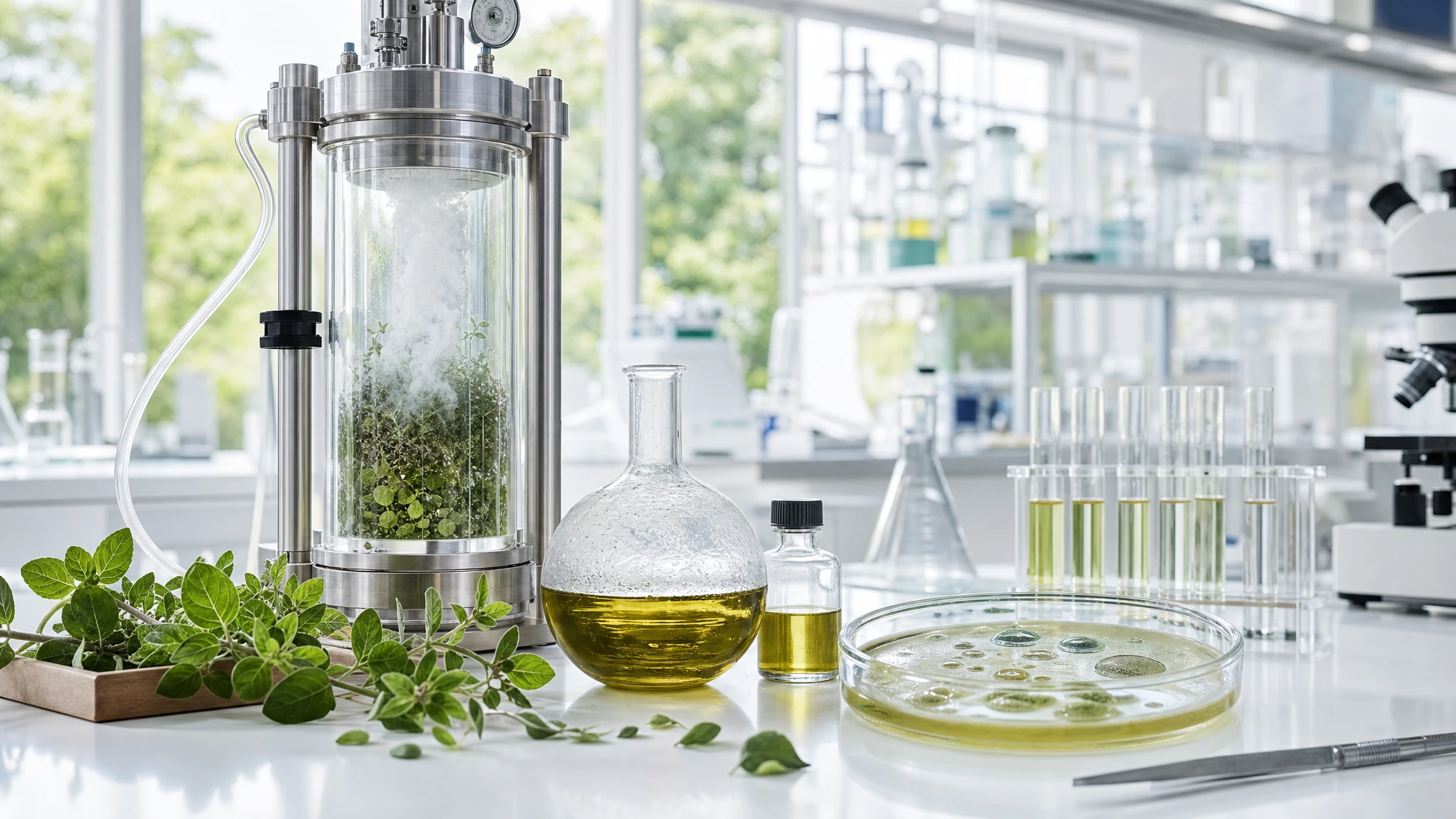
ABSTRACT : WHAT THE SCIENCE SAYS
The study evaluated three extracts of Origanum vulgare leaves obtained using supercritical carbon dioxide. The results indicate activity against bacteria, fungi, and biofilms in laboratory tests. The intensity of the effect varied based on the microorganism, the concentration, and the conditions used to prepare the extract.
The authors' summary describes experimental in vitro research, meaning it was conducted on microorganisms cultured in a laboratory and not on humans or animals. Oregano leaves were extracted using supercritical CO2, a technique that uses high-pressure carbon dioxide to separate plant molecules; methanol was also used as a co-solvent. Extracts produced at 40, 50, and 60 °C were compared. Chemical analysis detected phenolic acids, flavonoids, and triterpenes, including rosmarinic acid, luteolin, naringenin, oleanolic acid, and ursolic acid. The extracts inhibited selected bacteria, including Salmonella Enteritidis, Listeria monocytogenes, and Staphylococcus aureus, with minimum inhibitory concentrations between 0.25 and 1.0 mg/mL. They also acted against Fusarium species, but generally at higher concentrations. The extract obtained at 40 °C reduced L. monocytogenes and S. aureus biofilm formation by up to 100% at twice the minimum inhibitory concentration. It only partially removed already mature biofilms. These results demonstrate technological potential in the laboratory; they do not prove clinical efficacy, safety of use, or the ability to prevent infections in humans.
What this research analyzed
To understand whether the method of preparing an extract changes its effects in a test tube, Gwiazdowska and colleagues compared three preparations obtained from oregano leaves at 40, 50, and 60 °C. Supercritical CO2 is a form of carbon dioxide that combines the characteristics of a liquid and a gas and can penetrate plant material; in this case, methanol was added to facilitate the recovery of more polar molecules.
The authors identified plant components using liquid chromatography and mass spectrometry, techniques that separate and identify molecules. They then tested bacteria, fungi of the Fusarium genus, and biofilms—microbial communities that adhere to a surface and are protected by a matrix. The tests measured both the inhibition of growth and the ability to hinder or remove already formed biofilms.
Research data
Antimicrobial and Antibiofilm Activity of Origanum vulgare Extracts Obtained by Supercritical Fluid Extraction Under Various Extraction Conditions
- Three leaf extracts, obtained at 40, 50, and 60 °C using supercritical CO2 and a co-solvent, were compared.
- Against the tested bacteria, the minimum inhibitory concentrations ranged between 0.25 and 1.0 mg/mL.
- The extract obtained at 40 °C completely inhibited the biofilm formation of Listeria and Staphylococcus at 2×MIC.
What results emerged from the study
In practical terms, the extracts hindered the growth of the microorganisms examined, though not all with the same intensity. Bacteria were generally found to be more sensitive than fungi. For bacteria, the minimum inhibitory concentration—the lowest amount capable of preventing visible growth—was between 0.25 and 1.0 mg/mL. For some Fusarium species, however, 7.5 or 15 mg/mL were required.
The extract produced at 40 °C showed the most thoroughly evaluated effect on biofilm. At 2×MIC, it completely prevented biofilm formation by L. monocytogenes and S. aureus, while against Pseudomonas aeruginosa, the inhibition was 34%. On mature biofilms, which are more difficult to remove, the effect was partial, ranging from 18% to 52%. The observed differences indicate that the microbial species, dosage, and extract preparation influence the result.
Why this study is relevant
The research is primarily relevant to the microbiological safety of food and surfaces, not for the treatment of infections. It shows that a plant extract is not a fixed substance: temperature, solvent, and extraction process can change the profile of the recovered molecules and the measured activity. The same principle also emerged in a previous study on oregano fractions obtained with supercritical CO2 [1].
The result regarding biofilm deserves attention because these structures make microorganisms more difficult to control. Another study on the essential oil of O. vulgare subsp. hirtum observed activity against free-floating cells and biofilms of Salmonella and Listeria [2]. However, essential oils and supercritical extracts have different compositions and concentrations: they are not equivalent products.
Study limitations and what it does NOT demonstrate
The main limitation is that all the evidence was conducted in vitro. An effect in a petri dish does not prove that the extract prevents or cures infections in people, nor that it is safe to ingest, inhale, or apply to the skin. No individuals, animals, absorption, metabolism, clinical toxicity, or drug interactions were studied.
Furthermore, the effect was measured against specific strains and conditions. The presence of phenolic acids, flavonoids, and triterpenes documents a complex composition, but it does not identify with certainty which molecule is responsible for the activity. It is also not possible to equate these extracts to the common food spice: the experimental concentrations and the form of preparation are different.
Independent confirmatory evidence
The chain of confirmation begins with preparation. Santoyo and colleagues compared oregano leaf fractions obtained via supercritical CO2 in an experiment on six microorganisms: all were active, but the most effective fraction was the one rich in volatile components obtained with specific parameters [1]. This directly supports the idea that extraction modifies activity, even while using different equipment and microbial species.
The next step concerns the biofilm. Kolypetri and colleagues studied an essential oil of O. vulgare subsp. hirtum in vitro against two foodborne pathogens. The minimum inhibitory concentrations were 0.03-0.06%, and those required to prevent biofilm were 0.06-0.13%; treatment at 6.25% for 15 minutes eliminated biofilm cells in their model [2]. The confirmation is moderate because it concerns an oil, not the substance extracted by Gwiazdowska.
A third study analyzed an ethanolic extract against twelve oral isolates and found biofilm inhibition that varied between strains and the surface model [3]. It therefore confirms that the effect can extend to adherent microbial communities, but also emphasizes that it is not uniform and remains confined to laboratory tests.
Conflicting evidence
The data do not indicate equal activity for all preparations. Stamenic and colleagues compared supercritical extracts of Greek oregano with oil obtained via hydrodistillation. The supercritical extracts were more active against staphylococci, while the distilled oil was more effective against Escherichia coli, Salmonella, and Klebsiella pneumoniae [4]. This result is relevant because it demonstrates a dependency on the extraction method and the bacterial species.
Even more clearly, Sahin and colleagues detected essential oil activity against 10 bacteria and 15 fungi or yeasts, but no antimicrobial activity from the methanolic extract of the plant's aerial parts [5]. No directly conflicting evidence sufficiently relevant to each individual data point from Gwiazdowska and colleagues was identified; this does not prove the absence of data contradicting what was observed. Overall, the literature suggests that composition, dose, and microorganism strongly influence the outcome.
Comparative overview
Comparison between independent studies and results obtained with the extracts analyzed by Gwiazdowska and colleagues.
| Publication | Model and material | Main result | Relationship to the study |
|---|---|---|---|
| Santoyo et al., 2006 [1] | Six microorganisms; leaf fractions extracted with supercritical CO2 | Activity varied between fractions; the most active was obtained with specific parameters. | Direct confirmation of dependence on extraction parameters. |
| Kolypetri et al., 2023 [2] | Salmonella and Listeria; oregano essential oil | Antibacterial and antibiofilm activity with concentrations varying according to the test. | Indirect confirmation of activity against pathogens and biofilms. |
| Vervaeke et al., 2022 [3] | Twelve oral isolates; ethanolic oregano extract | Biofilm inhibition varied by strain, concentration, and surface. | Indirect confirmation and dependence on the experimental model. |
| Stamenic et al., 2014 [4] | Selected bacteria; supercritical extracts and distilled oil | Distilled oil was more active against certain Gram-negative bacteria. | Conflicting evidence: the method does not always favor the same action profile. |
| Sahin et al., 2004 [5] | 10 bacteria and 15 fungi or yeasts; essential oil and methanolic extract | The oil was active; the methanolic extract showed no antimicrobial activity. | Conflicting evidence: the extracted form may lose or fail to concentrate relevant components. |
Editorial conclusion
References
[1] Supercritical Carbon Dioxide Extraction of Compounds with Antimicrobial Activity from Origanum vulgare L.: Determination of Optimal Extraction Parameters
[2] Chemical Composition, Antibacterial and Antibiofilm Actions of Oregano (Origanum vulgare subsp. hirtum) Essential Oil against Salmonella Typhimurium and Listeria monocytogenes
[3] Origanum vulgare ethanolic extracts as a promising source of compounds with antimicrobial, anti-biofilm, and anti-virulence activity against dental plaque bacteria
[4] Free-radical scavenging activity and antibacterial impact of Greek oregano isolates obtained by SFE
[5] Biological activities of the essential oils and methanol extract of Origanum vulgare ssp. vulgare in the Eastern Anatolia region of Turkey
Editorial note
Artificial Intelligence was used solely as a tool to support editorial and documentary work. All content, interpretations, bibliographic citations and conclusions have been verified, reviewed and approved by the author, who assumes full scientific responsibility for them.
The manuscript was also subject to independent peer review prior to publication.
To ensure maximum transparency, the article's complete history — including the dates of submission, review, acceptance and publication, as well as information on the peer review process — is available on the dedicated Article History page.