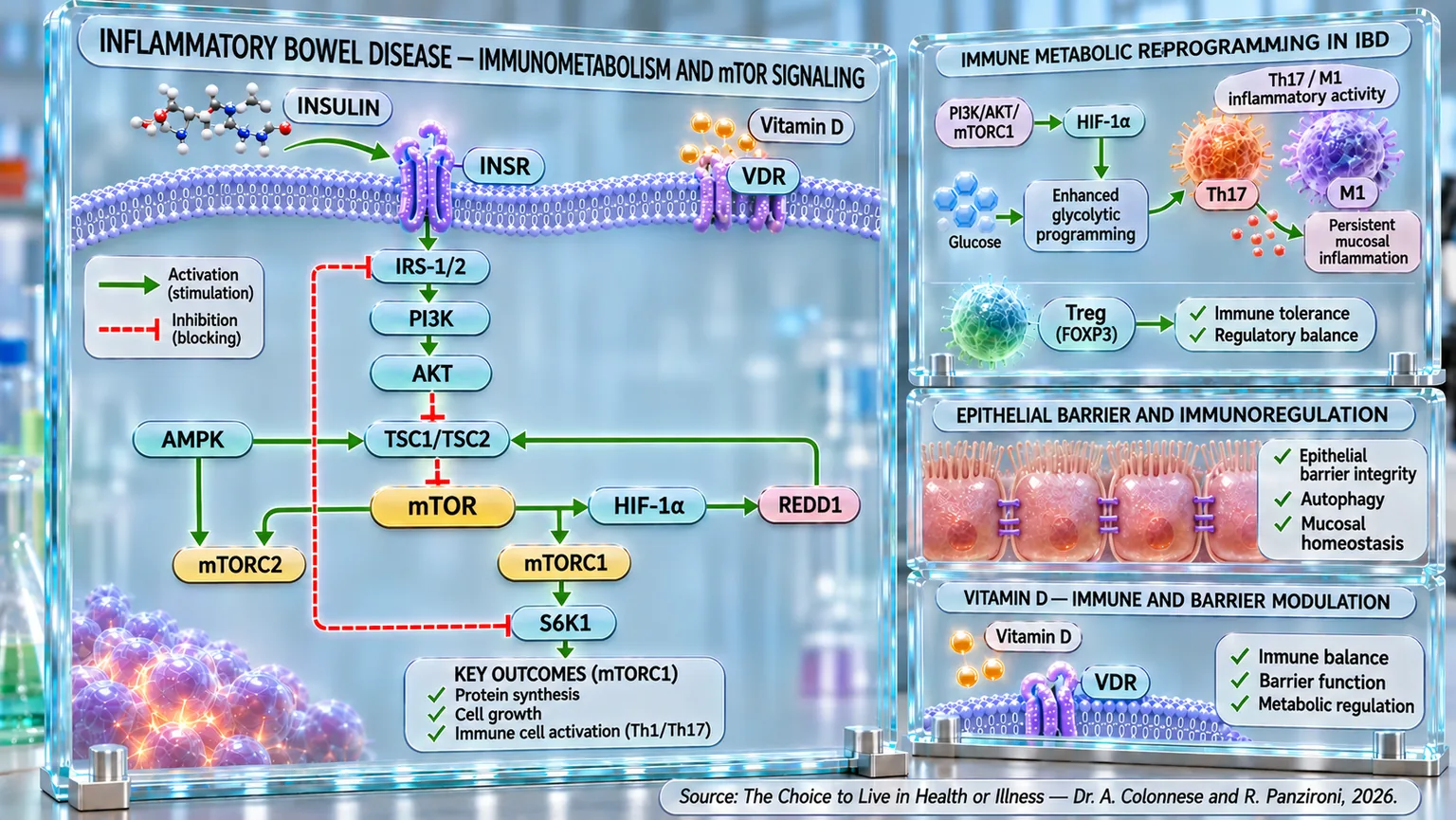
It is precisely within this network of metabolic and inflammatory signals that one of the main points of convergence between alterations in the insulin pathway and the immune dysregulation characteristic of IBD emerges: mTOR. Located downstream of the PI3K/AKT pathway, mTOR is not merely an effector of insulin signaling, but a true metabolic sensor capable of integrating nutrient availability, growth signals, cytokines, and stress conditions. Its activity can therefore translate a metabolic alteration into a different cellular and immune response, creating a direct link between the previously described state of insulin resistance and the mechanisms that sustain intestinal inflammation.
In 2024, researchers described mTOR as an important metabolic regulator capable of directing the behavior of immune cells based on the nutrients and cytokines present in the microenvironment. Its activity contributes in particular to determining the fate of T lymphocytes, influencing the balance between effector and regulatory populations. In IBD, an alteration of this control can therefore favor a more pro-inflammatory response, supporting the differentiation and activity of Th17 cells at the expense of the regulatory mechanisms necessary to contain intestinal mucosal inflammation (Zhang et al., 2024) [3].
This relationship becomes particularly important considering that Th17 cells produce cytokines such as IL-17, IL-21, and IL-22, which are capable of profoundly modifying the intestinal inflammatory microenvironment. When mTOR activity favors metabolic programs associated with the effector response, naïve T cells (T lymphocytes not yet activated by their specific antigen) can be more oriented toward pro-inflammatory phenotypes; conversely, the reduction of mTOR signaling can favor the development of Treg cells, which are responsible for controlling the immune response and maintaining tolerance.
An experimental demonstration of this balance emerges from the work of some researchers, in which the use of the mTOR inhibitor INK128 in animal models of colitis resulted in a significant attenuation of intestinal inflammation. The treatment was associated with a decrease in Th1 and Th17 populations and, simultaneously, an increase in the Treg component. The treated animals also showed better colon integrity and less weight loss, indicating how intervention in mTOR signaling can translate into concrete changes in both the immune response and intestinal damage (Shi et al., 2019) [4].
Consistent results were also reported in 2016, evaluating the effects of mTOR inhibition using AZD8055 (a substance that directly inhibits mTOR) in experimental models of colitis. In this case as well, the treatment reduced inflammation and the presence of Th1 and Th17 populations, while simultaneously favoring the expansion of Tregs and the increase of IL-10, an important anti-inflammatory cytokine associated with the regulatory response. mTOR inhibition therefore shifted the immune balance from a predominantly effector and pro-inflammatory condition toward a more regulatory profile (Hu et al., 2016) [5].
The contribution of mTOR is not limited to adaptive immunity: the colon epithelium (the tissue that lines and protects the body's surfaces), far from being a passive barrier, "talks" to the immune system by modulating the tissue's cytokine profile based on its differentiation state, a process that depends precisely on mTOR signaling. When this circuit is altered, the epithelium promotes hyperplasia and pro-inflammatory recruitment, fueling colitis from within the tissue itself (Lyons et al., 2018) [13].
This same metabolic "control center" governs the language choice of T cells: when mTOR is active, naive T cells take the effector pathways (Th1/Th2/Th17); when the signal is dampened, the regulatory pathway prevails and Tregs and Foxp3+ cells appear, which are better suited to restoring tolerance. It is an immunological switch that transforms a discordant chorus into more orderly music (Delgoffe et al., 2009) [11].
In another study from 2013, mTOR was defined as a metabolic sensor that integrates nutrients, cytokines, and stress and decides the fate of cells in the intestine and immune system. When its natural brake, PTEN (a protein that slows the PI3K/AKT pathway), is lowered, the PI3K/AKT/mTOR insulin pathway becomes hyperactivated in T cells and mucosal lymphocytes in Crohn's disease, supporting proliferation, survival, and inflammatory mediators as if one were keeping their foot on the accelerator on a road already crowded with inflammation (Long et al., 2013) [10].
It is no coincidence that, under controlled ex vivo conditions, rapamycin (a drug that primarily inhibits mTOR activity) allows for the expansion of human Tregs while maintaining their phenotype and suppressive function, a practical clue as to how modulating mTOR can rebalance the regulatory arm in contexts of chronic hyper-activation (Battaglia et al., 2012) [12].
It is not surprising, therefore, that pharmacological strategies against mTOR are emerging, as we will see in the next paragraph, as concrete avenues in IBD: preclinical data show reductions in cytokines, restoration of the barrier, and Th17/Treg rebalancing, while clinical practice still requires larger studies to define long-term efficacy and safety (Lashgari et al., 2021) [14]; (Afzal et al., 2022) [15].
Overall, the evidence analyzed outlines a close interaction in IBD between metabolic alterations, the insulin pathway, and immune dysregulation. In this scenario, mTOR emerges as a central node capable of integrating signals from the PI3K/AKT pathway with the metabolic programs that regulate T lymphocyte activity. Its excessive activation can favor proliferation, pro-inflammatory responses, and effector polarization, contributing to the Th17/Treg imbalance and the persistence of intestinal inflammation. Conversely, proper modulation of mTOR can support autophagy, the regulatory function of Tregs, and epithelial homeostasis, highlighting the importance of the balance of this network in the pathophysiology of IBD.