
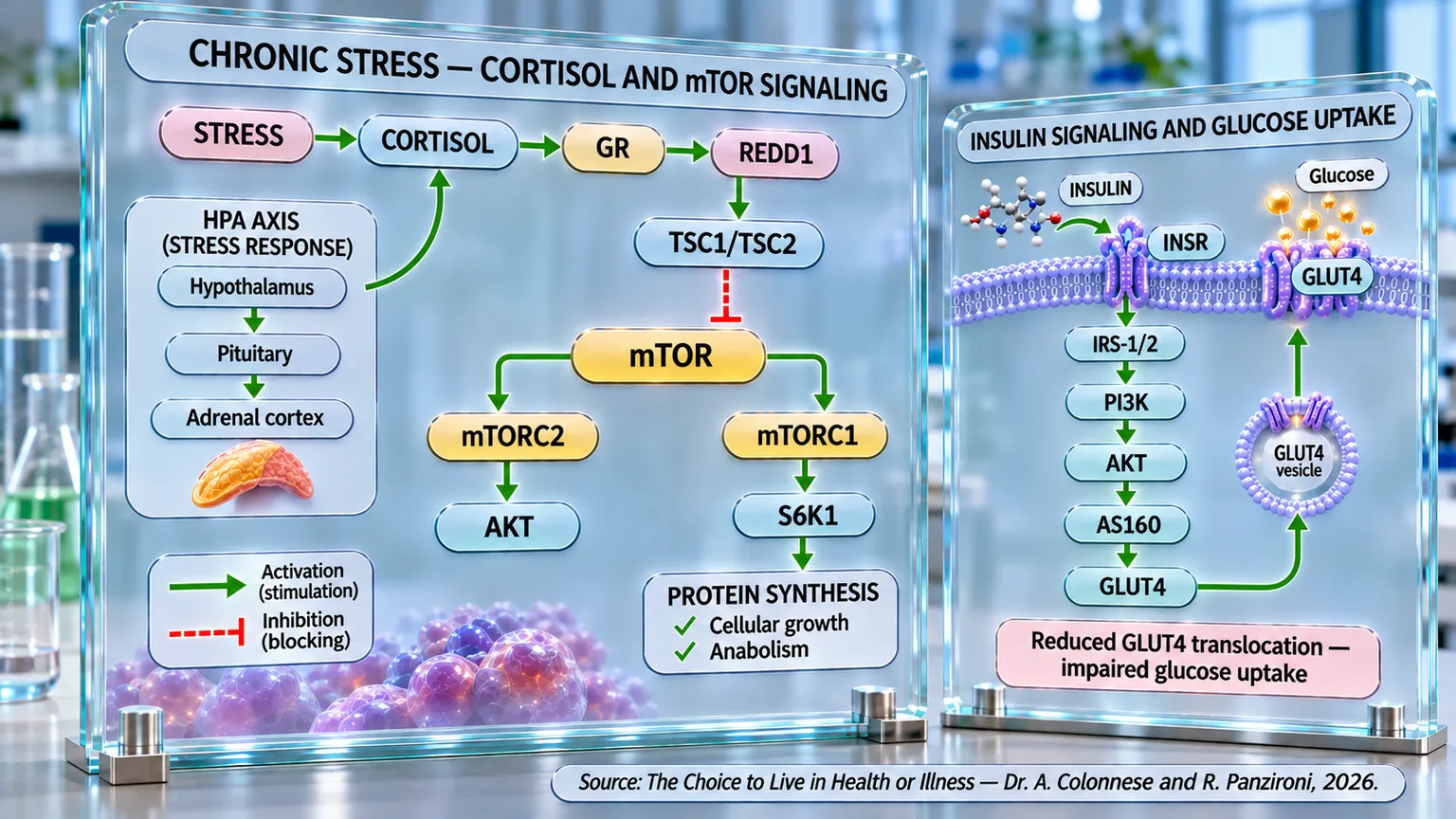
After understanding how chronic stress can profoundly alter the activity of the hypothalamic-pituitary-adrenal axis, the next step is to understand how this neuroendocrine hyperactivation can progressively transform into insulin resistance. In physiology, cortisol is an essential hormone for survival: during a dangerous situation, its task is to ensure the brain and muscles have rapid access to energy. To do this, it increases hepatic glucose production, reduces peripheral sugar consumption, and mobilizes fats and proteins as alternative energy sources. In the short term, this mechanism is advantageous; the problem emerges when cortisol remains elevated for weeks, months, or years. At that point, the body continues to behave as if it were constantly under threat, maintaining active metabolic processes that slowly end up compromising insulin sensitivity.
One of the first effects of chronic cortisol concerns the liver. Glucocorticoids stimulate hepatic gluconeogenesis, which is the production of glucose from amino acids and other energy substrates. Simultaneously, they reduce peripheral glucose utilization by muscles and interfere with normal insulin signaling. At the cellular level, cortisol reduces the translocation of the GLUT-4 transporter, alters the phosphorylation (activation process) of IRS-1, and compromises the PI3K/AKT pathway, one of the main intracellular systems through which insulin exerts its metabolic effects (Blaslov et al., 2018) [9]. It is as if insulin were continuing to knock on the cell door, but the signal were being progressively ignored.
This alteration can initially remain invisible to standard tests. The pancreas, in fact, tries to compensate by producing ever-increasing amounts of insulin. In an initial phase, the body still manages to maintain relatively normal glycemic values thanks to compensatory hyperinsulinemia. However, behind this apparent metabolic normality, the system is already working in overload. An experimental study conducted on healthy women treated with dexamethasone (a drug similar to cortisol that reduces inflammation) clearly showed this mechanism: after a few days of exposure to glucocorticoids, insulin sensitivity decreased drastically, while insulin secretion increased compensatorily. Although the pancreas managed to temporarily maintain normal peripheral glucose utilization, the liver continued to produce excess glucose, signaling persistent hepatic insulin resistance (Nicod et al., 2003) [10].
This finding is particularly important because it suggests that the liver may be one of the first organs to lose sensitivity to insulin during chronic hyperactivation of the HPA axis. Even in the presence of high insulin levels, hepatic glucose production is not adequately suppressed. In practice, the body continues to “manufacture sugar” even when it does not need it. In the long term, this mechanism contributes to chronic hyperinsulinemia, increased glycemia, and the progressive compensatory exhaustion of pancreatic β-cells.
In recent years, various studies have shown that these phenomena can also appear in apparently healthy, normal-weight individuals. A study conducted in Algiers observed that individuals with morning cortisol levels in the high end of the physiological range had significantly higher values of the HOMA-IR index, one of the main indicators of insulin resistance. Subjects with higher cortisol also showed greater abdominal obesity, insomnia, sedentary behavior, and a worse general lipid profile (Ould Bessi et al., 2025) [11]. This suggests that it is not necessary to reach extreme pathological levels of cortisol, as in Cushing's syndrome (a condition caused by prolonged exposure of the body to excessive levels of cortisol), to observe significant metabolic alterations. Even moderate but persistent chronic hyperactivation of the HPA axis can gradually contribute to the loss of insulin sensitivity.
A particularly interesting aspect is that insulin resistance is not exclusively a disease of obesity. For many years, it was thought that the main driver of insulin dysfunction was excess visceral adipose tissue; although obesity is certainly one of the most important factors, we now know that even lean individuals can develop significant insulin resistance. According to the hypothesis proposed by Blaslov and colleagues, in these subjects, the main pathological trigger could be neuroendocrine rather than adipocentric. Chronic stress, through the hyperactivation of the HPA axis and the persistent increase of insulin counter-regulatory hormones, could therefore represent one of the main hidden metabolic factors in normal-weight subjects (Blaslov et al., 2018) [9].
Chronic stress also appears to exert profound effects on pancreatic β-cells, the cells responsible for insulin production. In overweight young Latin Americans, higher cortisol levels were associated not only with reduced insulin sensitivity but also with a lower compensatory capacity of the pancreas. In particular, cortisol correlated negatively with the acute insulin response to glucose and with the disposition index, a parameter that reflects the compensatory functionality of β-cells. This means that cortisol does not seem to be limited to making peripheral cells less sensitive to insulin, but could also progressively compromise the pancreas's ability to react adequately to the increase in insulin demand (Adam et al., 2010) [12].
This phenomenon is extremely relevant in the progression toward type 2 diabetes. In the initial phases, the pancreas manages to compensate for insulin resistance by increasing insulin secretion. Over time, however, chronic functional overload can favor β-cell deterioration. It is like constantly asking an engine to run beyond its limit: initially, it manages to maintain performance, but in the long run, structural failures begin.
Experimental evidence also shows that chronic stress does not only act on peripheral metabolism but can also directly alter brain metabolism. In murine models (laboratory animals, mainly mice) of chronic unpredictable stress, prolonged exposure to stressors significantly increased the HOMA-IR index and induced pathological alterations in insulin signaling in the hippocampus. In particular, increased inhibitory phosphorylation of IRS1 and activation of JNK, a kinase involved in neuronal insulin resistance, were observed. Simultaneously, the animals developed significant cognitive and memory deficits (Rong et al., 2024) [13].
Parallel to the endocrine imbalance, chronic stress also promotes significant production of reactive oxygen species. Oxidative stress appears to be one of the main mechanisms through which cortisol alters insulin sensitivity. In police officers exposed to high occupational stress, higher levels of urinary cortisol were associated with both markers of oxidative stress and an increase in the HOMA-IR index. Researchers observed that perceived stress correlated positively with an indicator of lipid peroxidation (damage to cellular fats caused by oxidation) and oxidative damage (Janczura et al., 2020) [14].
An experimental study on mice exposed to chronic unpredictable environmental stress showed the systemic consequences of this condition extremely clearly. After weeks of exposure to stress, the animals developed persistent hyperglycemia, increased HbA1c, an increase in the HOMA-IR index, and a significant reduction in insulin levels. Simultaneously, a marked reduction in antioxidant defenses, DNA damage, and diffuse degenerative alterations in the pancreas, liver, kidneys, and muscles were observed (Raghav et al., 2019) [15].
Even during pregnancy, cortisol appears to profoundly influence insulin homeostasis. In a cohort of over 500 Peruvian women, higher levels of cortisol in hair were associated with significant increases in fasting insulin and the HOMA-IR index. This suggests that chronic hyperactivation of the HPA axis can amplify physiological gestational insulin resistance, forcing pancreatic β-cells into further compensatory effort.
It is interesting to note that cortisol was not directly associated with the onset of overt gestational diabetes. This finding suggests that hyperactivation of the HPA axis can initially alter insulin metabolism without immediately producing clinically evident hyperglycemia. Once again, the concept of a long “silent” compensatory phase emerges, in which the body manages to temporarily maintain glycemic balance at the cost of increasing metabolic overload (Juvinao-Quintero et al., 2023) [16].
Overall, all this evidence converges toward a central concept: chronic stress is not just a psychological phenomenon, but a biological condition capable of profoundly modifying the insulin regulation of the entire organism. Through cortisol, catecholamines (substances that help the body and nervous system respond rapidly to stress and stimuli), oxidative stress, inflammation, and alterations in cellular signaling, chronic hyperactivation of the HPA axis appears to contribute progressively to the loss of insulin sensitivity, β-cell deterioration, and systemic metabolic dysfunction. In this view, insulin resistance no longer appears only as a consequence of caloric excess or obesity, but as the result of a complex interaction between metabolism, the brain, the endocrine system, and the psychological environment.