
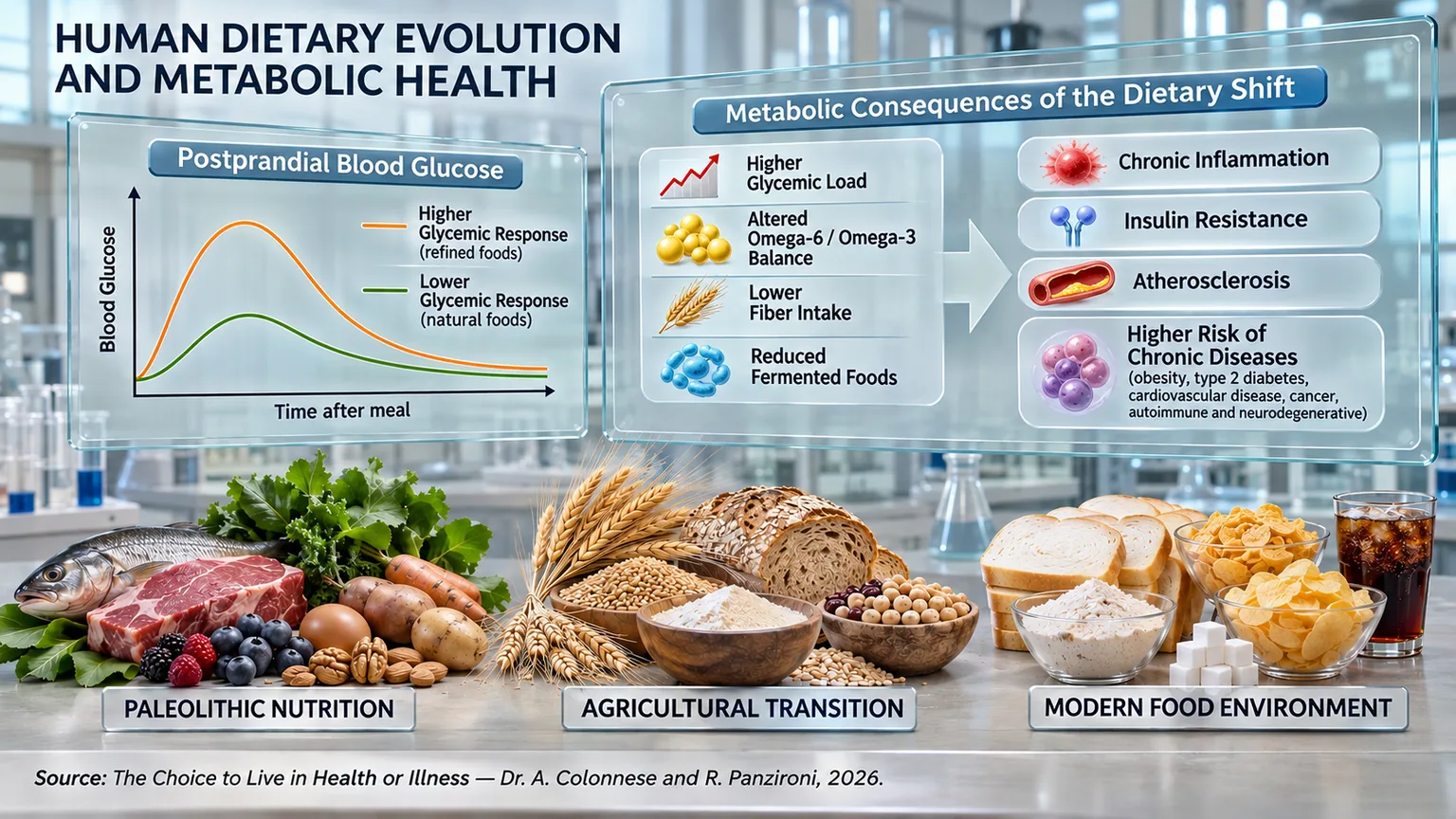
Before the advent of agriculture and animal husbandry, humans relied solely on wild foods of animal and plant origin, consumed in their natural or minimally processed state. The diet was a direct result of the ecosystem and the seasons, and each food maintained its original nutritional characteristics intact. With the domestication of plants and animals, these qualities began to change: at first almost imperceptibly, then more and more markedly, especially with the technological progress accelerated by the Industrial Revolution (Cordain et al., 2005) [7].
This period represents a clear break in the evolutionary history of our diet. New foods were introduced and, above all, processing techniques were developed that allowed for combinations of nutrients and calories never before experienced by Homo sapiens throughout its history. This is not just about new flavors or preparations, but about actual changes in the nutritional structure of food: refined grains, simple sugars, hydrogenated fats, and long-life products became an integral part of the daily diet, altering the balance between macronutrients and micronutrients that had characterized millions of years of evolution.
The comparison between pre- and post-agricultural diets highlights two crucial aspects. First: hunter-gatherers had access to a range of foods that did not undergo industrial processes, with a balance of lean proteins, unsaturated fats, fiber, and complex carbohydrates with a low glycemic index. Second: the foods introduced with agriculture, industrialization, and advanced technologies possess nutritional characteristics that humans could not have consumed regularly before these revolutions, and to which our metabolism has not had sufficient time to adapt (Cordain et al., 2005) [7].
This “evolutionary discordance,” the gap between our genetic heritage and the new nutritional environment, is now recognized as one of the main factors underlying the chronic diseases of civilization. The transformations following the Neolithic and the Industrial Age have profoundly modified at least seven key dietary parameters: glycemic load, fatty acid profile, macronutrient composition, micronutrient density, acid-base balance (a state of stability in which the body maintains the pH of blood and body fluids within an optimal range), sodium/potassium ratio, and fiber content. Each of these changes has had a direct impact on metabolism, the immune system, and hormonal regulation, promoting conditions such as insulin resistance, inflammation, and hypertension.
In summary, the transition from wild food to agricultural and finally industrial food has not represented merely a technological evolution, but a true shift in the nutritional paradigm. The problem is not just “what” we eat today, but how profoundly these foods differ from those for which our organism was designed.