Scientific Book

Social relationships and biological responses to loneliness

Social relationships represent an important component of physical and mental health, with potential implications for stress regulation, neuroendocrine activity, and inflammatory processes. Social isolation, loneliness, and the quality of interpersonal relationships are associated with different health outcomes through complex biological and behavioral mechanisms. In the book "The Choice to Live in Health or Disease," Dr. A. Colonnese and R. Panzironi explore the link between sociality, psychophysical balance, and the body's functioning.

Cite this article
Colonnese, A. & Panzironi, R. (2026). Social relationships and biological responses to loneliness. The Choice to Live in Health or in Disease. https://lifesciencehub.info/en/la-scelta-di-vivere-in-salute-o-in-malattia/social-relationships-and-biological-responses-to-loneliness
The Choice to Live in Health or in Disease · ISBN 979-12-82692-03-8

DOI lsh.en.libro.21

  • Published 05/11/2026
  • Updated 05/11/2026
  • SOCIAL ISOLATION
  • LONELINESS
  • CHRONIC STRESS
  • CORTISOL
  • REDD1
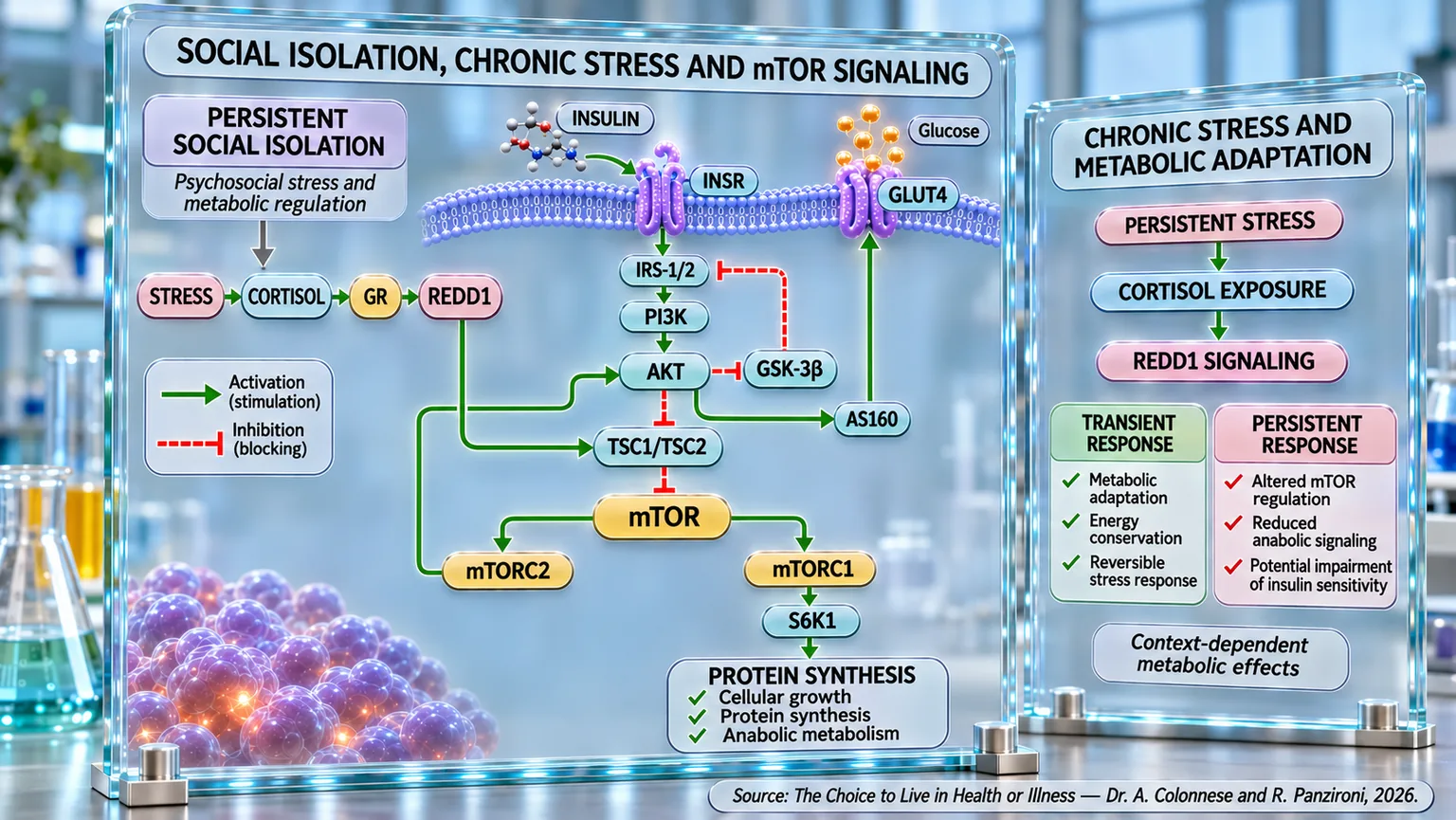
Molecular infographic featuring a cell membrane, insulin receptor, GLUT4, and diagrams of the REDD1, AKT, and mTOR pathways under chronic stress.
The diagram connects persistent social isolation, stress, and cortisol to REDD1/mTOR signaling, alongside the INSR–IRS-1/2–PI3K–AKT insulin pathway and GLUT4 glucose transport. It also distinguishes between transient and persistent responses, highlighting metabolic adaptation, altered anabolic regulation, and a possible reduction in insulin sensitivity.

ABSTRACT

Sociality constitutes a biological dimension of health, associated with survival, behavior, and metabolic regulation. In the book "La scelta di Vivere in Salute o in Malattia" (The Choice to Live in Health or Disease), Dr. A. Colonnese and R. Panzironi examine the relationships between social isolation, chronic stress, and insulin signaling. Epidemiological studies associate persistent loneliness and isolation with higher mortality and cardiovascular risk, without demonstrating a unique causal relationship.

The relevance of relationships finds an evolutionary context in cooperation, resource sharing, and social learning within human communities. During childhood and adolescence, isolation has been associated with inflammation, obesity, and subsequent cardiometabolic alterations. In adulthood, social disconnection is frequently accompanied by lower dietary quality, less physical activity, a greater propensity for smoking, and reduced therapeutic adherence. These behaviors may contribute to the observed associations between poor social support, insulin resistance, and glycemic alterations.

Beyond behaviors, experimental models suggest effects of isolation on central and peripheral insulin sensitivity, oxidative stress, and insulin signal transmission. A possible link involves the hypothalamus-pituitary-adrenal axis: persistent loneliness can modify the circadian regulation of cortisol. Through the glucocorticoid receptor, cortisol induces REDD1, which acts on TSC1/TSC2, reducing mTOR activity. This response may temporarily favor energy adaptation, while its persistence could compromise cellular metabolism.

Prolonged modulation of mTOR can affect mTORC2 and the activation of AKT, interfering with the AKT-AS160-GLUT4 sequence and glucose uptake; evidence also points to possible effects on pancreatic β-cell function. Overall, a network of epidemiological associations and experimental mechanisms emerges that links social relationships, stress response, and metabolic homeostasis. Understanding their interactions can guide further research, while avoiding the consideration of the cortisol-REDD1-mTOR pathway as an exclusive explanation for the health effects of loneliness. It remains fundamental to distinguish the effects of transient stress from the consequences of persistent exposure.

Sociality as a new risk factor

Sociality represents one of the most profound and often underestimated pillars of human health. By nature, humans are a social species: since our origins, survival has depended on the ability to form bonds, cooperate, and live within a community. Relationships are therefore not merely a backdrop to daily life, but a structural component of our biology. When this relational balance is lost, it does not just generate emotional distress; it triggers a genuine cascade of physiological changes that can compromise long-term health.

In recent years, scientific literature has begun to recognize social disconnection—understood as objective isolation or the subjective experience of loneliness—as a genuine risk factor, on par with those traditionally considered in clinical settings. In this context, sociality ceases to be an accessory element and becomes a central determinant of health status.

The epidemiological evidence is particularly clear. A large meta-analysis conducted on over 300,000 individuals demonstrated that people with stronger social relationships have a 50% higher probability of survival compared to those who are more isolated (Holt-Lunstad et al., 2010) [1]. This data takes on even greater significance when compared with other risk factors: the impact of social relationships on mortality is, in fact, comparable to that of smoking, obesity, and physical inactivity, suggesting that the relational dimension is a biological determinant of primary importance.

This observation is further confirmed by large-scale studies that have directly analyzed the role of social isolation in mortality. In a representative sample of the adult population, isolation proved to be an independent predictor of mortality, with an impact similar to that of smoking and greater than that of hypertension (Pantell et al., 2013) [2]. In other words, the lack of social relationships can influence survival as much as some of the most well-known clinical risk factors, highlighting how health is not determined exclusively by biological parameters, but also by the quality of human connections.

A particularly interesting aspect concerns the multidimensional nature of sociality. It is not just the number of relationships that counts, but also their quality and the subjective perception of connection. Two people can have the same number of social contacts but live completely different experiences: one may feel supported and integrated, the other profoundly lonely. It is precisely this discrepancy between desired and actual relationships that defines loneliness, a condition that, if persistent, can have even more marked effects on health.

The distinction between situational loneliness and chronic loneliness helps to better understand this phenomenon. The former is temporary, linked to specific life events; the latter is persistent and represents a more stable and deep-rooted condition. Evidence shows that both increase the risk of mortality, but with different intensities: situational loneliness is associated with an increase in risk of over 50%, while chronic loneliness can increase it by up to 83% (Shiovitz-Ezra and Ayalon, 2010) [3]. This suggests that the duration and persistence of social disconnection play a crucial role in determining the impact on health.

What makes this topic even more relevant is the fact that social disconnection does not act only at a psychological or behavioral level, but directly involves the body's biological systems. Recent studies have shown that social isolation is capable of profoundly altering cellular homeostasis, activating a complex network of neuroendocrine, immune, and metabolic mechanisms (Qaisiya et al., 2025) [4]. In conditions of isolation, the body enters a state of chronic stress, characterized by hyperactivation of the hypothalamic-pituitary-adrenal axis and a persistent increase in cortisol levels. This hormonal state promotes metabolic alterations such as hyperglycemia, insulin resistance, and redistribution of adipose tissue, which are key elements in the development of metabolic syndrome.

In parallel, an increase in chronic inflammation is observed. The body, as if perceiving a constant threat, keeps the immune system active, producing pro-inflammatory cytokines that, in the long term, contribute to the development of cardiovascular and metabolic diseases. Added to this are phenomena of oxidative stress, mitochondrial dysfunction, and alterations in autophagy processes, all of which compromise the cells' ability to maintain their internal balance.

In this perspective, loneliness can be interpreted as a true immunometabolic syndrome, characterized by a network of alterations that simultaneously involve the nervous system, the immune system, and metabolism (Pourriyahi et al., 2021) [5]. It is therefore not just a psychological condition, but a complex biological state that modifies the functioning of the entire organism.

A further element of reflection concerns the contemporary social context. Cultural changes, the rise of individualism, the digitalization of relationships, and the impact of global events like the pandemic have contributed to making social disconnection increasingly widespread. Today, a significant portion of the population experiences forms of isolation or loneliness, making this phenomenon a genuine public health emergency. Evidence suggests that the impact of social disconnection on mortality is comparable to that of consuming about fifteen cigarettes a day, a fact that makes its clinical relevance immediately evident (Na et al., 2023) [6].

The implications are also significant on a cardiovascular level. Loneliness and social isolation are associated with a significant increase in the risk of coronary heart disease and stroke, independently of other traditional risk factors (Holt-Lunstad and Smith, 2016) [7]. This confirms that the relational dimension acts as an autonomous determinant of health, capable of directly influencing the main physiological systems.

Overall, a clear picture emerges: sociality is not a simple element of psychological well-being, but a genuine biological factor that modulates health and survival. Social relationships function as a regulatory system, capable of attenuating stress, promoting healthy behaviors, and maintaining physiological balance. Conversely, their absence exposes the body to a condition of systemic vulnerability, in which various pathological mechanisms tend to activate and reinforce each other.

Understanding sociality in these terms means making a paradigm shift: no longer considering it a secondary aspect of life, but recognizing it as one of the central determinants of health. In this perspective, promoting quality social relationships is not just a social or psychological goal, but a genuine preventive strategy, capable of concretely influencing an individual's biological destiny.

Sociality in the past and the social brain

To truly understand how deeply rooted sociality is in our biology, we must take a step back and observe the evolution of the human brain. What clearly emerges is that our nervous system did not develop simply to solve technical or environmental problems, but primarily to manage relationships. In other words, the human brain is, first and foremost, a social brain.

The social brain hypothesis represents one of the most robust models in evolutionary biology for explaining the expansion of the brain in primates and humans. According to this perspective, the increase in the size of the neocortex was not driven primarily by needs related to the physical environment, but by the complex demands of group life (Dunbar, 2024) [8]. Living in a stable community involves a series of cognitive challenges: recognizing different individuals, remembering relationships, interpreting intentions, predicting behaviors, and maintaining often delicate social balances. All of this requires an extremely sophisticated processing capacity.

This relationship between the brain and sociality emerges even more clearly when observing the size of human groups. Comparative studies have shown that there is an extremely robust correlation between the size of the neocortex and the number of social relationships an individual is able to manage. In humans, this limit is around 150 individuals, a value known as “Dunbar’s number” (Dunbar, 2024) [8]. This figure is not random: it represents the equilibrium point between available cognitive capacities and the energy cost required to maintain stable relationships.

If we imagine the mind as a sort of “relationship manager,” we can better understand this concept. Every relationship requires time, attention, memory, and emotional energy. It is therefore not possible to maintain an infinite number of meaningful bonds: the brain imposes a natural limit, which is reflected in the structure of human social networks, organized into concentric circles of varying intensity.

The importance of sociality in brain development is not exclusive to humans, but also emerges clearly when comparing different species. Comparative studies among vertebrates show that, in primates, brain size is closely linked not only to the number of individuals in the group, but above all to the quality and stability of social relationships (Shultz and Dunbar, 2007) [9]. Maintaining lasting bonds, cooperating, negotiating, and resolving conflicts represents a much more complex cognitive challenge than simple individual survival.

A particularly interesting element is that the evolution of sociality seems to have occurred through progressive phases. In many species, the increase in cognitive capacity is initially linked to the management of pair bonds, which require mutual monitoring, coordination, and trust. In primates, this system then extended to larger groups, giving rise to increasingly complex social structures (Shultz and Dunbar, 2007) [9]. This transition represents one of the key moments in the evolution of the social brain.

In humans, this process has reached an unprecedented level of integration. Our species does not just live in groups, but builds actual highly coordinated social networks based on cooperation, communication, and knowledge sharing. This concept has been described as a “socio-cognitive niche,” a system in which cognitive capacities and social structures mutually reinforce each other (Whiten and Erdal, 2012) [10]. In this perspective, the human brain is not simply an individual tool, but part of a collective system, in which each individual contributes to the functioning of the group.

Theory of mind, which is the ability to understand the thoughts, emotions, and intentions of others, represents one of the pillars of this system. It allows for predicting the behavior of others, coordinating actions, and building relationships based on trust. Alongside this capacity, language allows for the precise transmission of information, while culture allows for the accumulation and sharing of knowledge over time (Whiten and Erdal, 2012) [10]. These elements, together with cooperation and egalitarianism, form an integrated system that has guided the evolution of the human species.

At the neurobiological level, these social functions are supported by a network of specific brain structures. Among these, the prefrontal cortex, the amygdala, and the temporoparietal junction play a central role in mentalization processes and relationship management. These areas allow for the interpretation of social signals, the evaluation of others' intentions, and the flexible adaptation of one's own behavior (Dunbar, 2024) [8].

A particularly significant finding emerges from neuroimaging studies (techniques used to visualize and study the brain): the size and structure of these brain areas are directly correlated with the complexity of an individual's social network. In particular, it has been observed that people with larger and more integrated social networks show a greater volume of gray matter in key regions of the social brain, such as the orbitofrontal cortex and the dorsomedial prefrontal cortex. This suggests that the ability to build and maintain relationships is not just a learned skill, but reflects a true structural organization of the brain (Kwak et al., 2018) [11].

An interesting aspect of these results is that it is not only how many relationships a person perceives they have that counts, but also how much they are recognized by others as a central node of the social network. Being “seen” by others as a relational point of reference is, in fact, associated with greater development of the brain areas involved in social understanding. This reinforces the idea that sociality is a deeply interactive phenomenon, which emerges from the encounter between individuals and not from subjective perception alone (Kwak et al., 2018) [11].

Overall, the human brain therefore appears to be shaped by the need to live in relationship. Every interaction, every bond, and every social dynamic contributes to shaping our cognitive and biological structures. Sociality is not an addition to our nature, but one of its fundamental components. Understanding this aspect means recognizing that human beings are not designed for isolation: on the contrary, they are built to connect.

Social behavior in hunter-gatherers

If the human brain evolved to manage relationships, social behavior represents its concrete expression in the real world. This is not simply about "being together," but rather a set of highly sophisticated dynamics that have allowed our species to survive, adapt, and thrive in often unpredictable contexts. By observing human societies closest to ancestral ones, it becomes clear that sociality was not an option, but a biological necessity.

One of the most surprising aspects concerns how humans learn from the very first years of life. In hunter-gatherer societies, learning is not confined to formal or structured moments but occurs continuously through social interaction. Children, even in their first months of life, begin to internalize behaviors, values, and skills by observing others, imitating them, and actively participating in the life of the group (Hewlett et al., 2011) [12]. This process is extremely early and rapid: many of the fundamental skills for survival are acquired within the first few years of life.

What makes this system particularly effective is its distributed nature. Learning does not happen only from parents, but from an entire social network that includes peers, other adults, and members of the community. This multi-level cultural transmission—vertical, horizontal, and oblique—allows for the rapid and flexible dissemination of information. In this context, trust and autonomy play a central role: children are not mere passive recipients but participate actively, exploring and learning through play and direct experience (Hewlett et al., 2011) [12].

Alongside learning, another pillar of human social behavior is cooperation. Unlike many other species, humans cooperate on a large scale even with unrelated individuals. This aspect emerges particularly clearly when analyzing the social structure of hunter-gatherer populations: studies conducted on various communities show that groups are composed primarily of non-consanguineous individuals, with low genetic correlation among members (Hill et al., 2011) [13]. This finding is fundamental because it indicates that human cooperation cannot be explained solely by the logic of kinship but is based on broader and more complex social networks.

These networks are characterized by remarkable flexibility. Individuals move between groups, form new connections, and maintain ties distributed across multiple levels. This structure fosters the exchange of information, cultural transmission, and innovation, creating a dynamic system in which the group functions as a collective organism. In this context, sociality becomes the means through which knowledge is built and transmitted (Hill et al., 2011) [13].

A concrete example of this interdependence emerges by observing the dynamics of food sharing. In ancestral societies, access to resources was not guaranteed: hunting and gathering were activities characterized by high variability and uncertainty. In this scenario, food sharing represented a fundamental strategy to reduce individual risk and ensure the survival of the group. Recent models show that the distribution of resources tends to organize into modular networks, in which individuals and families aggregate around central nodes, creating efficient cooperative systems (Plana et al., 2023) [14]. This type of organization is not random but emerges as an optimal solution in contexts of scarcity and unpredictability.

Sharing is therefore not just an altruistic act, but an adaptive strategy. Through it, the risk of hunger is distributed among the members of the group, transforming individual vulnerability into collective resilience. In other words, the group becomes a safety net.

This logic is also reflected in the multi-level structure of human societies. Studies conducted on contemporary hunter-gatherer populations show that social organization is articulated in different levels: the family, small sharing groups, and larger camps (Dyble et al., 2016) [15]. Each level performs a specific function. Within the family, cooperation based on the division of roles is observed; in sharing groups, mutual support among relatives emerges; at the broader community level, cooperation with unrelated individuals allows for coping with resource variability.

This multi-level structure represents one of the distinctive characteristics of human sociality. It allows for balancing close relationships and broader ties, ensuring both stability and flexibility. On one hand, more intimate relationships offer emotional support and security; on the other, more extensive networks increase opportunities for exchange, learning, and cooperation.

Overall, human social behavior appears as a highly integrated system, in which learning, cooperation, and sharing are continuously intertwined. Each individual does not act in isolation but within a network of relationships that profoundly influence their possibilities for survival and development.

This perspective allows us to understand a fundamental point: sociality is not simply an advantage, but a necessary condition for the functioning of the species. In the past, being isolated meant being exposed to high risk, not only from an emotional standpoint but especially in terms of survival. Connection with others was the primary tool for adapting to the environment.

Understanding these evolutionary dynamics helps to interpret the role of sociality in the modern context more deeply. What might seem like a psychological need today actually has its roots in biological and behavioral mechanisms built over thousands of years. Ultimately, the human being is not designed to live alone, but to exist within a network of relationships.

Confirmation from the past: sociality among hunter-gatherers

To fully understand the role of sociality in human history, it is necessary to look closely at the context in which our species lived for the majority of its existence: that of hunter-gatherers. For over 95% of our evolutionary history, humans did not live in cities, nor in structured societies as we know them today, but in dynamic, flexible, and deeply interconnected social systems. It is in this environment that the biological and behavioral mechanisms that still guide the way we relate to one another today were developed.

Contrary to the traditional image of small, isolated groups, the most recent evidence shows that hunter-gatherer societies were embedded in much broader and more complex social networks. Local groups, often small in size, represented only the visible part of a more extensive social structure, composed of relationships distributed across vast territories and maintained over time through exchange, mobility, and symbolic bonds. In this context, sociality was not confined to the immediate group but extended far beyond it, creating a continuous web of connections between individuals and communities.

This network-based organization emerges clearly when analyzing the composition of the groups. Ethnographic data indicate that local units were not composed primarily of close relatives, but of individuals from different backgrounds, often non-consanguineous (Bird et al., 2019) [16]. This implies that social cohesion was not based exclusively on genetics, but on systems of relationships built, maintained, and activated over time. True "wealth" was not represented by material accumulation, but by the ability to build and maintain social bonds: a genuine form of relational wealth.

Another fundamental element concerns the extraordinary variability of these societies. For a long time, it was believed that hunter-gatherers lived in small, nomadic, and rigidly egalitarian groups. However, archaeological and ethnographic evidence shows a much more complex picture. Some populations were highly mobile, others more sedentary; some showed an equitable distribution of resources, others forms of hierarchy and more structured organization (Singh and Glowacki, 2022) [17]. This diversity suggests that human sociality does not follow a single model, but is the result of an extraordinary capacity for adaptation to environmental conditions.

This flexibility represents one of the key elements of human evolution. Humans did not adapt to a single type of social organization, but developed the ability to modify their relational structures based on the context. In rich and predictable environments, forms of sedentary life and larger aggregations could emerge; in more difficult contexts, mobility and more fluid organizations prevailed (Singh and Glowacki, 2022) [17]. In both cases, sociality remained the central factor that allowed for the management of resources, risks, and opportunities.

A particularly fascinating aspect concerns the geographical extent of social networks. Archaeological analyses based on strontium isotopes have shown that, as early as 30,000 years ago, there were exchange systems that connected groups hundreds of kilometers apart (Stewart et al., 2020) [18]. Symbolic objects, such as ostrich eggshell beads, were transported and traded over long distances, serving as true "social markers" and tools for connection between groups.

These networks did not just have a cultural function; they represented a survival strategy. Connecting groups located in ecologically diverse environments allowed for the reduction of risks associated with resource variability. In the event of local scarcity, the social network offered access to alternative territories and resources, increasing the overall resilience of the system. In other words, sociality functioned as a form of biological insurance against environmental uncertainty (Stewart et al., 2020) [18].

This model highlights a fundamental principle: in the past, surviving meant being connected. The isolated individual was exposed to high risks, while the individual embedded in a broad and active social network had a greater probability of adapting and thriving. Large-scale cooperation, mobility, and the ability to maintain relationships even at a distance represented decisive evolutionary advantages.

Overall, the image that emerges is that of a deeply interdependent species, in which sociality was not an accessory element, but the supporting structure of our biological and behavioral organization. Hunter-gatherers did not simply live in groups: they lived within networks.

Understanding this reality means redefining the very concept of human nature. Humans are not designed for self-sufficiency, but for interdependence. The ability to build, maintain, and activate relationships represents not only an evolutionary advantage but one of the distinctive traits of our species.

Social interaction in teenagers

If sociality represents a structural component of human biology, there is a phase of life in which this dimension becomes particularly critical: childhood and adolescence. It is precisely during these years that the brain, the endocrine system, and the immune system are still developing and are therefore extremely sensitive to the social environment. In this context, the quality of relationships does not only influence psychological well-being, but also contributes to shaping the individual's physiology in a profound and lasting way.

Longitudinal evidence (observing how something changes over time) clearly shows that early social isolation is not a transient phenomenon without consequences, but a risk factor with effects that extend over time. Children who occupy marginal or isolated positions in peer groups show, decades later, a significantly higher risk of developing unfavorable health conditions, particularly of a cardiovascular nature (Caspi et al., 2006) [19]. This finding is particularly relevant because the association persists even after controlling for variables such as socioeconomic status, IQ, or risky behaviors, suggesting a direct and independent effect of the social dimension.

Even more significant is the fact that this effect follows a cumulative logic. Prolonged exposure to isolation, distributed across multiple phases of life, is associated with a more than doubled risk of developing health problems in adulthood. This suggests that the body “records” social experiences over time, accumulating a biological load that can manifest even many years later (Caspi et al., 2006) [19].

One of the main mechanisms through which this phenomenon occurs is low-grade chronic inflammation. Longitudinal studies show that socially isolated children exhibit, in adulthood, higher levels of C-reactive protein, a key biomarker of systemic inflammation (Lacey et al., 2014) [20]. This finding is particularly important because inflammation represents one of the main pathogenic factors underlying diseases such as type 2 diabetes, cardiovascular diseases, and depressive disorders.

The concept that emerges is that of “biological embedding”: early social experiences are progressively integrated into the body's physiological systems, modifying their functioning in the long term. In other words, what happens on a relational level during childhood does not remain confined to the psychological dimension, but translates into concrete changes at a biological level.

This vulnerability does not end with childhood, but continues during adolescence, a phase characterized by profound neurobiological and social transformations. During this period, loneliness emerges as a powerful predictor of future metabolic alterations. Recent data show that adolescents who experience high levels of loneliness have a significantly higher risk of developing obesity in adulthood, with relevant increases in body mass index (Rangul et al., 2025) [21]. This link may be mediated by several factors, including dysfunctional eating behaviors, reduced physical activity, and chronic activation of stress systems.

At the same time, even in apparently healthy young adults, loneliness is associated with early signs of cardiovascular impairment. In particular, a significant relationship has been observed between loneliness and increased arterial stiffness, a subclinical indicator of cardiovascular risk (Vasan et al., 2024) [22]. This finding suggests that the effects of social disconnection can begin to manifest long before the appearance of clinically evident pathologies.

The metabolic dimension also appears to be strongly influenced by social factors. A large analysis conducted on 14,217 young adults between 18 and 35 years old highlighted a close association between loneliness, stress, social support, social cohesion, and the presence of prediabetes or type 2 diabetes. In the population studied, as loneliness increased, the probability of prediabetes or type 2 diabetes also progressively increased: compared to the lowest levels, the third quartile of loneliness was associated with a 42% increase in odds, while in the highest quartile the increase reached 78%. Higher levels of stress and discrimination, together with lower social support and reduced neighborhood social cohesion, were also associated with a more unfavorable metabolic condition. A particularly relevant element is that these factors do not seem to act in isolation, but tend to organize themselves into actual “social profiles.” Latent class analysis has in fact identified three distinct profiles, showing that the one characterized by the most unfavorable social experiences had more than double the probability of prediabetes or type 2 diabetes (OR=2.32) compared to the reference profile (Harrison et al., 2025) [23].

Finally, it is important to emphasize that the impact of social isolation is transversal to all ages, but is particularly marked in the earliest phases of life. Population studies show that adolescents and young adults represent one of the most vulnerable groups, with particularly strong associations between social isolation and negative health conditions, including depression, unhealthy behaviors, and multimorbidity (Hämmig, 2019) [24]. This finding highlights a criticality that is often underestimated: young people, despite being perceived as a low-risk population, can in reality be deeply influenced by the quality of their social relationships.

Overall, a clear and coherent picture emerges: sociality during childhood and adolescence is not a simple factor of well-being, but a fundamental biological determinant. Early relational experiences contribute to shaping the body's physiological systems, influencing the risk of developing chronic diseases throughout life.

Understanding this means recognizing that prevention does not begin in adulthood, but much earlier. Investing in the quality of social relationships in the first years of life is not just an educational or psychological intervention, but a true strategy for metabolic, cardiovascular, and systemic prevention.

Social isolation and loneliness: impact on mortality

When analyzing the role of sociality in human health, one of the most relevant and, at the same time, most impactful aspects concerns its direct relationship with mortality. It is no longer just a matter of understanding whether relationships influence well-being or the risk of disease, but of observing how their presence or absence can concretely affect the very probability of survival.

The most robust epidemiological evidence shows that social isolation is a major predictor of all-cause mortality. A large prospective cohort, including 580,182 adults enrolled in the Cancer Prevention Study II, highlighted a significant association between increasing social isolation and the risk of death. Comparing the most isolated individuals with the least isolated, the risk of all-cause mortality was more than doubled in Black men (HR=2.34) and Black women (HR=2.13), while it increased by 60% in White men and 84% in White women; the association with all-cause mortality therefore emerged in all groups analyzed, with no statistically significant differences between men and women. The link did not only concern overall mortality: social isolation was also associated with higher cardiovascular mortality in each subgroup. Overall, these results reinforce the hypothesis that the relational dimension represents a significant determinant of health and longevity, capable of exerting its influence in populations that differ by sex and ethnic background (Alcaraz et al., 2019) [25].

A particularly significant aspect is that this increase in risk does not only concern general mortality, but extends to specific causes, particularly cardiovascular ones. Prospective studies have shown that socially isolated individuals have an almost doubled risk of cardiovascular mortality, as well as an increased incidence of events such as stroke (Kawachi et al., 1996) [26]. This data suggests that sociality does not act only at a behavioral level, but intervenes directly in the pathophysiological mechanisms that regulate cardiovascular function.

The strength of this association emerges with even greater clarity when analyzing clinical populations. In patients with coronary artery disease, social isolation is associated with a significant increase in the risk of death, both from cardiac causes and from all causes, with values more than double those of non-isolated subjects (Brummett et al., 2001) [27]. This result is particularly relevant because it persists even after controlling for disease severity and other risk factors, indicating that the social dimension directly influences clinical prognosis.

A key element that emerges from these studies is that it is not only the presence of relationships that counts, but also their quality. Socially isolated patients do not necessarily perceive a reduction in the number of contacts, but rather a lower quality of the social support received. This suggests that the benefit of sociality does not derive simply from the quantity of interactions, but from their ability to provide emotional support, security, and stress regulation.

Even at the general population level, data confirm a clear and consistent relationship between social isolation and mortality. Cohort studies conducted in different contexts show that the most isolated subjects have an increased risk of death of between 40% and 70%, with a continuous gradient: the higher the level of isolation, the higher the risk (Laugesen et al., 2018) [28]. This trend suggests a dose-response effect, in which the progressive reduction of social relationships translates into a proportional increase in biological vulnerability.

A further element of great interest concerns the temporal dimension. It is not only the presence of social isolation or loneliness that is associated with health outcomes, but also their persistence over time. A prospective study conducted on 18,258 participants of the UK Biobank, aged between 38 and 73, distinguished four different conditions: absence, transient exposure, onset over time, and persistent exposure. During a median follow-up of 8 years, persistent social isolation, compared to its absence, was associated with a 42% increase in all-cause mortality and a 53% increase in cardiovascular mortality. A similar trend was observed for persistent loneliness, associated with increases of 28% and 52%, respectively. The analysis was not limited to clinical events: in a subgroup of 5,188 participants who underwent cardiovascular magnetic resonance imaging, the persistence and accumulation of these social conditions were also associated with worse cardiac function. These results therefore suggest that the duration of exposure represents an important component of the relationship between social relationships and health: occasional or transient conditions do not seem equivalent to a situation of isolation or loneliness maintained over the years (Chen et al., 2024) [29].

This concept is further reinforced by long-term studies on general populations, which highlight how persistent loneliness is associated with an increase in mortality of up to 57%, while social isolation entails a significant, albeit slightly lower, increase (Crowe et al., 2021) [30]. The difference between these two dimensions suggests that the subjective experience of disconnection may have an even deeper impact than the simple objective lack of relationships.

Even in the most socioeconomically advanced contexts, where welfare systems guarantee high levels of healthcare, the relationship between social isolation and mortality remains significant. This data is particularly important because it indicates that the relational dimension operates through biological and behavioral mechanisms that cannot be completely compensated for by external factors (Laugesen et al., 2018) [28].

Finally, it is relevant to observe that the impact of social isolation on mortality does not exclusively concern older age groups, but also emerges in younger adults. The Tromsø Study, conducted in Norway on 17,796 participants aged between 25 and 69 with a follow-up extended to 2023, highlighted a significant association between social isolation, loneliness, and all-cause mortality. During the observation, 3,729 deaths were recorded; the most isolated women had a 37% higher mortality risk compared to the least isolated, while in men the increase reached 41%. A particularly interesting fact emerges when considering age: in participants who were under 50 at baseline, the association was even more marked, with a 55% increase in risk in women and 76% in men. Loneliness also showed an independent association with mortality, with a 51% higher risk in women and 46% in men. The study also highlights the possible persistence of these conditions over time: a substantial portion of the most isolated participants continued to be so in subsequent surveys (Løvsletten and Brenn, 2024) [31].

Overall, an extremely clear picture emerges: sociality is not just an element of well-being, but a direct determinant of survival. Social relationships act as a biological regulation system, capable of influencing the functioning of the cardiovascular, immune, and neuroendocrine systems. Their absence, conversely, exposes the organism to a condition of systemic vulnerability, which over time can translate into a concrete increase in the risk of death.

Understanding this relationship means recognizing that health cannot be interpreted exclusively in individual terms. Human beings are biologically designed to live in relationships, and the quality of these relationships represents one of the most powerful factors in determining not only how we live, but also how long we live.

Social interaction and risk reduction

If social isolation is a powerful risk factor for mortality, the other side of the coin is the protective role of social relationships. Understanding this aspect means shifting the focus from a purely negative logic—what increases risk—to an active and constructive perspective: what reduces it. In this sense, sociality is not just a factor to be addressed when it is lacking, but a biological resource capable of positively modulating survival.

Longitudinal evidence clearly shows that individuals embedded in broader and more structured social networks have a higher probability of survival over time. In a cohort of elderly people followed for ten years, the presence of solid social relationships, particularly active and frequent friendships, was associated with a significant reduction in the risk of death, approximately 22% compared to more isolated subjects (Giles et al., 2005) [32]. This finding is particularly relevant because it emerges even after accounting for variables such as health status, functional conditions, and lifestyle, suggesting a direct effect of social relationships on longevity.

An interesting aspect concerns the type of relationships. Not all social connections produce the same effect. Friendships, for example, seem to have a more marked impact than family ties. This phenomenon can be interpreted by considering the nature of these relationships: friendships are generally based on choice, reciprocity, and sharing—elements that foster authentic emotional support and greater active participation in social life. Conversely, family ties, while fundamental, can be influenced by obligations or more complex dynamics that do not always translate into a direct health benefit (Giles et al., 2005) [32].

In parallel, other studies highlight how the protection associated with sociality does not depend exclusively on the number of relationships, but also on the structure of the social network and the role the individual occupies within it. A study conducted on 1,174 elderly people living in Leganés, Spain, followed for six years, showed that having a trusted person was associated with an approximately 25% reduction in mortality risk, regardless of various sociodemographic and health characteristics (Rodriguez-Laso et al., 2007) [33]. However, this finding does not seem to be simply attributable to the emotional support received: the latter, when considered separately, was not in fact associated with survival. What emerged more strongly were the structural and participatory aspects of social relationships. A lack of social participation was associated with a 50% higher mortality risk, while maintaining significant roles in the lives of those close to one was associated with greater survival. This introduces a particularly important dimension: the benefit of relationships does not seem to derive only from receiving support, but also from feeling involved, useful, and participating in the lives of others (Rodriguez-Laso et al., 2007) [33].

A particularly relevant aspect is that these protective effects persist even after considering clinical and functional factors. This means that sociality does not simply act as an indirect indicator of good health, but represents an independent determinant of survival. Even in the presence of comorbidities or conditions of frailty, maintaining active social relationships continues to offer a significant advantage.

Overall, a key concept emerges: sociality functions as a true "systemic protective factor." Social relationships act on multiple levels simultaneously: they modulate stress, influence behaviors, support adherence to treatments, and contribute to maintaining psychophysical balance. This integrated effect translates, in the long term, into a concrete reduction in mortality risk.

Social interaction and other risk factors: inadequate nutrition

If sociality represents a direct determinant of health and survival, one of the most relevant aspects concerns its ability to influence other risk factors, particularly those related to lifestyle. Among these, nutrition plays a central role. What is emerging with increasing clarity from the literature is that the quality of one's diet does not depend solely on individual choices or nutritional knowledge, but is profoundly conditioned by the social context in which the individual lives.

Large-scale evidence shows that social isolation is systematically associated with less healthy eating behaviors. In an analysis conducted on over 67,000 European adults, socially isolated individuals showed a significantly higher probability of following an inadequate diet, characterized in particular by a reduced intake of fruits and vegetables (Delerue Matos et al., 2021) [34]. This finding is not isolated, but emerges consistently across numerous geographical contexts, suggesting a stable and reproducible pattern.

The relationship between sociality and nutrition appears even more evident when analyzing the nutritional quality of the diet. Studies indicate that social isolation is associated with a significant increase in the risk of deficiencies in essential micronutrients, including magnesium, potassium, vitamin B6, folates, and vitamin C. These are fundamental nutrients for the proper functioning of the immune system, as well as the cardiovascular and metabolic systems. Their deficiency therefore represents a possible mechanism through which social isolation contributes to the development of chronic diseases (Steptoe et al., 2024) [35].

A particularly interesting element is that this association mainly concerns the objective dimension of sociality—that is, isolation—rather than the subjective perception of loneliness. In other words, it is not just feeling lonely that influences diet, but above all living in a condition of poor social integration (Steptoe et al., 2024) [35]. This suggests that concrete factors, such as the lack of practical support or shared contexts, play a decisive role.

In support of this interpretation, studies show that socially isolated individuals are less likely to maintain healthy eating behaviors over time, including the adequate consumption of fruits and vegetables (Kobayashi & Steptoe, 2018) [36]. This data highlights how sociality does not only influence episodic choices, but contributes to structuring stable eating habits in the long term.

The relationship between isolation and nutrition is not limited to nutritional quality, but also involves the ways in which food is consumed. A systematic review of the literature highlights that loneliness and isolation are associated with a reduction in the overall quality of the diet, a lower consumption of fresh foods, and a greater reliance on energy-dense foods (Hanna et al., 2023) [37]. In this context, the meal loses its social dimension and becomes a functional act or, in some cases, a mechanism of emotional compensation.

The concept of commensality, or eating together, emerges as a key element for understanding this phenomenon. A shared meal represents not just a nutritional moment, but a relational experience that structures eating behavior. Its absence can translate into less regular meals, reduced dietary variety, and less motivation to prepare balanced meals (Hanna et al., 2023) [37].

A further element to consider is that social isolation is frequently associated with other unhealthy behaviors, creating a cumulative effect. Studies on general populations show that isolated individuals simultaneously present a higher probability of an unhealthy diet, physical inactivity, and other risk factors (Hämmig, 2019) [24]. This suggests that sociality does not act on a single behavior, but influences the entire lifestyle.

From a physiological and behavioral point of view, several mechanisms can explain these associations. Firstly, the lack of social integration reduces exposure to healthy norms and behavioral models, limiting the so-called “social control” that often guides daily choices (Delerue Matos et al., 2021) [34]. Secondly, the absence of practical support can make it more difficult to access quality food or prepare meals. Finally, the reduction of opportunities for sharing limits the chances of structuring regular eating behaviors.

Overall, an integrated vision emerges: nutrition is not an isolated behavior, but a profoundly social phenomenon. Nutritional choices are influenced by relationships, contexts, and interaction dynamics that go well beyond the individual dimension.

Understanding this connection means recognizing that intervening in nutrition without considering sociality risks being partial. Improving the quality of the diet does not just mean providing nutritional guidance, but also creating favorable social conditions: relationships, shared contexts, support, and integration.

In this perspective, sociality becomes an indirect but powerful determinant of nutrition, capable of guiding daily behaviors and, through them, profoundly influencing metabolic risk and long-term health.

Social interaction and smoking

If nutrition represents one of the main areas in which sociality exerts an indirect but profound influence, smoking constitutes an even clearer example of how risky behaviors can be shaped by the relational context. Unlike diet, which is often perceived as a daily choice linked to knowledge and the availability of food, tobacco consumption fits into a more complex dimension, in which emotional, social, and neurobiological factors are tightly intertwined.

Epidemiological evidence clearly shows that social isolation is associated with a higher probability of smoking. In a representative population of over 8,000 elderly individuals, socially isolated people are more than twice as likely to be smokers, with an increase that becomes more than fivefold in cases of severe isolation (Gimm et al., 2023) [38]. This data suggests a particularly marked dose-response effect: as isolation increases, the risk of adopting this behavior increases proportionally.

This link is not limited to the presence or absence of the behavior, but also extends to its intensity. These studies indicate that higher levels of loneliness are associated with a significant increase in the number of cigarettes smoked daily (Yang et al., 2022) [39]. In other words, not only are more isolated people more likely to be smokers, but they also tend to smoke more, further amplifying the risk.

A particularly interesting aspect concerns the role of behaviors as mediators between social isolation and mortality. In patients with stable ischemic heart disease, smoking emerges as one of the main factors through which low social integration translates into an increased risk of death (Kreibig et al., 2014) [40]. This finding is of great relevance because it indicates that sociality does not act only directly on physiology, but also indirectly, by modulating behaviors that have a concrete impact on survival.

To understand this relationship, it is useful to consider the underlying mechanisms. One of the most relevant is the function of smoking as a coping strategy (a behavior or thought used to manage stress and adapt to difficulties). In conditions of isolation, characterized by greater stress, boredom, and emotional distress, nicotine consumption can become a tool for self-regulation, used to modulate negative internal states (Gimm et al., 2023) [38]. This explains why isolation is often also associated with higher levels of anxiety and depression, which in turn favor the maintenance of the behavior.

Alongside this, a second mechanism emerges related to the reduction of social control. In the presence of active relationships, individual behaviors are often influenced, more or less explicitly, by shared norms, expectations, and feedback from others. The absence of this regulatory system can facilitate the adoption and maintenance of risky behaviors, such as smoking (Gimm et al., 2023) [38]. In other words, when the social context is missing, one of the main behavioral brakes also disappears.

A further element concerns the possible bidirectionality of the relationship. Smoking, in fact, can in turn contribute to social isolation, both for reasons related to stigma and for the progressive reduction of interactions in contexts where tobacco consumption is limited or socially discouraged. This creates a vicious cycle in which isolation and smoking reinforce each other, making it more difficult to stop the behavior (Gimm et al., 2023) [38].

At a deeper level, experimental studies also suggest a neurobiological basis for this association. Animal models show that social isolation is capable of altering reward systems, increasing sensitivity to stimuli associated with nicotine and facilitating relapse (Mastrogiovanni et al., 2021) [41]. In these conditions, it is not so much the substance itself that changes, but the way the brain responds to the stimuli that trigger it, making the behavior more automatic and difficult to control.

This increased vulnerability also emerges clearly in real-world contexts. During periods of forced isolation, such as the lockdown linked to the SARS-CoV-2 pandemic, a significant portion of smokers increased their cigarette consumption, with relevant average increases (Ferrante et al., 2020) [42]. This data confirms how the reduction of social interactions can quickly translate into a worsening of health behaviors.

Overall, the picture that emerges is consistent and multidimensional. Sociality acts as a regulatory factor for behavior: when it is present, it helps to limit the adoption of risky behaviors; when it is lacking, it leaves room for dynamics that favor the establishment and maintenance of addiction.

Understanding this relationship means recognizing that smoking is not simply an individual choice or an isolated addiction, but a behavior deeply influenced by the social context. Intervening exclusively on the individual behavior, without considering the relational dimension, therefore risks being insufficient.

In this perspective, sociality becomes a key element also in smoking prevention and cessation strategies. Strengthening social networks, promoting integration, and reducing isolation does not only represent an intervention on psychological well-being, but a concrete lever to modify behaviors that directly affect health and survival.

Social interaction and lack of adherence to therapies

A further area, often less visible but equally crucial, concerns adherence to pharmacological therapy. In this case, the problem is not so much the adoption of a harmful behavior, but rather the failure to perform a protective one. Yet, the consequences can be just as significant, especially in individuals suffering from chronic conditions.

Evidence consistently shows that social isolation is associated with a significant reduction in treatment adherence. In large populations of elderly people with chronic diseases, socially isolated individuals are more likely to fail to follow medication prescriptions correctly, thereby compromising the effectiveness of treatments (Lu et al., 2020) [43]. This finding is particularly relevant because it concerns a central dimension of modern medicine: the ability to translate a prescribed therapy into a real benefit for the patient.

The relationship between sociality and adherence is not direct and linear, however, but mediated by a series of psychosocial factors. Among these, social support emerges as a key element. Studies based on mediation models demonstrate that social isolation reduces the availability of emotional, informational, and practical support, and that this reduction represents the main mechanism through which non-adherence occurs (Lu et al., 2020) [43]. In other words, it is not simply isolation itself that causes the problem, but what is missing when relationships diminish.

This dynamic has also been confirmed by several studies, which show how social isolation increases loneliness over time and progressively reduces social support, with a negative cumulative effect on treatment adherence (Yu et al., 2024) [44]. This trend suggests that the problem is not static, but evolves over time, becoming increasingly relevant as isolation progresses.

Alongside social support, loneliness represents another critical factor. Unlike isolation, which describes an objective condition, loneliness reflects a subjective perception of disconnection. Recent studies indicate that high levels of loneliness are associated with a reduction in long-term adherence, with effects that become evident especially after months or years (Fan et al., 2024) [45]. This suggests that the emotional dimension of sociality can progressively influence the motivation and ability to follow a therapy.

A particularly interesting element concerns the role of self-efficacy, that is, the perception of being able to correctly manage one's own treatment. Studies on hypertensive patients show that loneliness is associated with a reduction in self-efficacy, while social support increases it (Hacihasanoglu Asilar et al., 2020) [46]. This data is fundamental because treatment adherence depends not only on understanding medical instructions but also on the patient's confidence in their ability to apply them in daily life.

In this context, social support performs a multiple function. On one hand, it provides practical help, reminders, assistance in managing medications, and accompaniment to medical appointments. On the other, it offers emotional support that reduces stress and increases motivation. This dual function makes social networks one of the most important determinants of treatment adherence (Improta et al., 2026) [47].

A further aspect to consider is that non-adherence is not an isolated phenomenon, but often fits into a broader framework of unfavorable health behaviors. As already observed for smoking and diet, in this case too, social isolation tends to generate a cumulative effect, in which different risk factors reinforce each other. This makes clinical management particularly complex, especially in patients with multimorbidity.

Overall, a key concept emerges: pharmacological therapy is not a purely individual act, but a behavior deeply influenced by the social context. Following a therapy requires organization, motivation, support, and continuity—all dimensions that are facilitated or hindered by the quality of one's relationships.

Understanding this relationship means redefining the very concept of adherence. It is not simply about "taking medications correctly," but about being embedded in a system that makes this behavior possible over time. In the absence of such a system, even the best therapy risks losing its effectiveness. From this perspective, sociality becomes an integral component of the therapeutic journey. Intervening on adherence therefore means not only educating the patient, but also strengthening their relational networks, reducing isolation, and promoting a context in which care can be truly sustained.

Social interaction and reduced physical activity

While diet, smoking, and treatment adherence are areas where sociality modulates complex behaviors, physical activity is arguably the most immediate and visible expression of this influence. Movement, in fact, is not merely a biological function but a behavior deeply integrated into the social context: it often arises from opportunities for interaction, sharing, and participation. When these dimensions are lacking, activity levels also tend to decrease significantly.

Evidence consistently shows that social isolation is associated with a decrease in physical activity and an increase in sedentary behavior. Studies based on objective measurements using accelerometers highlight that socially isolated individuals exhibit significantly lower levels of total physical activity and spend more time in sedentary conditions, regardless of factors such as age, health status, or socioeconomic conditions (Schrempft et al., 2019) [48]. This finding is particularly relevant because it indicates a direct effect of sociality on motor behavior, not mediated solely by clinical conditions or functional limitations.

An interesting aspect concerns the distinction between social isolation and loneliness. While the former, understood as an objective condition of a reduced relational network, shows a clear association with reduced physical activity, perceived loneliness does not always present the same relationship (Schrempft et al., 2019) [48]. This suggests that the concrete presence of relationships and social contexts acts as a direct stimulus for movement, regardless of subjective perception.

However, when analyzing the longitudinal dimension, the role of loneliness as a predictive factor also emerges. Prospective studies demonstrate that individuals who experience higher levels of loneliness have a significantly lower probability of engaging in physical activity in subsequent years and a greater tendency to become sedentary (Hawkley et al., 2009) [49]. This data highlights how the emotional dimension of social disconnection can progressively influence behavior, reducing motivation and the ability to maintain an active lifestyle.

Alongside these data, the protective role of social well-being emerges strongly. Higher levels of social support and active participation in community life are associated with a significant reduction in time spent in sedentary activities and an increase in physical activity levels, even of a light nature (Chen et al., 2021) [51]. This effect is particularly evident in older age groups, suggesting that, as age increases, sociality becomes an increasingly decisive factor in maintaining an active lifestyle.

This relationship also emerges transversally in younger populations. Studies conducted on university students show that high levels of loneliness are associated with a greater probability of physical inactivity and a higher presence of sedentary behaviors (Jiang et al., 2024) [50]. This suggests that the influence of sociality on physical activity is not limited to older age but is distributed throughout the entire life cycle.

To understand these results, it is useful to consider the underlying mechanisms. On one hand, sociality creates concrete opportunities for movement: going out, meeting up, and participating in group activities inevitably imply an increase in physical activity. On the other hand, it acts at a motivational and emotional level. The presence of relationships fosters the sharing of goals, mutual support, and the continuity of behaviors over time.

A particularly relevant element concerns the role of emotional regulation. Supporting studies indicate that loneliness can reduce the ability to modulate emotional states, making it more difficult to maintain healthy behaviors such as physical activity (Hawkley et al., 2009) [49]. In this context, movement loses its dimension of gratification and becomes more difficult to sustain over time.

Overall, a coherent picture emerges: sociality not only facilitates physical activity but represents one of its main determinants. Its absence, conversely, promotes inactivity and sedentary behavior, two conditions closely associated with an increased metabolic, cardiovascular, and systemic risk. Understanding this relationship means recognizing that promoting physical activity cannot be limited to individual recommendations or structured programs. It is necessary to intervene in the social context as well, creating conditions that foster participation, integration, and sharing.

In this perspective, movement is not just a biological behavior but a social phenomenon. And, as such, it depends largely on the quality of the relationships that surround the individual.

Loneliness and insulin metabolism

While in the previous paragraphs sociality emerged as a determinant of health behaviors, in the case of insulin metabolism, the level of depth changes radically. Here, we are no longer talking only about choices or habits, but about actual biological mechanisms that directly link the relational dimension to cellular function. Loneliness and social isolation, in fact, do not merely influence metabolic risk indirectly, but appear to act directly on the processes that regulate glycemia and insulin sensitivity.

Broader epidemiological evidence shows that the social dimension represents an independent determinant of insulin resistance. In a cohort of over 117,000 individuals, low social support is significantly associated with an increased risk of insulin resistance, with values nearly tripled compared to subjects with more solid social networks (Riutord-Sbert et al., 2025) [52]. This finding is particularly relevant because it emerges even after controlling for traditional factors such as diet, physical activity, and smoking, suggesting a direct effect of sociality on glucose metabolism.

This association fits into a broader framework of metabolic dysregulation. Studies indicate that higher and more stable levels of social integration are associated with a significant reduction in the risk of metabolic alterations, including abdominal obesity, hypertension, and glycemic dysfunction (Yang et al., 2013) [53]. Conversely, a reduction in social relationships translates into an increase in the overall metabolic load, highlighting how sociality acts as a true systemic regulator.

A particularly important element concerns the subjective dimension of loneliness. Studies on this subject show that loneliness is associated with a progressive worsening of several metabolic biomarkers, including glycated hemoglobin, body mass index, and global metabolic load (Shiovitz-Ezra and Parag, 2019) [54]. In practical terms, this means that lonely individuals have up to a 70% higher probability of developing unfavorable metabolic conditions over time.

This effect becomes even more evident when loneliness is associated with other psychological factors, such as depression. Under these conditions, metabolic risk increases significantly, contributing to the development of multimorbidity (de la Torre-Luque et al., 2021) [55]. This suggests that loneliness does not act in isolation, but is part of a network of psychosocial factors that amplify biological risk.

From a physiological point of view, one of the first signs of this alteration concerns glycemia. Longitudinal studies show that increased stress and social isolation are associated with a progressive increase in fasting glycemia, regardless of factors such as age and body mass index (Fang et al., 2024) [56]. This finding is particularly significant because fasting glycemia represents one of the first indicators of metabolic dysfunction.

At an even deeper level, experimental studies allow for the direct observation of the biological mechanisms involved. Animal models demonstrate that social isolation is capable of compromising insulin sensitivity at both the central and peripheral levels, even in the absence of evident alterations in glycemia (Bove et al., 2022) [57]. In these models, isolation induces an increase in the HOMA index, indicative of early insulin resistance, accompanied by alterations in insulin signaling in key tissues such as the brain and liver.

A central element of this process is represented by oxidative stress. Social isolation leads to an increase in reactive oxygen species and an imbalance in antioxidant systems, resulting in hepatic damage and alteration of insulin signaling pathways (Bove et al., 2022) [57]. This mechanism suggests that psychosocial stress can translate into a concrete alteration of cellular function, anticipating the development of metabolic pathologies.

Overall, an integrated model emerges in which loneliness and social isolation act through multiple simultaneous pathways. On one hand, they influence health behaviors, such as diet and physical activity; on the other, they directly activate biological systems linked to stress, inflammation, and energy metabolism.

Understanding this relationship means recognizing that insulin is not regulated exclusively by nutritional or genetic factors, but also by relational variables. The quality of social connections thus becomes an integral part of metabolic regulation.

In this perspective, loneliness can be interpreted as a chronic stressor capable of progressively altering physiological homeostasis, while sociality represents a protective factor capable of maintaining the stability of biological systems.

The message that emerges is clear: metabolism is not an isolated system, but one that is deeply interconnected with the social environment. And, among all the factors that influence it, human relationships represent one of the most powerful and, at the same time, most underestimated.

Loneliness and cortisol

If the relationship between loneliness and insulin highlights how social factors can directly influence metabolism, the link with cortisol represents the physiological pathway that makes this connection possible. Cortisol, in fact, is the key hormone of the stress response and constitutes one of the main mediators through which psychosocial experiences are translated into biological signals.

From a physiological standpoint, everything converges on a central system: the hypothalamic-pituitary-adrenal (HPA) axis. This axis regulates cortisol production and is activated whenever the body perceives a threat. In social species, including humans, isolation and loneliness represent precisely this type of signal: a condition interpreted by the brain as potentially dangerous to survival (Hawkley et al., 2012) [58]. In response, the body activates a neuroendocrine cascade that leads to an increase in glucocorticoids.

In the short term, this response has an adaptive significance: it mobilizes energy, modulates inflammation, and prepares the body to face stress. However, when loneliness becomes chronic, this system loses its regulatory function and undergoes a true dysregulation. Alterations are observed in the circadian rhythms of cortisol (the daily variation of cortisol according to the sleep-wake cycle), with changes in the awakening response and the diurnal slope (Hawkley et al., 2012) [58].

Evidence in humans confirms this model. Studies on young adults show that higher levels of loneliness are associated with greater total cortisol production throughout the day and an alteration of its circadian rhythm (Lai et al., 2019) [59]. Similarly, other works highlight a combination of an attenuated awakening response and increased overall secretion, suggesting a condition of chronic stress with a loss of the physiological regulation of the HPA axis (Lai et al., 2018) [60].

This pattern emerges as early as the earliest stages of life. During the transition to adulthood, an increase in loneliness is associated with a modification of the diurnal cortisol slope, indicative of a less efficient stress response (Drake et al., 2016) [61]. It is interesting to note how, in this context, psychological factors such as coping ability can attenuate these alterations, suggesting that the biological response to stress is not rigid, but modifiable.

In parallel, studies on middle-aged adults show that loneliness is associated with greater cortisol reactivity to stress, particularly in the awakening phase (Steptoe et al., 2004) [62]. This finding indicates a condition of hyperactivation of the stress response system, which over time can contribute to the development of chronic diseases.

A particularly relevant element concerns the interaction between loneliness and daily stress. Evidence shows that loneliness does not act only as an independent factor, but amplifies the physiological response to stressful events. In lonelier individuals, daily difficulties are associated with more marked increases in cortisol, highlighting greater biological vulnerability (Lai et al., 2019) [59]. In other words, loneliness makes the body more sensitive to stress.

In the long term, this chronic hyperactivation translates into an increase in the so-called allostatic load, which is the progressive wear and tear of biological systems due to prolonged exposure to stress. Loneliness is, in fact, associated with persistent activation of the HPA axis, elevated cortisol levels, and reduced sensitivity to glucocorticoids, with consequent impairment of feedback mechanisms (Warren, 2025) [63]. This state of dysregulation represents one of the main bridges between psychosocial stress and disease.

Alongside the quantity of relationships, the role of their quality also emerges. Studies on the elderly show that it is not so much the number of social contacts that influences cortisol, but the ability to actively cultivate relationships. Individuals more involved in maintaining their bonds exhibit a more efficient circadian profile, characterized by lower cortisol levels and a more marked diurnal decline (Lai et al., 2012) [64]. This suggests that sociality is not just presence, but active participation.

Overall, a clear and consistent model emerges. Loneliness activates the stress axis, increasing cortisol production; when this condition persists, the system loses its ability to self-regulate, generating a state of chronic hyperactivation. This state, in turn, influences other physiological systems, including the immune system and metabolic systems.

Understanding this mechanism is fundamental because cortisol represents one of the main points of connection between mind and body. It is through this hormone that seemingly “immaterial” experiences, such as the quality of relationships, become concrete biological signals.

In this perspective, loneliness can no longer be considered just an emotional condition, but a chronic stressor capable of profoundly altering physiological balance. Conversely, sociality acts as a natural regulator of the stress system, helping to maintain the body's stability. The result is an integrated vision in which human relationships do not represent an accessory element of life, but one of the main modulators of the biological systems that determine health and disease.

Cortisol and REDD1

Chronic stress and excess cortisol do not only affect the mind, but directly alter metabolism. Through mediators such as REDD1, the stress signal interferes with the insulin pathway, progressively reducing cellular sensitivity to this hormone. This is where the biological response to stress can turn into insulin resistance, glycemic alterations, and chronic metabolic dysfunction.

Understanding the link between cortisol and REDD1 therefore means getting to the heart of the mechanism by which chronic stress modifies metabolism, cell growth, and, ultimately, the body's state of health.

From a molecular perspective, the key step is represented by the activation of the glucocorticoid receptor. When cortisol increases, as happens in conditions of chronic stress or loneliness, it binds to this receptor and activates its transcriptional function, inducing the expression of specific stress-sensitive genes. Among these, REDD1 emerges as one of the most relevant (Koyanagi and Arimura, 2020) [65].

REDD1, as we have already seen in chapter 4 dedicated to the insulin pathway, is a highly conserved protein that is rapidly induced in response to various forms of stress, including hypoxia, DNA damage, and, above all, exposure to glucocorticoids (Canal et al., 2014) [66]. This element is fundamental because it positions REDD1 as a true cellular sensor of stress: every time the system perceives a prolonged threat, its expression increases.

Experimental evidence directly demonstrates this link. Exposure to synthetic glucocorticoids, such as dexamethasone, leads to a rapid and significant increase in REDD1 expression in various tissues, including skeletal muscle and immune system cells (Wang et al., 2006) [67]. This increase is not a secondary phenomenon, but represents a key step through which glucocorticoids exert their catabolic effects (effects that promote the degradation of the body's reserves).

The functional role of REDD1 emerges clearly when analyzing its main target: the mTOR pathway. This pathway represents one of the central systems for regulating cell growth, protein synthesis, and energy metabolism. Under physiological conditions, mTOR promotes the building and maintenance of tissues; conversely, when it is inhibited, the body enters an energy-saving and catabolic mode.

REDD1 acts exactly at this point. Once induced by glucocorticoids, it inhibits mTOR signaling through the activation of the TSC1/TSC2 tuberous sclerosis complex and the consequent inactivation of a direct activator of mTOR. This leads to a reduction in the phosphorylation of the main mTOR targets and therefore to a decrease in protein synthesis (Wang et al., 2006) [67].

This mechanism has also been confirmed by independent studies, which identify REDD1 as a potent negative regulator of the mTOR pathway in response to cellular stress (Corradetti et al., 2005) [68]. In other words, REDD1 represents the point where the stress signal translates into a concrete change in cellular metabolism.

The implications of this process are profound. In conditions of acute stress, the temporary inhibition of mTOR can have an adaptive significance: it reduces energy consumption and promotes survival processes, such as autophagy, which allows the cell to eliminate damaged components and recycle resources (Molitoris et al., 2011) [69]. In this context, REDD1 performs a protective function.

However, when the activation of the system becomes chronic, as happens in the presence of persistent stress or prolonged loneliness, this balance breaks. The continuous expression of REDD1 keeps mTOR in a state of persistent inhibition, favoring catabolic processes at the expense of anabolic ones. This translates into loss of muscle mass, reduced protein synthesis, and broader metabolic alterations.

Experimental models confirm this scenario. Under conditions of chronic stress, characterized by high levels of cortisol, an increase in REDD1 expression is observed, associated with an activation of catabolic pathways and a suppression of IGF-1/AKT/mTOR signaling (Batsukh et al., 2023) [70]. This imbalance represents one of the main mechanisms through which chronic stress contributes to the deterioration of muscle and metabolic function.

A further element emerges from the analysis of the central nervous system. Experimental studies show that chronic hypercortisolemia is associated with an increase in REDD1 expression in the brain, accompanied by a reduction in AKT-mTOR signaling and an increase in proteolysis (the process of protein degradation) (Nipu et al., 2022) [71]. This suggests that the effects of stress are not limited to peripheral tissues, but also directly involve central energy regulation.

Overall, an integrated and coherent model emerges. Cortisol, produced in response to loneliness and chronic stress, activates the glucocorticoid receptor and induces the expression of REDD1. The latter, in turn, inhibits the mTOR pathway, shifting the cellular balance from an anabolic state to a catabolic one.

This step represents one of the most critical points in the physiology of stress, because it directly links a psychosocial experience, such as loneliness, to a structural change in cellular energy metabolism. It is no longer an indirect influence, but a true biological pathway.

In this perspective, REDD1 can be considered a "molecular translator" of stress: it transforms environmental and relational signals into concrete modifications of cellular function. When this system is activated acutely, it promotes adaptation; when it becomes chronic, it contributes to dysfunction and disease.

The final result is a deeply integrated vision of human physiology, in which the mind, relationships, and cellular biology are not separate elements, but parts of a single interconnected system.

REDD1 and mTOR

If REDD1 represents the molecular translation point of stress, its relationship with mTOR constitutes one of the central nodes through which this signal is transformed into a concrete modification of cellular metabolism. To understand this step, it is necessary to start from a fundamental principle: mTOR, as we have already seen in chapter 4 dedicated to the insulin pathway, is not simply a protein, but a true regulator of growth, protein synthesis, and the cell's energy balance. When mTOR is active, the cell grows, synthesizes proteins, and consumes energy; when it is inhibited, the system enters a conservation mode, slowing down anabolic processes.

In this context, REDD1 acts as one of the main negative regulators of mTOR, functioning as a true molecular switch sensitive to stress. Numerous pieces of evidence demonstrate that the induction of REDD1 leads to a direct suppression of mTORC1 activity, with a consequent reduction in the phosphorylation of its main targets, which are fundamental for protein synthesis (Brugarolas et al., 2004) [72].

The mechanism through which this occurs is extremely refined. REDD1 does not act directly on mTOR, but modulates an upstream regulatory system represented by the TSC1/TSC2 complex. Under physiological conditions, growth signals activate AKT, which inhibits TSC2, allowing mTOR to remain active. However, when REDD1 is induced, this balance is overturned: the protein reactivates the TSC1/TSC2 complex and thus determines the inhibition of mTOR (DeYoung et al., 2008) [73].

This step represents a true metabolic control point. REDD1 functions as a sensor that intercepts signals of stress, hypoxia, cellular damage, and glucocorticoids, and converts them into an adaptive response: turning off mTOR to reduce energy consumption and promote cell survival (Kim et al., 2023) [74]. In other words, when resources become limited or the environment becomes hostile, the cell interrupts growth processes to preserve energy.

Experimental evidence directly confirms this relationship. In resistant multiple myeloma cells, the induction of REDD1 is associated with rapid dephosphorylation of S6K (an enzyme activated primarily by mTORC1 that helps regulate protein synthesis and cell growth) and a reduction in cell size, which are typical signs of mTORC1 pathway suppression (Decaux et al., 2010) [75]. This data demonstrates that the activation of REDD1 is not a theoretical phenomenon, but translates into concrete changes in cellular physiology.

A particularly interesting aspect is that this mechanism can take on a dual biological significance. In acute conditions, the inhibition of mTOR mediated by REDD1 represents a protective response: it reduces energy consumption, activates autophagy, and allows the cell to adapt to stress. This is evident, for example, in contexts of hypoxia, where the suppression of mTOR allows the cell to survive in conditions of low oxygen availability (DeYoung et al., 2008) [73].

However, when this system remains active chronically, the picture changes radically. Persistent inhibition of mTOR leads to a prolonged reduction in protein synthesis, an increase in autophagy, and a prevalence of catabolic processes. This can translate into loss of muscle mass, metabolic dysfunction, and impairment of the regenerative capacity of tissues.

The implications of this mechanism also emerge clearly in pathological contexts. Studies on liver fibrosis models show that the overexpression of REDD1 attenuates the activation of the PI3K/AKT/mTOR pathway, reducing cell proliferation and the deposition of extracellular matrix (Li et al., 2025) [76]. In this case, the inhibition of mTOR plays a protective role, limiting the progression of the disease.

Conversely, in other contexts, such as smoke-induced lung damage, the activation of REDD1 and the consequent inhibition of mTOR contribute to increased oxidative stress, inflammation, and cellular apoptosis (Yoshida et al., 2010) [77]. This highlights a fundamental concept: the relationship between REDD1 and mTOR is not inherently "good" or "bad," but depends on the context and the duration of the activation.

Overall, an extremely coherent model emerges. REDD1 represents a stress sensor that, through the activation of the TSC1/TSC2 complex, inhibits mTOR and shifts the cell from an anabolic state to a catabolic one. This transition allows for rapid adaptation to adverse conditions, but if maintained over time, it can contribute to dysfunction and disease.

Understanding this balance is fundamental because mTOR represents one of the main regulators of cellular longevity and systemic metabolism. Its modulation by REDD1 therefore constitutes one of the deepest points of connection between environment, stress, and cell biology.

In this perspective, the REDD1–mTOR relationship is not simply a biochemical pathway, but a true evolutionary adaptation system: a mechanism that allows the organism to survive stress, but which, if activated chronically, can become one of the main drivers of metabolic dysfunction.

mTOR inhibition and insulin resistance

If the relationship between REDD1 and mTOR represents the pivot point between stress and cellular regulation, it is precisely in the resulting inhibition of mTOR that one of the most significant metabolic effects manifests: the development of insulin resistance. This step closes the physiological circle that began with loneliness and stress, showing how an initially psychosocial signal can translate into systemic metabolic dysfunction.

Experimental evidence clearly demonstrates that mTOR inhibition, both acute and chronic, profoundly compromises insulin sensitivity. In vivo studies show that pharmacological blockade of the mTOR kinase rapidly induces systemic insulin resistance, accompanied by glucose intolerance and an alteration in the use of energy substrates (Kleinert et al., 2014) [78]. This finding is particularly significant because it highlights how the function of mTOR is not accessory, but central to the regulation of glucose metabolism.

A key element of this process is represented by the differential role of the two complexes, mTORC1 and mTORC2. While mTORC1 is primarily involved in cell growth and protein synthesis, mTORC2 plays an essential role in regulating insulin signaling. Inhibition of mTORC2 leads to a reduction in the phosphorylation of AKT, one of the main mediators of insulin action, thereby resulting in a reduced capacity of cells to respond to insulin stimulation (Lamming et al., 2012) [79].

This distinction is fundamental to understanding the nature of insulin resistance induced by mTOR inhibition. It is not simply a reduction in peripheral sensitivity, but a direct alteration of the insulin signaling cascade. In the absence of proper AKT activation, essential processes such as the translocation of GLUT4 transporters and glucose uptake in peripheral tissues are compromised.

Evidence at the tissue level confirms this mechanism. In skeletal muscle, the main site of glucose uptake, chronic inhibition of mTOR leads to a significant reduction in glucose absorption, associated with an impairment of the AKT-AS160 pathway and a decrease in the expression and translocation of GLUT4 (Deblon et al., 2012) [80]. This translates into a reduced capacity of the muscle to utilize glucose, contributing directly to systemic insulin resistance.

A similar picture also emerges in human adipose tissue. Studies on mature adipocytes demonstrate that rapamycin (a drug that acts as an mTOR inhibitor) significantly reduces glucose uptake both under basal conditions and after insulin stimulation, through a reduction in the phosphorylation of AKT and other key mediators of insulin signaling (Pereira et al., 2012) [81]. This finding is particularly relevant because it confirms that the effect is not limited to animal models but also manifests in human tissues.

Alongside peripheral alterations, an involvement of pancreatic function also emerges. Chronic inhibition of mTORC1 via rapamycin leads to a reduction in pancreatic β-cell mass, a decrease in insulin content, and an impairment of insulin secretion (Yang et al., 2012) [82]. In this case, insulin resistance is associated with a reduced availability of insulin, creating a particularly unfavorable metabolic condition.

This body of evidence clarifies a fundamental concept: mTOR inhibition does not act at a single level, but simultaneously involves multiple physiological compartments. On one hand, it reduces the ability of peripheral tissues to respond to insulin; on the other, it compromises the production of the hormone itself. The result is an integrated dysfunction of glucose homeostasis.

A particularly interesting aspect concerns the temporal dimension of these effects. Acute inhibition of mTOR can lead to rapid but reversible alterations in insulin sensitivity, while chronic inhibition leads to deeper structural changes, such as the reduction of β-cell mass and the reorganization of metabolic pathways (Yang et al., 2012) [82]. This suggests that the duration of exposure represents a critical element in the transition from adaptation to dysfunction.

Overall, a coherent and multilevel model emerges. mTOR inhibition, initially activated as an adaptive response to stress, can over time transform into a pathogenetic factor, contributing to the development of insulin resistance and glycemic alterations.

In this perspective, the cortisol/REDD1/mTOR/insulin resistance pathway represents one of the deepest connections between environment, stress, and metabolism. What begins as a protective response—reducing anabolic activity under adverse conditions—can, if prolonged over time, compromise metabolic balance.

The final result is an integrated vision in which insulin regulation does not depend exclusively on nutrients or genes, but also on cellular signals modulated by stress and the quality of relationships. In this sense, insulin resistance is not just a metabolic condition, but the final expression of a complex system in which biology and environment are deeply interconnected.

Conclusions

Overall, the analyzed evidence shows that sociality is not merely a psychological dimension of existence, but a component deeply rooted in human biology. Epidemiological studies associate strong social relationships with greater survival, while isolation and loneliness, especially when persistent, are accompanied by an increase in mortality and cardiovascular risk.

This relationship finds an evolutionary explanation in the very organization of the human brain: life in complex groups has favored the development of cognitive abilities dedicated to cooperation, communication, and relationship management. Observations of hunter-gatherer societies reinforce this perspective, showing how resource sharing, social learning, and extended networks have been fundamental tools for adaptation and survival.

Vulnerability to disconnection emerges as early as the first stages of life: isolation during childhood and adolescence has been associated, in the reported studies, with greater inflammation, cardiovascular risk, obesity, and metabolic alterations in later years. Social relationships therefore seem to leave a true biological imprint over time. The effects become even more evident when observing daily behaviors.

Isolation is associated with lower dietary quality, a higher risk of nutritional deficiencies, increased smoking, lower adherence to therapies, and reduced physical activity. Sociality can therefore indirectly influence health by modulating numerous risk factors simultaneously.

The next step, however, leads beyond behavior and directly into metabolism. The reported evidence links low social support and loneliness to a higher risk of insulin resistance, alterations in glycemia, and the worsening of various metabolic indicators. Experimental models also suggest alterations in central and peripheral insulin sensitivity, accompanied by oxidative stress and modifications in insulin signaling. It is at this point that the possible biological bridge with stress emerges.

Persistent loneliness can alter the hypothalamic-pituitary-adrenal axis and the circadian regulation of cortisol, transforming an initially adaptive response into a condition of chronic stress. Cortisol, through the glucocorticoid receptor, then induces the expression of REDD1, a stress-sensitive protein capable of intervening directly in cellular metabolic regulation. REDD1, through TSC1/TSC2, actually reduces mTOR activity, temporarily shifting the cell from anabolism toward an energy-saving and adaptation mode.

If transient, this response can be functional for survival; if persistent, it can instead promote catabolism, reduced protein synthesis, and metabolic alterations. Evidence on the prolonged inhibition of mTOR completes the picture: the impairment of mTORC2 can reduce the activation of AKT, interfere with the AKT-AS160-GLUT4 pathway, and decrease glucose uptake, while chronic inhibition can also involve the function of pancreatic β cells.

Thus, an integrated pathway emerges: social disconnection → chronic stress → cortisol → REDD1 → TSC1/TSC2 → mTOR alteration → impaired insulin signaling. Sociality therefore enters metabolic mechanisms not as an accessory element, but as one of the environmental factors capable of interacting, through stress, with the cellular mechanisms that regulate metabolism, adaptation, and health.

References

[1] Social Relationships and Mortality Risk: A Meta-analytic Review

Holt-Lunstad et al., 2010

PLoS Med. 2010;7(7):e1000316.

[2] Social Isolation: A Predictor of Mortality Comparable to Traditional Clinical Risk Factors

Pantell et al., 2013

Am J Public Health. 2013;103(11):2056–2062.

[3] Situational Versus Chronic Loneliness as Risk Factors for All-Cause Mortality

Shiovitz-Ezra e Ayalon, 2010

Int Psychogeriatr. 2010;22(3):455–462.

[4] Social Isolation: An Integrated Molecular Network Disrupting Cellular Homeostasis

Qaisiya et al., 2025

Front Neurosci. 2025;19:1693696.

[5] Loneliness: An Immunometabolic Syndrome

Pourriyahi et al., 2021

Int J Environ Res Public Health. 2021;18(22):12162.

[6] Social Disconnection as a Global Behavioral Epidemic: A Call to Action

Na et al., 2023

JAMA Psychiatry. 2023;80(2):101–102.

[7] Loneliness and Social Isolation as Risk Factors for Cardiovascular Disease

Holt-Lunstad e Smith, 2016

Heart. 2016;102(13):987–989.

[8] The social brain hypothesis: thirty years on

Dunbar, 2024

Ann Hum Biol. 2024;51(1):2359920.

[9] The evolution of the social brain: anthropoid primates contrasted with other vertebrates

Shultz e Dunbar, 2007

Proc Biol Sci. 2007;274(1624):2429– 2436.

[10] The human socio-cognitive niche and its evolutionary origins

Whiten e Erdal, 2012

Philos Trans R Soc Lond B Biol Sci. 2012;367(1599):2119–2129.

[11] Social brain volume is associated with in-degree social network size among older adults

Kwak et al., 2018

Proc Biol Sci. 2018;285(1871):20172708.

[12] Social Learning among Congo Basin Hunter– Gatherers

Hewlett et al., 2011

Philos Trans R Soc Lond B Biol Sci. 2011;366(1567):1168–1178.

[13] Co-residence patterns in hunter–gatherer societies show unique human social structure

Hill et al., 2011

Science. 2011;331(6022):1286–1289.

[14] The modularity of food-sharing networks minimizes individual and group starvation risk in hunter–gatherer societies

Plana et al., 2023

PLoS One. 2023;18(5):e0272733.

[15] Networks of food sharing reveal the functional significance of multilevel sociality in two hunter– gatherer groups

Dyble et al., 2016

Curr Biol. 2016;26(15):2017–2021.

[16] Variability in the organization and size of hunter–gatherer groups: hunter–gatherers do not live in small-scale societies

Bird et al., 2019

Journal of Human Evolution. 2019;131:96–108.

[17] Human social organization in the late Pleistocene: beyond the nomadic-egalitarian model

Singh e Glowacki, 2022

Evolution and Human Behavior. 2022;43(5):418–431.

[18] Strontium isotopes in ostrich eggshell beads reveal persistent social networks across southern Africa during the late Quaternary

Stewart et al., 2020

Proc Natl Acad Sci U S A. 2020;117(12):6453–6462.

[19] Socially isolated children 20 years later: risk of cardiovascular disease

Caspi et al., 2006

Arch Pediatr Adolesc Med. 2006;160(8):805–811.

[20] Social isolation in childhood and inflammation in adulthood: evidence from a national birth cohort

Lacey et al., 2014

Psychoneuroendocrinology. 2014;50:85–94.

[21] Adolescent loneliness as a predictor of adult obesity: a longitudinal study from the HUNT cohort

Rangul et al., 2025

BMC Public Health. 2025;25(1):2751.

[22] Loneliness is associated with early cardiovascular dysfunction in young adults

Vasan et al., 2024

Scientific Reports. 2024;14:14221.

[23] Loneliness, discrimination, stress and risk of type 2 diabetes in young adults

Harrison et al., 2025

Am J Prev Med. 2025;68(2):217–226.

[24] Health risks associated with social isolation in different age groups

Hämmig, 2019

PLoS One. 2019;14(7):e0219663.

[25] Social isolation and mortality in US black and white men and women

Alcaraz et al., 2019

Am J Epidemiol. 2019;188(1):102–109.

[26] A prospective study of social networks in relation to total mortality and cardiovascular disease in men

Kawachi et al., 1996

J Epidemiol Community Health. 1996;50(3):245–251.

[27] Characteristics of socially isolated patients with coronary artery disease who are at high risk of mortality

Brummett et al., 2001

Psychosom Med. 2001;63(2):267–272.

[28] Social isolation and all-cause mortality: a population-based cohort study in Denmark

Laugesen et al., 2018

Sci Rep. 2018;8:4731.

[29] Changes in social isolation and loneliness in relation to cardiovascular events and mortality

Chen et al., 2024

J Epidemiol Glob Health. 2024;14(3):962–973.

[30] Associations of loneliness and social isolation with healthy life expectancy and lifespan

Crowe et al., 2021

J Gerontol A Biol Sci Med Sci. 2021;76(11):1997–2006.

[31] Social isolation and loneliness and their association with all-cause mortality: the Tromsø study 1994–2023

Løvsletten e Brenn, 2024

Prev Med Rep. 2024;48:102930.

[32] The effect of social networks on 10-year survival in very old Australians: the Australian longitudinal study of ageing

Giles et al., 2005

J Epidemiol Community Health. 2005;59(7):574–579.

[33] Social relationships and mortality in elderly people: a cohort study in southern Europe

Rodriguez-Laso et al., 2007

BMC Geriatr. 2007;7:19.

[34] Social isolation, physical inactivity and inadequate diet among European middle-aged and older adults

Delerue Matos et al., 2021

BMC Public Health. 2021;21:924.

[35] Social isolation, loneliness and low micronutrient intake in older adults

Steptoe et al., 2024

Age Ageing. 2024;53(10):afae223.

[36] Social isolation, loneliness and health behaviours in older adults: a longitudinal cohort study

Kobayashi e Steptoe, 2018

Ann Behav Med. 2018;52(7):582–593.

[37] The association between loneliness or social isolation and diet and eating behaviours: a scoping review

Hanna et al., 2023

Appetite. 2023;191:107051.

[38] Social isolation and smoking among older adults

Gimm et al., 2023

J Appl Gerontol. 2023;42(11):2261–2267.

[39] The influence of loneliness on smoking and physical activity among community-dwelling older adults

Yang et al., 2022

Am J Health Promot. 2022;36(6):959–966.

[40] Social integration and mortality in patients with coronary heart disease: the Heart and Soul Study

Kreibig et al., 2014

Psychosom Med. 2014;76(8):659–668.

[41] Social isolation increases cue-induced sucrose and nicotine seeking and this effect is reversed by social housing

Mastrogiovanni et al., 2021

Sci Rep. 2021;11(1):2422.

[42] Did social isolation during the SARS-CoV-2 epidemic have an impact on citizens’ lifestyles?

Ferrante et al., 2020

Epidemiol Prev. 2020;44(5-6 Suppl 2):353–362.

[43] How social isolation and loneliness effect medication adherence among elderly with chronic diseases: An integrated theory and validated cross-sectional study

Lu et al., 2020

Arch Gerontol Geriatr. 2020;90:104154.

[44] Association between social isolation and medication adherence in older adults with chronic diseases: serial mediation of social support and loneliness

Yu et al., 2024

Ann Behav Med. 2024;58(10):670–678.

[45] Loneliness, perceived social support and their changes predict medication adherence over 12 months in patients with coronary heart disease

Fan et al., 2024

Br J Health Psychol. 2024;29(3):814–832.

[46] The effect of loneliness and perceived social support on self-efficacy in medication adherence in hypertensive patients

Hacihasanoglu Asilar et al., 2020

J Vasc Nurs. 2020;38(4):183–190.

[47] Effects of social isolation and loneliness on medication adherence in older adults: a systematic review

Improta et al., 2026

BMC Public Health. 2026;26:577.

[48] Social isolation, loneliness and objective physical activity in older men and women

Schrempft et al., 2019

BMC Public Health. 2019;19:74.

[49] Loneliness predicts reduced physical activity: cross-sectional and longitudinal analyses

Hawkley et al., 2009

Health Psychol. 2009;28(3):354–363.

[50] Loneliness is associated with unhealthy eating and physical inactivity among U.S. college students

Jiang et al., 2024

J Am Coll Health. 2024;72(8):2932–2937.

[51] Subjective and social well-being and their associations with sedentary behavior and physical activity in older adults

Chen et al., 2021

J Gerontol A Biol Sci Med Sci. 2021;76(10):1789–1795.

[52] Sociodemographic, lifestyle and social isolation correlates of TyG, METS-IR and SPISE-IR scores in a large working population

Riutord-Sbert et al., 2025

Med Sci (Basel). 2025;13(3):171.

[53] Social integration and metabolic function: evidence from a nationally representative longitudinal study of U.S. older adults

Yang et al., 2013

BMC Public Health. 2013;13:1210.

[54] Loneliness and subsequent changes in inflammatory and metabolic markers

Shiovitz-Ezra e Parag, 2019

Aging Ment Health. 2019;23(10):1358–1366.

[55] Metabolic dysregulation in older adults with depression and loneliness: the ATHLOS study

de la Torre-Luque et al., 2021

Psychoneuroendocrinology. 2021;123:104918.

[56] Psychological stress and fasting glucose among Chinese immigrants in the United States

Fang et al., 2024

Ann Behav Med. 2024;58(12):799–808.

[57] Social isolation triggers oxidative state and impairs insulin sensitivity in normoglycemic rats

Bove et al., 2022

Biomed Pharmacother. 2022;149:112820.

[58] Effects of social isolation on glucocorticoid regulation in social mammals

Hawkley et al., 2012

Horm Behav. 2012;62(3):314–323.

[59] Daily stress, loneliness, and diurnal cortisol rhythms in young adults

Lai et al., 2019

Horm Behav. 2019;115:104558.

[60] Loneliness and diurnal salivary cortisol in young adults

Lai et al., 2018

Int J Mol Sci. 2018;19(7):1944.

[61] Daily cortisol activity, loneliness, and coping efficacy in late adolescence: A longitudinal study of the transition to college

Drake et al., 2016

Int J Behav Dev. 2016;40(4):334–345.

[62] Loneliness and neuroendocrine, cardiovascular and inflammatory stress responses

Steptoe et al., 2004

Psychoneuroendocrinology. 2004;29(5):593–611.

[63] Loneliness as a determinant of allostatic load

Warren, 2025

Stress. 2025;28(1):2594067.

[64] Social network characteristics and salivary cortisol in healthy older people

Lai et al., 2012

ScientificWorldJournal. 2012;2012:929067.

[65] Comparative analysis of stress-inducible gene expression in murine immune cells

Koyanagi e Arimura, 2020

Immunol Invest. 2020;49(8):907–925.

[66] RTP801/REDD1: a stress management regulator that becomes a troublemaker in neurodegenerative disorders

Canal et al., 2014

Front Cell Neurosci. 2014;8:313.

[67] Dexamethasone represses mTOR signaling in muscle cells by inducing REDD1 expression

Wang et al., 2006

J Biol Chem. 2006;281(51):39128–39134.

[68] Stress-induced proteins RTP801 and RTP801L are negative regulators of mTOR signaling

Corradetti et al., 2005

J Biol Chem. 2005;280(11):9769–9772.

[69] Glucocorticoid-induced Dig2/RTP801/REDD1 mediates autophagy in lymphocytes

Molitoris et al., 2011

J Biol Chem. 2011;286(34):30181–30189.

[70] Rice Germ Attenuates Chronic Unpredictable Mild Stress-Induced Muscle Atrophy

Batsukh et al., 2023

Nutrients. 2023;15(12):2719.

[71] Glucocorticoid receptor activation reduces food intake independent of hyperglycemia in zebrafish

Nipu et al., 2022

Sci Rep. 2022;12:15677.

[72] Regulation of mTOR function in response to hypoxia by REDD1 and the TSC1/TSC2 tumor suppressor complex

Brugarolas et al., 2004

Genes Dev. 2004;18(23):2893–2904.

[73] Hypoxia regulates TSC1/2-mTOR signaling via REDD1-mediated 14-3-3 protein displacement

DeYoung et al., 2008

Genes Dev. 2008;22(2):239–251.

[74] The stress-responsive protein REDD1 and its physiological and pathological roles

Kim et al., 2023

Exp Mol Med. 2023;55(9):1933–1944.

[75] Inhibition of mTORC1 activity by REDD1 induction in multiple myeloma cells

Decaux et al., 2010

Cancer Sci. 2010;101(4):889–897.

[76] REDD1 attenuates cholestatic liver fibrosis via suppression of PI3K/AKT/mTOR signaling

Li et al., 2025

Front Med (Lausanne). 2025;12:1628260.

[77] RTP801 is a key mediator of cigarette smoke-induced lung injury via mTOR suppression

Yoshida et al., 2010

Nat Med. 2010;16(7):767–773.

[78] Acute inhibition of mTOR induces insulin resistance and alters substrate utilization in vivo

Kleinert et al., 2014

Mol Metab. 2014;3(6):630–641.

[79] Rapamycin-induced insulin resistance is mediated by mTORC2 loss and is separable from longevity

Lamming et al., 2012

Science. 2012;335(6076):1638–1643.

[80] Chronic mTOR inhibition by rapamycin induces muscle insulin resistance despite weight loss in rats

Deblon et al., 2012

Br J Pharmacol. 2012;165(7):2325–2340.

[81] Rapamycin impairs insulin signaling and glucose uptake in human adipocytes

Pereira et al., 2012

Mol Cell Endocrinol. 2012;355(1):96–105.

[82] Rapamycin induces glucose intolerance by reducing islet mass, insulin content, and insulin sensitivity

Yang et al., 2012

J Mol Med (Berl). 2012;90(5):575–585.