
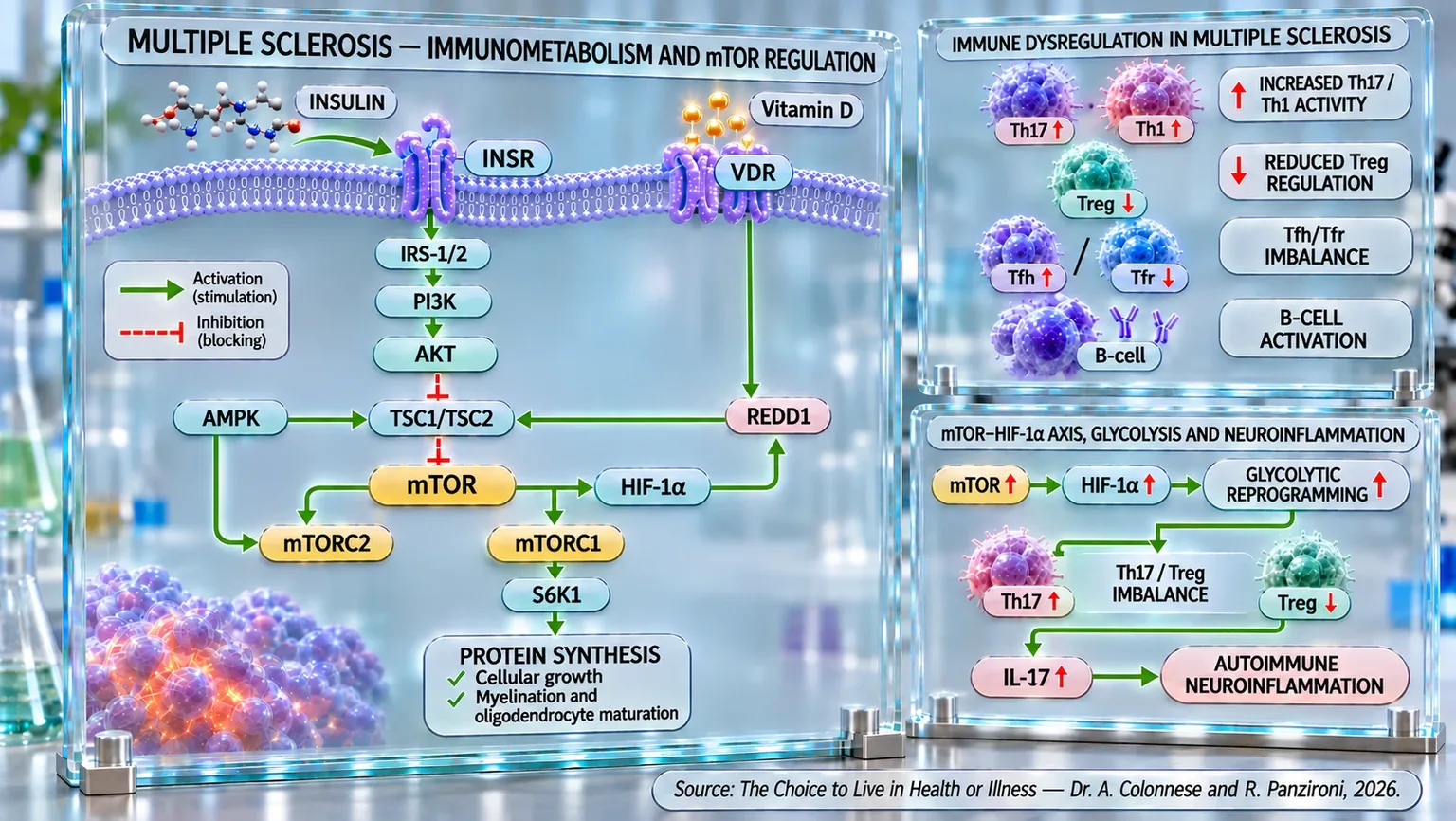
Multiple sclerosis can be described as a complex disharmony of the immune system, where the cells responsible for maintaining immunological balance and tolerance—regulatory T cells, or Tregs—lose their ability to contain the aggressiveness of effector cells. Under physiological conditions, Tregs act as the "brakes" of immunity: they maintain tolerance toward the body's own tissues and prevent the immune system from turning against itself. In multiple sclerosis, however, this control mechanism appears profoundly compromised.
Studies conducted in recent years have shown that in patients with relapsing-remitting multiple sclerosis, CD4+ T cells, which constitute the main population of Tregs, are reduced in both number and ability to suppress pro-inflammatory effector T cells (Viglietta et al., 2004) [1].
This loss of "regulatory power" facilitates the activation of autoreactive lymphocytes directed against myelin proteins (the protective coating of nerves), resulting in inflammation and demyelination (damage to the protective sheath of the nerves) of the central nervous system. In a sense, it is as if the immune system has lost its sense of proportion: the cells that should mediate peace become unable to contain the internal war.
The alterations are not limited to quantity but also involve the quality of Tregs. Some studies have shown that their suppressive function is selectively impaired and that effector cells resist their inhibitory signals; this double defect—a weakening of control and a resistance of inflammatory cells—creates a vicious cycle that amplifies the autoimmune response. This imbalance is particularly evident in pediatric-onset cases, where an expansion of pro-inflammatory T lymphocytes (Th1 and Th17) and a functional deficit of Tregs are observed (Mexhitaj et al., 2019) [2].
In parallel, more recent research has shown that Treg dysfunction may stem from specific alterations in cells derived from the thymus (the organ where T lymphocytes mature and are selected), the so-called t-Tregs. In patients with multiple sclerosis, these cells show a profoundly altered profile and a reduced capacity to suppress immune activity; this anomaly appears to worsen with age and can be modulated by certain immunomodulatory therapies (Lorenzini et al., 2024) [3].
The ratio between follicular helper T cells (Tfh) and follicular regulatory T cells (Tfr) also appears profoundly disturbed. Normally, these populations maintain a balance that regulates antibody production by B cells. In multiple sclerosis, however, an excess of Tfh compared to Tfr is associated with an abnormal production of immunoglobulins in the cerebrospinal fluid (antibodies present in the fluid that protects the brain and spinal cord), one of the hallmarks of the disease (Puthenparampil et al., 2019) [4]; it is as if, within the germinal centers, the orchestra of immune cells has lost its conductor, leading to a chaotic symphony of autoreactive antibodies.
This complex scenario is not without hope. Understanding the mechanisms underlying this regulatory failure has already paved the way for new therapeutic perspectives. Some studies have shown that drugs like sorafenib, originally developed for oncology, can inhibit the differentiation of Th1 and Th17 cells—the primary architects of the autoimmune response—while simultaneously promoting polarization toward a Treg phenotype (Wang et al., 2025) [5].
More generally, Treg dysfunction represents a paradigm common to autoimmune diseases, but in multiple sclerosis, it assumes a particularly evident role: the impairment of these cells, which normally operate as the arbiters of immunity, partly explains why the central nervous system becomes the target of prolonged aggression. Studies on humans and animal models converge in demonstrating that the loss of balance between effector and regulatory T cells is key to understanding the origin and progression of the disease (Buckner, 2010) [7]; (Kleinewietfeld and Hafler, 2014) [8].
Another study from 2019 highlighted that in multiple sclerosis, regulatory T cells (Tregs) can present quantitative and functional alterations, contributing to the loss of control over autoreactive immune responses and the persistence of neuroinflammation. The evidence analyzed shows that Tregs can suppress effector T cells, B cells, and antigen-presenting cells and, in the central nervous system, may also promote remyelination. On these grounds, the authors indicate the adoptive transfer of Tregs as a promising immunotherapeutic strategy for multiple sclerosis (Duffy et al., 2019) [6].
Ultimately, multiple sclerosis can be seen as the result of a communication error in the language of the immune system. The cells that should speak the language of tolerance become mute or misunderstood, while those of inflammation take over. Restoring a voice to regulatory cells therefore means restoring harmony to a system that has lost its natural self-regulation.