
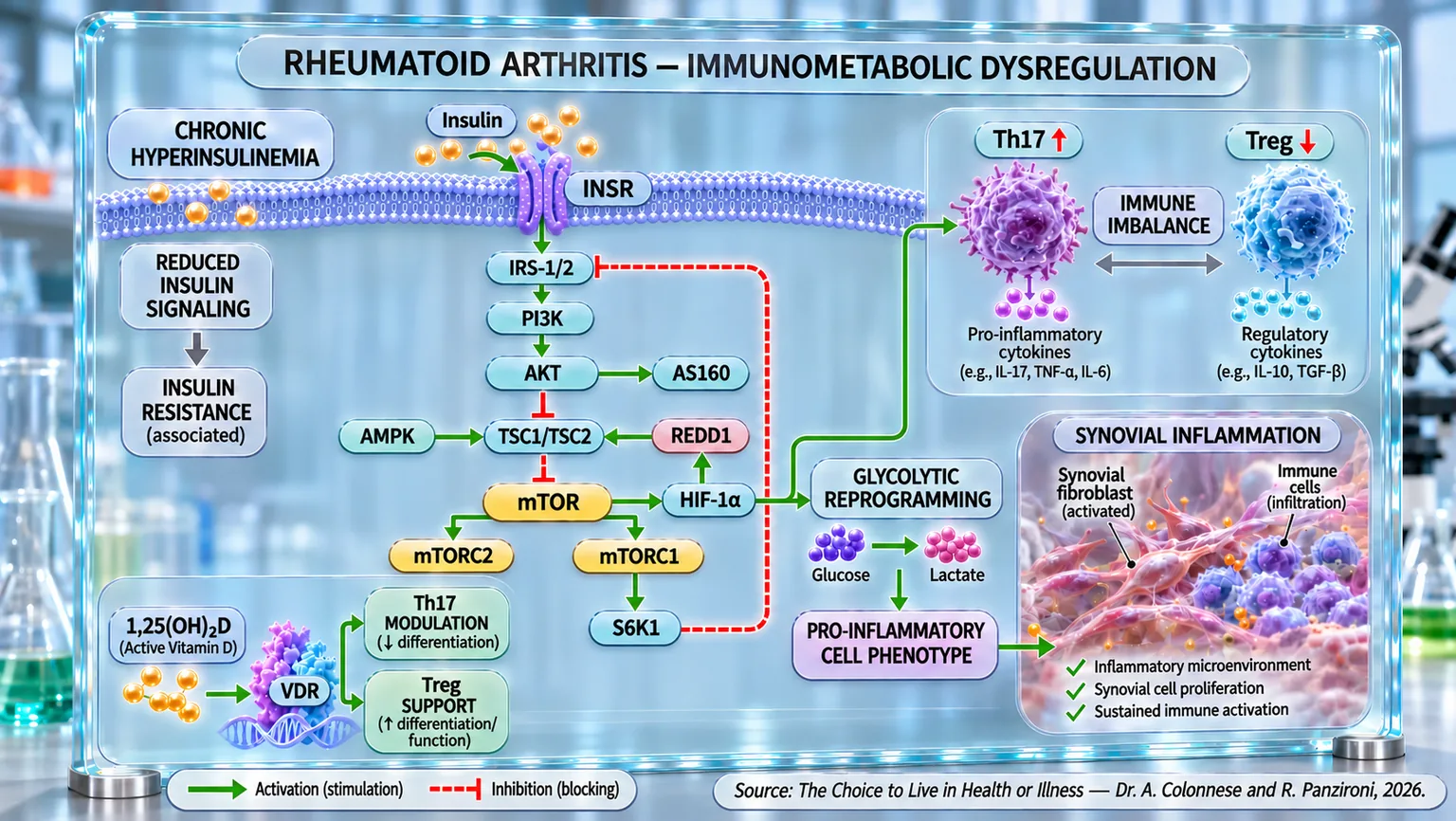
One of the immunological cornerstones that emerges strongly in rheumatoid arthritis is the imbalance of T cells, the cells that act as the conductors of the immune system. In particular, the delicate relationship between pro-inflammatory effector cells and regulatory cells appears profoundly altered. In patients with active rheumatoid arthritis, Th17 cells (Teff), known for their production of inflammatory cytokines such as IL-17, are increased, while regulatory T cells (Treg), tasked with curbing autoimmune responses and maintaining tolerance, appear reduced in both number and functionality. This imbalance, often quantified as the Th17/Treg ratio, is heavily skewed in favor of the former and is directly correlated with clinical severity and serological markers of the disease (Wang et al., 2012) [1]. It is as if the accelerator of autoimmunity were pressed to the floor, while the regulatory brake were weakened.
The abnormalities of Tregs are not limited to their scarcity, but also involve an intrinsic functional defect. Studies have shown that Tregs in patients with RA are unable to effectively suppress joint inflammation, contributing to the persistence of the autoimmune response. Similar defects, observed in other autoimmune diseases such as multiple sclerosis, confirm that regulatory dysfunction is a common thread in many immune pathologies (Buckner, 2010) [2]. Conversely, the expansion or restoration of Tregs appears to correlate with clinical improvements, so much so that it is now considered one of the most promising therapeutic strategies (Zhang et al., 2024) [3].
The role of Tregs manifests even in the early stages of the disease: patients with untreated rheumatoid arthritis show a significant reduction in these cells compared to healthy controls. It is interesting to note that treatment with methotrexate, one of the first-line drugs, not only reduces clinical disease activity but also increases the number and functionality of Tregs, suggesting that part of its therapeutic benefit derives precisely from this immunoregulatory modulation (Avdeeva et al., 2020) [4]. In other words, in addition to "turning off" inflammation, methotrexate also seems to "re-educate" the immune system to regain a balance between T eff and T reg cells.
A similar discussion applies to follicular regulatory T cells (Tfr), a specialized subset of Tregs that acts within germinal centers (specialized areas within lymphatic follicles), regulating the activity of follicular helper T cells (Tfh, a form of effector T cells). The latter are known to stimulate B cells (immune cells that contribute to the body's defense by producing antibodies) and promote the production of autoantibodies, a key feature of RA. In patients in stable remission, an increase in Tfr cells and a reduction in the Tfh/Tfr ratio are observed, associated with lower levels of autoantibodies such as rheumatoid factor (an autoantibody frequently associated with rheumatoid arthritis) and anti-CCP (autoantibodies used primarily to help diagnose rheumatoid arthritis). This suggests that the rebalancing between Tfr and Tfh represents a marker of remission and a potential therapeutic target (Liu et al., 2018) [5]; (Wang et al., 2019) [6]; (Cao et al., 2020) [7].
Ultimately, the picture that emerges is that of an immune system that has lost the harmony between its components. Effector cells, such as Th17 and Tfh, take over, fueling chronic inflammation that leads to joint damage and autoantibodies, while regulatory cells, Treg and Tfr, are weakened or dysfunctional, unable to restore tolerance. Traditional therapies like methotrexate, and more innovative ones based on the inhibition of mTOR or the expansion of Tregs, share the goal of restoring this lost balance, transforming an "out of control" immune system into a machine once again capable of making a clear distinction. It is precisely in this regained balance that the key to lasting remission and, perhaps, a future cure lies.